About the theory of planetary ages
By Manuel da Costa — GeoAstro
In our study of chess players ranked as International Grandmasters (GMI), we found that Mars and Saturn appeared to be markedly overrepresented, suggesting a connection with certain cognitive abilities engaged in the game of chess. To extend this line of thought within the framework of the theory of planetary ages1, let us start from the following observation: some players had already reached an international level while still in the Jovian age, which spans from 2 to 12 years old.
Early planetary manifestations?
Among very young chess players, let us mention in particular the two youngest “prodigies,” according to Wikipedia: the Ukrainian Sergey Karjakin, who became an International Grandmaster (GMI) at the age of 12 years and 7 months, and the American of Indian origin Abhimanyu Mishra, who in turn became an International Grandmaster in 2021 at the age of 12 years and 4 months. Abhimanyu Mishra had already earned the title of Grandmaster (GM) at 10 years and 9 months, and was therefore already capable of facing and defeating players of international level. Sergey Karjakin had likewise earned the title of International Master before the age of 12, as had other chess prodigies.
We will also begin from the assumption that the development of a high level in chess requires a strong degree of so-called “hypothetico-deductive” cognitive abilities, which, according to psychogeneticists, begin to manifest characteristically from the age of 12 onward—that is, at the beginning of the Saturnian age, which extends from 12 to 30 years old. Let us also recall that Saturn, like Mars, appears to be overrepresented in our study of chess players ranked as International Grandmasters (GMI).
The question that concerns us, then, is the following: how do the forms of learning associated with each planet develop when the individual has not yet reached the age corresponding to it according to the theory of planetary ages? In the case that serves here as our example, the issue is to understand how the Saturnian function could have developed in chess players who had already reached an international level while still in the Jovian age.
The case of Saturn in young chess players
Even before reaching the age that corresponds to it according to the theory of ages, each planet has already begun its sidereal revolution. It has therefore already formed, in transit, aspects to its own natal position as well as to the other planets in the astrological chart. This explains why, in children who are still in the Jovian age, one may observe certain early indications of behaviors and abilities associated with the Saturnian function. It nevertheless remains certain that the planet will express itself less distinctly at that stage, since the age at which it fully manifests its potential has not yet been reached.
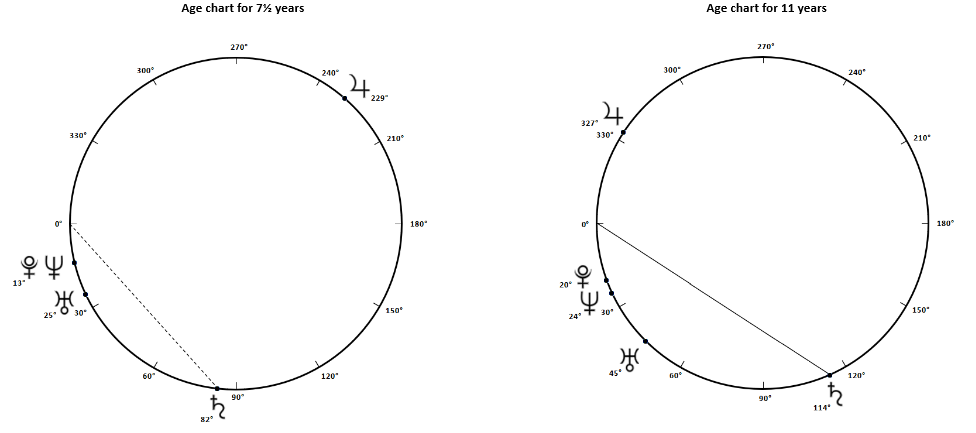
An age chart2 is a circle marked with a zero point corresponding to the starting point of the planetary cycles. It makes it possible to measure, for a given age, the elongation of each planet from this initial point.
On the two age charts presented here — 7½ years and 11 years — the following points may be noted in particular:
- At 7½ years, Saturn forms its first square to its natal position; this is when the child reaches what psychologists call “the age of reason.” From the age of 5, Saturn had already formed its first sextile.
- At 11 years, Saturn forms its first trine to its natal position. Then, at 12 years, at the end of the Jovian stage, Saturn will have progressed 125° from its natal position and will thus have had time to form aspects with the full range of ecliptic longitudes in the local sphere — in other words, with all the planets in the astrological chart. Enough to activate the first Saturnian frequencies…
Chess players who are still in the Jovian age can already attain the title of International Master (IM), which suggests that hypothetico-deductive abilities begin to develop before the Saturnian stage. However, no child at that age has yet achieved the title of International Grandmaster (GMI), which is generally obtained a few years later. This suggests that the Saturnian age intensifies the faculties of abstraction, without necessarily marking the starting point of their development.
If, according to the theory of ages, one had to wait until a planetary cycle prevailed over the others before a planet could manifest itself, then one would also have to wait until the age of 30 to see the Uranian temperament emerge. By that logic, adolescents in the Saturnian age could not be “Uranian,” which observation clearly disproves. As for individuals born under a Neptunian or Plutonian dominance, they could, so to speak, almost never experience that dominance — except, in Neptune’s case, for people over the age of 84 — since those ages exceed the ordinary span of human life.
Let us quote Jean-Pierre Nicola on this point: “A planet’s natal dominance does not mean that it must wait to act until the time when, according to the theory of ages, its cycle prevails over the others, either because it is moving toward the repetition of its strongest aspect (the first repetition of the natal position), or perhaps—and more generally—because the time elapsed since birth will awaken the first harmonic frequencies of that planet3.”
The subject’s potential and planetary expression
It also seems necessary to distinguish between the psychological and behavioral plane and the cognitive plane, insofar as the link between an individual’s cognitive faculties and the astrological chart is far from self-evident. Indeed, not everyone develops, during the Saturnian age, a high level of abstraction, hypothetico-deductive reasoning, or other intellectual abilities of the same order. Moreover, the subsequent planetary ages do not appear to be accompanied by the emergence of new cognitive faculties. For example, one does not observe, at the beginning of the Uranian stage—that is, around the age of 30—the appearance of additional intellectual abilities. Most cognitive and brain development therefore seems to take place up to the end of the Jovian stage, or even into the beginning of the Saturnian stage when the individual has sufficiently high potential. Perhaps this is because the current level of human development lies somewhere between these two planetary stages. It is indeed possible that the average cognitive level of Homo sapiens currently corresponds to a mental age of around 10 to 12 years, as observation seems to suggest.
One may therefore interpret the forms of learning associated with each planet as expressing themselves through the subject’s developmental potential. In a subject whose potential lies within the average range, these forms of learning will manifest primarily through the cognitive abilities accessible up to the middle or end of the Jovian stage. By contrast, if the subject has above-average potential, these planetary forms of learning may also be expressed through the cognitive faculties made possible by entry into the Saturnian stage, involving a higher degree of abstraction.
Perhaps, then, the particular aptitudes that we seek to relate to the astrological planets in our astro-statistical studies are observed especially in individuals whose nervous system has integrated more of Saturn—that is, more long-term structuring4. These would therefore be individuals endowed with sufficiently high potential to allow the development of uncommon talents, enabling them to reach an exceptional level in the activity they favor.
Notes
1 According to the theory of planetary ages, there is a correlation between the stages of human psychological and behavioral development, from birth to death, and the durations of planetary revolutions.
2 Read on Astroariana « L’échéancier planétaire et la théorie des âges » (in French).
3 Jean-Pierre Nicola, communication presented at the International Astrological Conference in Paris, September 1974; Cahiers conditionalistes (in French), no. 12, Comac
4 This claim would apply even more strongly to talents potentially associated with the outer planets—Saturn, Uranus, Neptune, and Pluto. Observation indeed seems to show that these planets, being of a higher degree of complexity, are also the most difficult to integrate and require, in the individuals concerned, a higher level of development.