
On the Statistical Method in Astrology
By Manuel da Costa — GeoAstro
Significant Correlations
Astro-statistical studies aim to identify correlations between dominant or non-dominant elements in an astrological chart and the psychological and behavioral profiles of individuals within a given cohort. Through the analysis of the activities performed, they seek to highlight the influence of astrological conditioning on a group of people brought together by specific criteria. So, what insights does statistical research in astrology bring?
Astro-statistics refines our understanding of the influence of planets, planetary families, and zodiac signs. It allows for the identification of chart elements related to specific talents, and adjusts the meanings assigned to planetary functions by confronting theory with observation.
When a study reveals atypical valuations of certain planets, planetary families, or zodiac signs within a group, it is also able to demonstrate that astrological influence is based on natural phenomena and can be observed in human behavior. Thus, it helps prove that astrological influence can be highlighted through a recognized scientific approach that is widely used in other disciplines.
The statistical approach is based on mathematical calculations that guarantee impartiality. Unlike individual observations, which can be perfectly relevant but still subjective, it relies on objective and measurable data. While the interpretation of these findings remains open to debate, these results, when obtained through a rigorous methodology, are difficult to contest.
However, the absence of compelling results in an astro-statistical study does not necessarily invalidate the astrological influence. It simply indicates that no particular trend emerges within the studied sample, or that the skills required for a particular activity cannot be directly correlated with the elements of the chart. We have already highlighted the complexity of the link between the astrological chart and the activity performed: on the one hand, a conditional link exists between the chart and the individual; on the other hand, the relationship between the individual and their activity remains probabilistic and non-linear.
Finally, it would be relevant to explore in more depth the influences exerted by each element of an astrological chart. The work of Gauquelin, whose conclusions have largely been invalidated by observation, highlighted trends only for five planets: the Moon, Mars, Saturn, Jupiter, and Venus. He erroneously concluded that the other planets had no impact on human psychology and behavior. When we obtain significant results for all ten planets of the astrological chart, we will have irrefutably demonstrated that each of them exerts a real influence.
A Branch of Conditionalism
This approach, based on a rigorous methodology, belongs to a lineage of research that remains underdeveloped. Among the few figures who attempted to link astrology and statistics, Michel Gauquelin, already mentioned, is the best known. He sought to establish a link between certain professions and astrological planets1. While his object of study was legitimate, his conclusions turned out to be largely irrelevant2. Among the criticisms, we can mention his arbitrary selection of individuals forming the population cohorts, the lack of a clearly defined calculation method, entirely extravagant probabilities of valuation, results that often conflicted with empirical observation, and interpretations that were often questionable.
In contrast, this work relies on rigorously selected population cohorts, uses a true probability calculation tool, and arrives at results that are generally consistent with the empirical observation of rigorous astrologers. Thus, the modern statistical methods developed here, when applied to astrology, are intended to become a reference in the field of astro-statistical research.
By nature, statistical studies focus on groups and rely on a collective approach. Their goal is to highlight collective astrological trends within a given population. They allow for the establishment of correlations between a behavioral or cognitive aptitude, associated with a specific activity, and an element of the astrological chart that either promotes or hinders its expression. In contrast, the usual individual approach, focusing on the conditioning of a particular subject, overlooks the general trends observable in other individuals within the same group. Only the statistical approach allows for a reliable objectification of the link between an element of the astrological chart and a specific aptitude or talent.
However, astro-statistical studies struggle to capture how an individual experiences their own chart, as each personality is molded by a multitude of influences. The study of individual cases offers a more nuanced approach, allowing for an examination of the different ways an astrological dominant can be expressed. The astrologer's observation, placing astrological conditioning among the various influences received, allows for a more holistic analysis of the subject’s behavior and psychology.
Statistical methods are also poorly suited for studying planetary transits, which can highlight astrological milestones accompanying the subject's success (or potential difficulties) in their field of activity. Likewise, some subtler elements of the chart, such as planets in signs, planetary aspects, or astrological houses, may escape the filter of statistical tools without lacking real influence. This is why empirical observation of individual cases must remain the foundation of an astrologer’s work.
Astrological studies thus emerge as a distinct branch of conditionalist astrology, with their strengths and limitations. However, they cannot replace empirical observation and individual experience, which remain crucial for chart analysis. Hence, there is a need to be vigilant to avoid the emergence of a "neo-conditionalist" astrology that is overly reductionist, focusing solely on statistical results at the expense of non-quantifiable elements of the chart whose influence is more subtle.
Deep-Rooted Prejudices
The interest of an astro-statistical study also lies in deconstructing the prejudices surrounding certain planets and elements of an astrological chart. With the statistical tool, we now have an objective basis to evaluate these beliefs and test their validity.
Our investigations reveal, in particular, that Mars, often considered the planet of athletes or action, is actually not dominant among Formula 1 drivers, ballet dancers, football players, or aviators. However, it is overrepresented among chess players and famous comedians. Doesn’t this correlation between Mars and physical performance seem to be merely an astrological prejudice?
This preconceived notion tends to prevail as soon as we enter the realm of astrology. Many astrologers associate Mars with sports activities and physical effort, but also with traits like being direct and blunt, impulsive, aggressive, and even confrontational or provocative. Mars is even linked to tendencies of aggression, opposition, conflict-provocation, or anger.
Let’s reframe the question: Do you think about one in three people functioning this way3? Recall that the sum of the angular zones (Ascendant, Midheaven, Descendant, and IC) covers about 38%4 of the local sphere, meaning an astrological planet has an average chance of one in three of being angular. One could easily argue that such behavior, if consistent, might rather suggest a psychological imbalance. Empirical observation also confirms that truly quarrelsome or aggressive individuals are not statistically more likely to be “Martian” than the average population.
No significant correlation appears between Mars and sports performance. Regardless of their discipline, champions do not more frequently display an angular or strong Mars in their planetary hierarchy compared to the rest of the population. The same applies to impulsive or quarrelsome temperaments: many individuals who fit this description are not “Martian,” while the majority of true “Martians” do not exhibit this type of behavior at all.
So, what does a Martian dominance actually reveal? Mars primarily favors realism, a sharp sense of observation, and a grounded thought process. With the formula “eE,” the individual stays connected to reality, perceives cause and effect clearly, and prioritizes tangible facts. It’s time to put an end to these preconceived ideas that persist among many astrologers and restore a more objective reading of this planet.
Evolving Hierarchization Methods
The statistical tool can serve as a crucial lever for refining the methods of hierarchizing the astrological chart. Based on observation, these methods are evolving and can be adjusted based on the results obtained. In particular, the planetary angular zones (Ascendant, Midheaven, Descendant, and IC), which are empirically established, could be re-evaluated statistically to identify the most relevant configurations according to the studied population groups.
The planetary hierarchization grid used by the software AstroStat5, which allowed us to evaluate statistical probabilities for each of our astrological cohorts, is represented here.
The concept of "domitude" places the twelve astrological houses within the local sphere, allowing visualization of the organization of valorization zones. The diagram shown here illustrates sixteen zones, ranked by order of importance, with their extent defined by observation. Zones 1, 2, 3, and 4, located around the angles of the Ascendant, Midheaven, Descendant, and IC, are considered the most influential because they contain the so-called angular planets. After the angularity criterion, the planetary aspects, calculated in the ecliptic chart and considering their order of importance, continue the chart’s hierarchization6.
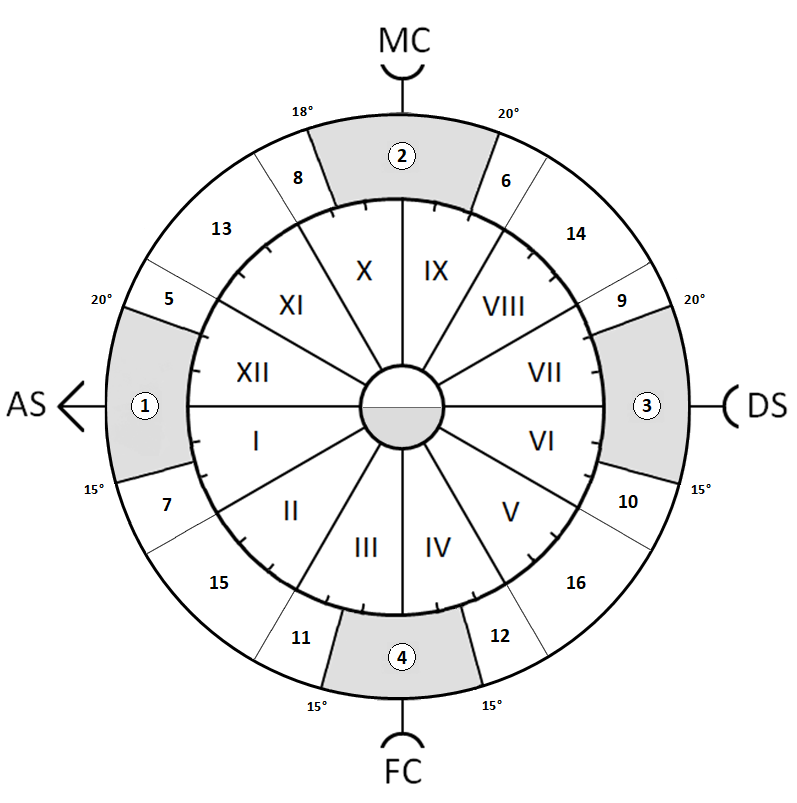
Astro-statistics provides an experimental framework that allows us to refine these methods. By testing different extents of the angular zones and comparing the results, it becomes possible to adjust the hierarchization criteria according to the most relevant correlations. This empirical approach would allow astrologers to confront astrological theories with statistical observations, validating or evolving certain methods.
The AstroStat software establishes planetary rankings according to their hierarchical position: the higher a planet’s rank, the more marked its influence on the subject’s visible psychology and behavior7. This gradual approach allows for the identification of dominant, medium, or weak planets in the astrological chart.
Another approach would be to base the evaluation of planetary influence solely on the angularity criterion. Astrology also posits that planets located near the angles are the most influential on the subject’s personality and manifest behaviors. In this model, planetary evaluation would rely on two criteria: angularity or non-angularity.
A comparison between these two methods, planetary hierarchization and strict angularity, would help evaluate which is most relevant for interpreting an astrological chart. In practice, most astrologers intuitively combine these criteria based on the structure of the analyzed chart. However, a deeper statistical exploration would allow us to assess the real impact of each method and refine our understanding of planetary hierarchization.
Analysis of Our Statistical Results
The astro-statistical studies presented on this site aim to highlight significant deviations from chance probabilities in the distribution of certain elements of the astrological chart. They are based on a rigorous analysis grounded in numerical data, in order to identify observable correlations without falling into methodologically unfounded extrapolations8.
We can already identify trends concerning the potential talents associated with each astrological planet or RET family. However, these trends should be understood only as potentials for expression, which will manifest differently from one individual to another. Indeed, it is more complex to analyze planets in terms of potential talents than in characterological terms.
| Potential Aptitudes | |
|---|---|
| ☽ |
Internal/Psychic Economy Intrapersonal intelligence Adaptability/plasticity |
| ☉ |
Aptitude to Appear/Eloquence Social/relational intelligence Ability to identify/recognize |
| ☿ |
Communication Ability Curiosity/open-mindedness Simplification/interpretation |
| ♀ |
Aesthetic Sense/Good Taste Sensitivity/emotional awareness Harmony/proportion/balance |
| ♂ |
Observation of Phenomena Understanding causes and effects Practical approach/mechanistic thinking |
| ♃ |
Oratory Ability/Art of Formulation Organizational skills/management Categorization/schematic thinking |
| ♄ |
Experimental Intelligence Hypothetico-deductive reasoning Ability to anticipate possibilities |
| ♅ |
Intuition of the Possible/Uniqueness Logical-mathematical reasoning Conceptualization ability |
| ♆ |
Creativity/Imagination Connection to deep aspirations Intuition of collective psychology |
| ♇ |
Critical Thinking/Investigation Lucid distance/relativity Authenticity/being oneself |
This brief list, highlighting some of the main behavioral or psychological aptitudes corresponding to each astrological planet, will be refined and expanded in future astro-statistical studies. The goal would be to create a complete typology that describes cognitive faculties and potential talents for each planet, as well as its shortcomings, in relation to the RET functions it ignores.
However, observation shows that no talent or aptitude is exclusive to one planet or RET family. When we obtain values that deviate from the laws of chance within a population cohort, not all individuals in that cohort share the observed collective statistical particularities. Only a statistical majority within the cohort exceeds chance thresholds and displays these abnormal valuations, while others have developed the same aptitudes but from different astrological configurations.
Therefore, it would be more pertinent to imagine a model for each planet (or RET family) that identifies the faculties most likely to develop, those that are sometimes only observed, and finally, those that emerge more rarely or are more unusual. This is because it is the individual nervous system and its numerous specificities that translate the effectiveness of cosmic influence.
Notes
1 Specifically, read Les personnalités planétaires, Le dossier des influences cosmiques, Les Hommes et les Astres, by Michel Gauquelin.
2 For a thorough analysis of Gauquelin's statistical work, read Astrologie & statistiques, by Richard Pellard.
3 Although this reasoning is oversimplified, since the same planetary trend can manifest in different ways, this question should be raised for any psychological trait attributed to an astrological planet. The key is to prioritize observation and intuition of human behavior rather than relying solely on theory.
4 Probability calculation for angularity: 138°/360° = 0.383 or 38.3%.
5 This is the ranking grid previously used by the online astrology software Astrosoft, available on the website AstroAriana.com.
6 For a complete description of the methods for ranking the theme, refer to Protocole de hiérarchisation d’Astrosoft 2.2 and Historique de l’évaluation des puissances planétaires by Richard Pellard, available on AstroAriana.com.
7 The weakest planets in the chart may have a more subtle influence, acting at an unconscious level and partially escaping the subject's control. However, it would be erroneous to consider them as lacking influence.
8 For more on the subject, consult the astrological works of Gauquelin.