
Introduction to Conditionalist Astrology
« To establish itself as a truly distinct science, astrology must define the rules and conditions governing its relationship between the "hard" sciences and the "soft" sciences, or more specifically, between the simple clocks of the non-living world (micro- and macro-cosmic) and the complex clocks of human receptors. »
Jean-Pierre Nicola, astrologer and pioneer
The Conditionalist Odyssey
In 1964, La Condition Solaire1 was published, marking the foundation of Conditionalist Astrology. This groundbreaking book redefined the relationship between humans and the cosmos, grounding it in astronomical and biopsychological principles. By introducing a modern and rational approach to astrology, this work sought to update and reformulate existing astrological knowledge, which had until then remained largely symbolic. The Conditionalist school seeks to demonstrate connections between the solar system and human neural activity.
La Condition Solaire presents several theoretical tools that lay the foundation for an astrology aligned with contemporary knowledge and capable of producing analyses that match observable human behavior. Among these tools are the RET system, the theory of planetary ages, and the photoperiodic and reflexological zodiacs. In Conditionalist Astrology, planets are referenced through a heliocentric perspective (theory of ages) and a rational classification (RET’s levels of information). Zodiac signs, in turn, are based on astronomical reality and neurological or reflexological foundations.
Another innovative tool in Conditionalist Astrology is SORI—standing for Subject, Object, Relationship, and Integration. This model refines the interpretation of natal charts and could also be applied to houses and angular zones of the local sphere.
Astrological influence should now be understood in relation to the life sciences and the humanities. Contrary to what most symbolist astrology schools claim, astrology is not an acausal, metaphysical, or purely semantic discipline—it would be more accurate to describe such approaches as astromancy.
The Conditionalist framework offers a deeper understanding of the relationship between humans and the cosmos, seen through a conditional perspective. Astrological influence is just one factor among many in shaping an individual's personality. It interacts with other influences present at birth and throughout life, including social, familial, and educational environments, as well as the genetic heritage unique to each individual.
By nature, astrology stands at the crossroads of many disciplines that seek to explain human behavior. Yet, it cannot encompass the full complexity of this phenomenon on its own. Any approach to human behavior must consider the diversity of influencing factors, as no single one can provide an exhaustive explanation. This raises a fundamental question: what role does the natal chart play within this web of influences?
The astrological chart reveals an individual's psychological and behavioral structure. It serves as a kind of "skeleton", which is then shaped by additional influences such as biological and sociological factors. Integrating extra-astrological conditioning into planetary and zodiacal profiles allows us to explore the various possible expressions of each person, bridging the gap between theoretical astrological functions and observable psychological and behavioral traits.
Furthermore, astrology does not predict specific events. The natal chart only highlights tendencies and instinctive behaviors that shape personality. It does not foretell events, which ultimately depend on the individual's circumstances and external context. At best, if a future situation can be anticipated, one might infer how likely an individual is to react in a certain way, based on their chart and overarching personality traits. However, astrology will never tell you which specific events will occur.
This highlights the widespread misconceptions surrounding astrology today. Often dismissed as charlatanism, it is frequently confused with fortune-telling, tarot reading, and other divinatory arts. The very title of "astrologer" has become ridiculed, and it is true that many practitioners, through their fatalistic and commercialized approach, have done little to change this perception. Yet, for over half a century, Conditionalist research has thoroughly stripped astrology of its mystical and symbolic excesses, firmly re-establishing it within the rational and scientific domain.
Understanding the Astrological Chart2
The Local Sphere
The local celestial sphere is an imaginary construct with an arbitrary radius, established for a specific latitude and longitude on Earth. Its two main planes are the celestial horizon, which corresponds to the projection of the observer’s horizontal plane, and the celestial meridian, which contains the celestial poles, the Zenith, and the Nadir of the observation location.
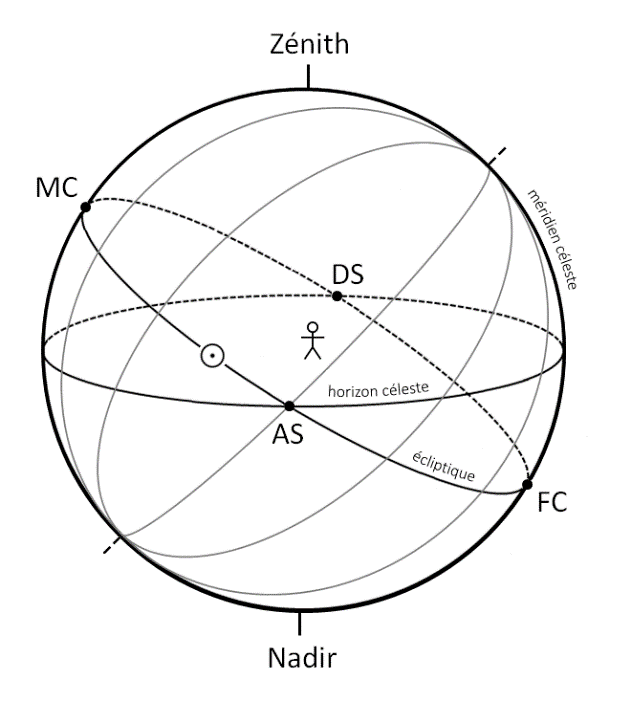
On the local sphere, we identify the Ascendant (AS) and Descendant (DS), which mark the intersection of the local horizontal plane and the ecliptic plane, as well as the Midheaven (MC) and Imum Coeli (IC), which correspond to the intersection of the meridian plane and the ecliptic plane.
Over a 24-hour period, the planets move through the local sphere from east to west, each moving through its respective zodiac sign. They rise in the east at the Ascendant (AS), reach their highest point in the southern direction at the Midheaven (MC), set in the west at the Descendant (DS), and reach their lowest point in the northern direction at the Imum Coeli (IC).
The Zodiacal Band
The ecliptic plane represents, from a geocentric perspective, the apparent path of the Sun around the Earth. However, the orbits of other planets have their own inclinations and are slightly tilted relative to this plane.
For this reason, the zodiacal band extends 8°30' on either side of the ecliptic, defining a zone of the local sphere in which most of the solar system’s planets move.
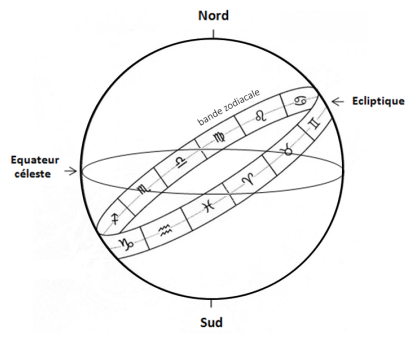
The zodiac signs are formed by dividing the zodiacal band into twelve equal 30° sections, starting from the vernal equinox (0° Aries). Each zodiac sign is characterized by a specific north or south declination, either increasing or decreasing.
The Astrological Houses
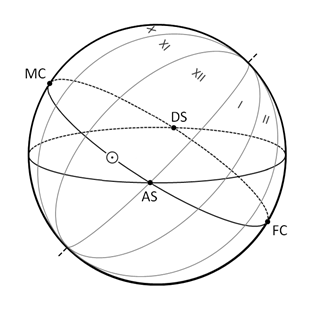
Astrological houses are divisions of the local sphere. The Ascendant marks the beginning of the 1st house, the Imum Coeli the start of the 4th house, the Descendant the start of the 7th house, and the Midheaven the beginning of the 10th house. These four are known as the cardinal houses.
The cusps of the intermediate houses are determined using the Placidus system, which divides the time it takes for planets to ascend within each quadrant of the ecliptic arc into three equal parts.
As planets move through their daily cycle, they pass through the twelve astrological houses in zodiac order, opposite to the diurnal motion. A rising planet moves from the 1st house to the 12th, then to the 11th, and so forth. In other words, each planet progresses from the Ascendant to the Midheaven, from the Midheaven to the Descendant, then to the Imum Coeli, and finally from the Imum Coeli back to the Ascendant.
The Astrological Chart
The Ecliptic Chart
Modern astrological chart displays represent the local celestial sphere in the zodiacal reference frame. This is known as the ecliptic chart, which determines the position of the planets within the zodiac signs.
In the example provided, we see, in zodiacal order, that Jupiter is in Aries; Mars in Gemini; Saturn and the Moon in Leo; Pluto in Libra; Uranus and Venus in Scorpio; Neptune and the Sun in Sagittarius; and Mercury in Capricorn.
The astrological chart is based on the projection of the planets onto the ecliptic plane. By definition, only the Sun strictly follows this path, meaning that the actual positions of the other planets must be recalculated based on their declination3.
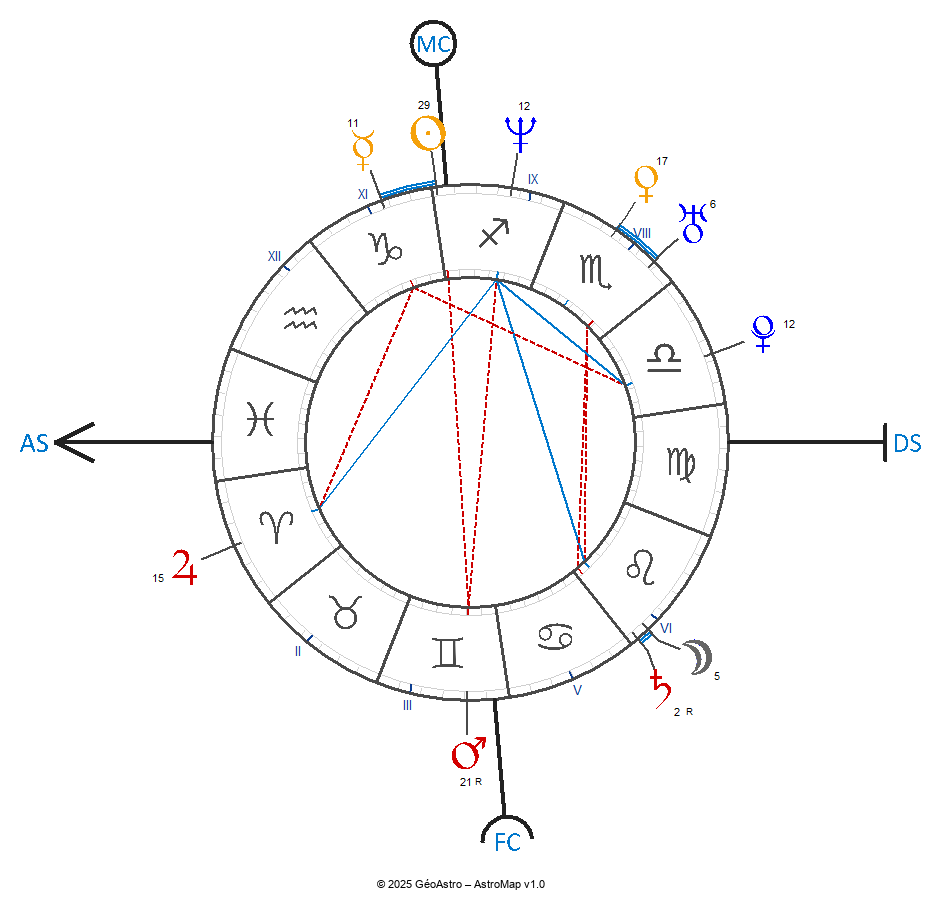
Planets also form angular relationships with each other. A planetary aspect refers to the angular separation between two celestial bodies as seen from Earth. The major aspects that have astrological significance include the conjunction, opposition, square, trine, and sextile.
The Domitude Chart
The domitude chart represents the local celestial sphere in the reference frame of astrological houses. It determines the actual position of each planet in the local sphere, taking into account their specific celestial latitudes.
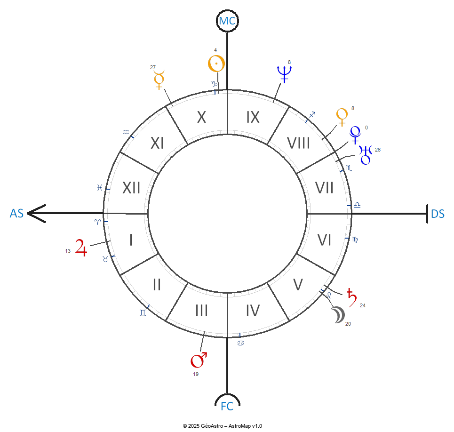
In the given example, we observe, following the house order, that Jupiter is in the 1st house; Mars in the 3rd house; the Moon and Saturn in the 5th house; Uranus in the 7th house; Pluto and Venus in the 8th house; Neptune in the 9th house; and the Sun and Mercury in the 10th house.
Due to their varying north or south celestial latitudes, the actual positions of the planets in the local sphere (as shown in the domitude chart) may differ from their apparent positions in the ecliptic chart. As a result, some planets may have a different altitude in the domitude chart than what appears in the ecliptic chart.
The ecliptic chart represents the ecliptic longitudes of the planets—that is, their positions in the zodiac signs. The domitude chart, on the other hand, highlights the ecliptic latitudes of the planets—that is, their positions within the astrological houses. These two charts complement each other, offering two different reference points to describe the local celestial sphere.
Reading the Astrological Chart
An astrological chart is a representation of the sky as seen from Earth, calculated for a specific moment and location. It is essentially a "snapshot" of the planetary and zodiacal configurations at the time of an individual's birth (natal chart) or at a given moment in their life (planetary transits).
Structuring the Elements of the Chart
An astrological chart is a structured system composed of various elements that must be prioritized before interpretation. The primary elements of focus are the planets, the zodiac signs, the planetary aspects, and then the astrological houses.
Let’s revisit the earlier example: the natal chart of Charles Michel, current President of the European Council, born on December 21, 1975, at 12:30 PM (local time) in Brussels:
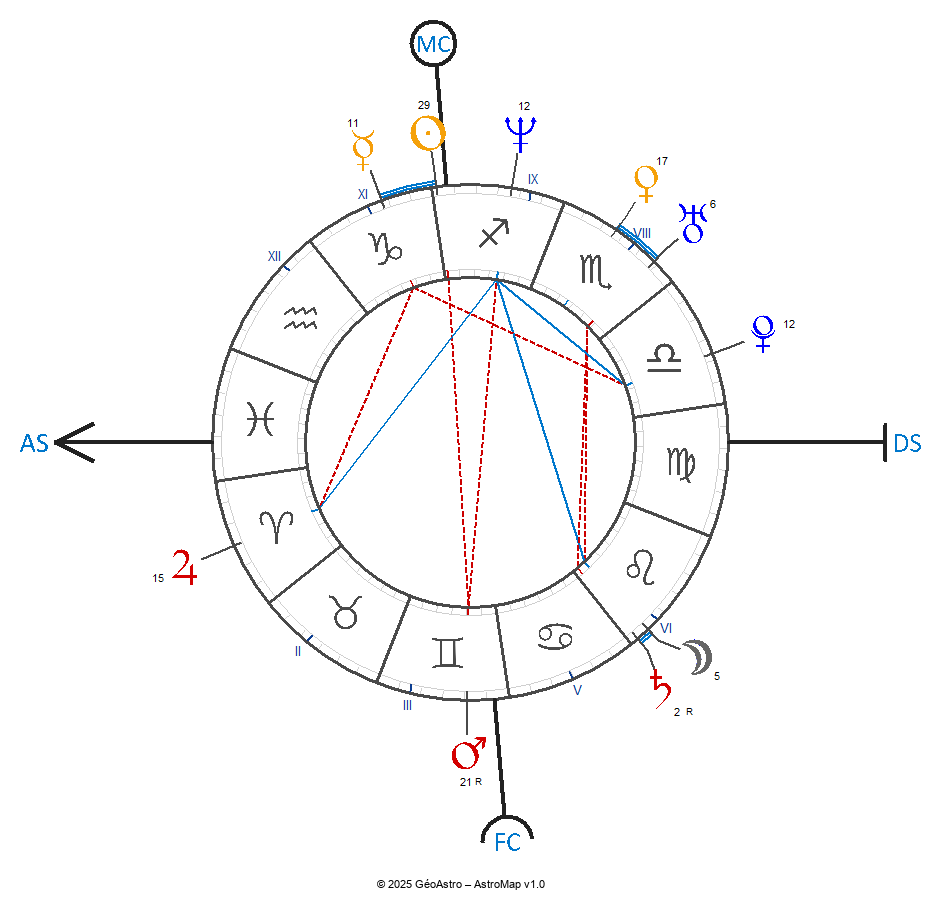
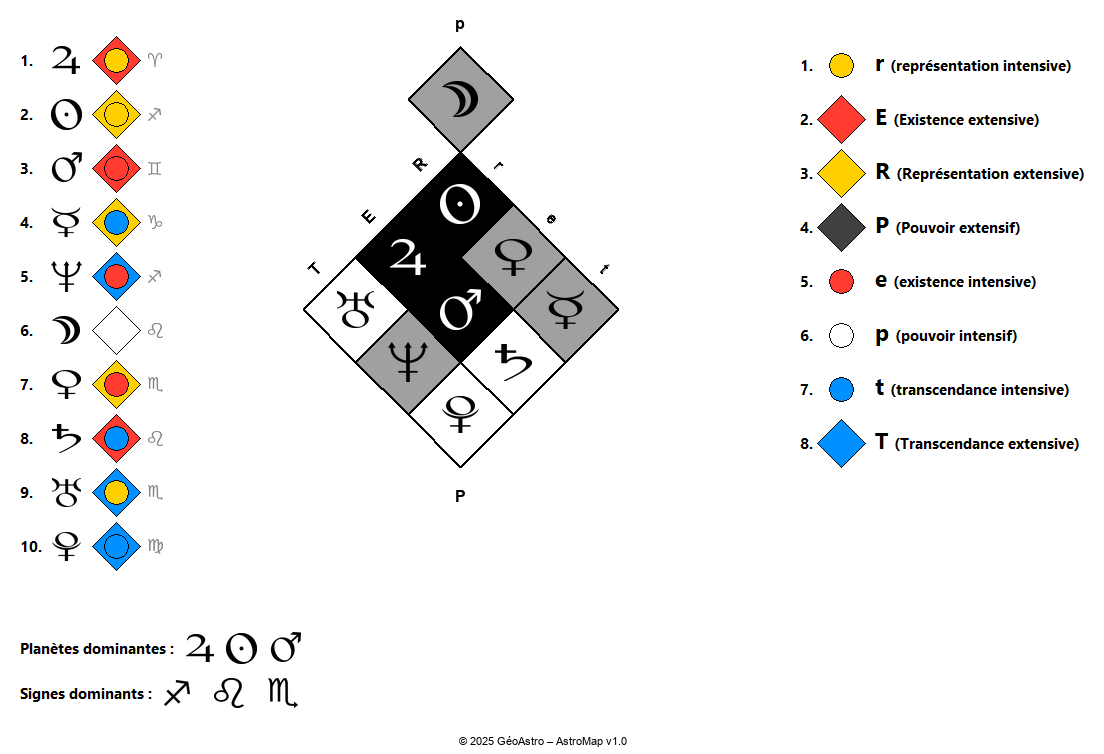
In the table above, the left graphic displays the astrological chart, while on the right, we find the planetary hierarchy and the RET diamond of the chart.
Planets
To prioritize the planets in an astrological chart, we first identify the angular planets—those positioned near the angles (AS, MC, DS, and FC). These are considered the most influential planets in the chart. Next come the planets forming aspects with angular planets, which are considered subdominant. Lastly, isolated planets are non-dominant and have the weakest influence.
In Charles Michel’s chart, the angular planets are Jupiter in Aries near the Ascendant, the Sun in Sagittarius at the Midheaven, and Mars in Gemini at the Imum Coeli. The subdominant planets include Mercury in Capricorn (conjunct the Sun and square Jupiter), Neptune in Sagittarius (trine Jupiter and opposite Mars), and Pluto (opposite Jupiter). Finally, the weakest planets in the hierarchy are the Moon and Saturn in Leo, along with Uranus and Venus in Scorpio.
The RET diamond on the right provides a visual summary of the most dominant planets (black cells), medium-ranked planets (gray cells), and the weakest ones (white cells). From this, we can deduce the dominant planetary families4 in the chart: intensive representation (r), extensive existence (E), and extensive power (P).
Additionally, the chart highlights the major planetary aspects: Sun-Mars opposition; Sun-Mercury conjunction; Jupiter-Mercury square; Jupiter-Neptune trine; Jupiter-Pluto opposition; Mars-Neptune opposition.
Zodiac Signs
The zodiac signs emphasized in a chart are those hosting planets, with priority given to signs containing dominant planets and "fast-moving" planets (Moon, Sun, Mercury, Venus). The zodiac sign associated with the birth date only indicates the Sun's position, so analyzing the positions of other planets is necessary to determine all emphasized signs.
In Charles Michel’s chart, the most emphasized zodiac sign is Sagittarius, with the dominant Sun at the MC. Aries (Jupiter), Capricorn (Mercury), and, to a lesser extent, Leo (lunar sign) are subdominant signs.
The dominant zodiac signs in an astrological chart can also be linked to their reflexological characteristics—season, reaction type, and phases. Charles Michel’s chart is primarily influenced by autumnal traits (dominant Sagittarius), an excitatory dynamic (Sagittarius, Aries, Leo), and a sense of wholeness reflected in the Sagittarius–Gemini and Capricorn axis.
Sectors of the Local Sphere
The local sphere sectors include the twelve astrological houses and angular zones: the Ascendant (AS), Midheaven (MC), Descendant (DS), and Imum Coeli (FC). Additionally, quadrants and hemispheres can be analyzed.
Like zodiac signs, the emphasized sectors of the local sphere are those containing planets. Priority is given to sectors hosting angular planets, fast-moving planets, or multiple planets.
In Charles Michel’s chart, the most emphasized astrological houses are the 1st house (Jupiter), the 3rd house (Mars), and the 10th house (Sun-Mercury). The key angular zones are the Ascendant, Midheaven, and Imum Coeli, where Jupiter, the Sun, and Mars are located, respectively. The angular planets are concentrated in the eastern diurnal quadrant (from AS to MC) and the eastern nocturnal quadrant (from FC to AS). The diurnal hemisphere (above the AS-DS axis) contains the highest number of planets.
Global Interpretation of the Astrological Chart
Identifying the emphasized planets and zodiac signs in a chart lays the foundation for interpretation. To delve further, one must also analyze planetary aspects, astrological houses, and other local sphere sectors.
A Method of Interpretation
An astrological chart is therefore a structured and hierarchical system, composed of various elements that can be dominant, subdominant, or non-dominant. This allows us to distinguish between strong tendencies—the most prominent personality traits; medium tendencies—traits that emerge occasionally; and weak tendencies—those that surface rarely.
It is essential to interpret the chart as a whole. Planets, zodiac signs, and local sphere zones interact to form a cohesive system. Each element has its own influence on the psychological and behavioral predispositions inherited at birth. An astrological chart consists of unique configurations that may either reinforce or contradict one another.
As previously mentioned, astrological interpretation must be conditional. Every individual is shaped by multiple influences that combine to form their personality. Besides astrological influences, sociocultural environment plays a crucial role: historical context, economic and cultural factors, group values, and norms. Additionally, astrology does not account for genetic conditioning inherited at birth.
President of the European Council
Charles Michel’s dominant astrological configuration includes Jupiter in Aries at the Ascendant, the Sun in Sagittarius at the Midheaven, and an opposition to Mars in Gemini at the Imum Coeli. Mercury and Neptune are subdominant, interacting with the three dominant planets.
This configuration is consistent with the public image of the European Council President. As a Jupiterian and solar figure, he is known for his charisma, rhetorical skills, and high ideals. His Mercurial influence adds a relaxed, curious, and open-minded nature. The combination of Mars and Jupiter suggests pragmatism, realism, and a keen sense of opportunity. Neptune’s strong presence in the planetary hierarchy indicates intuition and sensitivity to collective matters.
However, the Mars-Neptune opposition reveals an inner conflict: should he rely on observable realities and circumstances (Mars), or follow his personal aspirations and ideals (Neptune)?
From a zodiacal perspective, the dominant Sagittarius-Gemini axis grants him the ability to unify different perspectives, synthesize diverse elements, and maintain a broad, overarching vision that transcends common dualities and conflicts.
In contrast, the weakest planets in his chart—Saturn, Uranus, and Venus—indicate personality traits that are less developed. A weak Venus may suggest difficulty in expressing charm, emotional connections, or compassionate relationships. The lesser influence of Uranus and Saturn implies a lack of interest in abstract analysis, existential introspection, and detached intellectualism.
Statistics on Population Groups
What if astrology could be studied with the same rigor as the exact sciences? Long perceived as an esoteric discipline, astrology is now the subject of modern research that suggests it could meet methodological validation criteria.
Statistics encompasses a set of methods dedicated to data collection, processing, and interpretation. Its goal is to extract relevant information from complex data that are difficult to analyze through simple reading. It highlights the quantitative trends of a studied phenomenon, that is, its general behavior. A mathematical field of analysis, statistics is widely used in various domains such as production, marketing, finance, engineering, medicine, and social sciences.
The question arises as to whether statistical methods can be applied to astrology, whose influence on human behavior is, by nature, conditional. Indeed, the influence of the heavens interacts with other factors, such as inherited genetic traits and sociocultural conditioning, which also shape individual psychology and observable behaviors. Each of us responds uniquely to our birth chart. In other words, each planet or zodiac sign can be experienced in multiple ways. Consequently, it seems unlikely that astrological statistics on a large sample could reveal significant results.
However, statistical studies in astrology, when conducted with sufficient rigor, could reveal correlations between an element of the astrological chart (planets, zodiac signs, etc.) and a personality trait or a skill related to the analyzed activity, provided these correlations are strongly marked. Indeed, for an astrological dominant to stand out within a cohort, it must be either significantly overrepresented or significantly underrepresented among its members. The statistical tool can thus reveal the most significant astrological effects within a carefully selected and evaluated population group.
Statistical methods can highlight marked astrological correlations. However, they do not take into account the individual conditioning of each member of the group. The particularities of each individual’s chart compared to the results of the entire group, the influence of extra-astrological personal conditioning, or the impact of transits associated with success in the activity in which the subject excels are not considered.
Statistics adopts a collective approach, unlike individual case analysis, which focuses on each person. Individual analysis has strengths and limitations: by focusing on the specifics of an individual’s conditioning, whether astrological or otherwise, it overlooks general trends observable in people with similar competencies. Therefore, it cannot, or can more difficultly, establish a reliable correlation between a specific element of the chart and a cognitive ability or behavioral aptitude, unlike the statistical approach.
One of the most important and well-known statistical experiments in astrology was conducted by Michel and Françoise Gauquelin during the second half of the 20th century5. Their goal was to test astrological principles on large groups with varied profiles. While their work confirmed some traditional claims, it also invalidated many others. However, a detailed examination of these statistics reveals that the Gauquelins did not follow rigorous methodology6 to constitute their population groups, which calls into question the validity of their results. Moreover, the selection criteria for the groups were too vague, making it impossible to obtain significant results and ultimately discrediting their work7.
Today, statistical research in astrology remains an unexplored territory, one to be discovered and deepened by future generations of researchers.
While astro-statistical work primarily involves numerically evaluating data, this data must be accompanied by analyses explaining why certain results emerge or not within the tested population group. Statistical data is first collected and processed, then interpreted to identify the underlying astrological mechanisms. In this regard, conditional tools seem the most suitable: not only do they rely on a modern and rational approach, but observation also shows that they correspond to the very structure of astrological reality.
Moreover, as a scientific method of quantitative evaluation, statistics can—when results are positive—highlight an astrological effect within a population group. The goal of a statistical study in astrology is indeed to demonstrate, through a recognized methodological approach used in many fields of research, that the planets of our solar system exert a real influence on human psychology and behavior.
Finally, the statistical approach helps astrologers better understand how the natal chart influences the development of certain talents that promote excellence in a given activity. It helps deepen the understanding of how astrological dominants are expressed, while refining the analysis of areas where each can flourish. Statistics also help debunk persistent misconceptions in astrology that are not supported by observation—for example, the presumed influence of Mars on athletes, Saturn on scholars, or Jupiter on actors.
Notes
1 La Condition Solaire, Jean-Pierre Nicola, Éditions Traditionnelles, 1964.
2 For a complete description of the astronomical reality of the astrological chart and its interpretation, refer to Manuel d'Astrologie Universelle, Richard Pellard, Éditions Dervy, 1993.
3 On December 21, 1975, all the planets followed a zodiacal rhythm corresponding to their ecliptic sign, except for Pluto (declination of 10°52, Virgo rhythm).
4 As with the planets, planetary families can be ranked according to their degree of valuation in a chart.
5 On this topic, refer to Le dossier des influences cosmiques (Éditions J'ai lu) and Les personnalités planétaires (Éditions Guy Trédaniel), Michel Gauquelin.
6 The use of statistics in various fields of study requires a rigorous methodology, applied here to astrological cohorts.
7 Example: the "athletes" category, which includes various disciplines.