AstroMap Hierarchisation Protocol
By Manuel da Costa — GeoAstro
The Planets in the Chart
First criterion: angularity
In an astrological chart, planets do not all occupy the same position in the sky at the moment of birth.
The first criterion used to establish the hierarchy of the chart is angularity, defined as the proximity of a planet to the main local axes:
- the horizon (Ascendant – Descendant),
- the meridian (Midheaven – Imum Coeli).
The closer a planet is to one of these axes, the more angular it is considered, and the greater its relative weight in the analysis.
Planetary positions are first calculated within the local sphere reference frame, which describes the actual position of celestial bodies in the sky for a given observer, at a specific place and time.
These positions are then projected into real domitude using the Placidus house system, which is based on the temporal tripartition of the diurnal and nocturnal arcs. This method makes it possible to translate the real rotation of the sky into astrological houses.
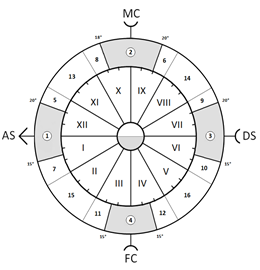
This approach aims to reproduce planetary positions as closely as possible to apparent astronomical reality, rather than relying on a purely abstract geometric division.
In order to evaluate angularity in a concrete way, the AstroMap software defines specific zones based on the proximity of planets to the local axes, in real domitude. The angularity zones are defined as follows:
Zone 1: first half of House I, last two thirds of House XII
Zone 2: first 18° of House X, last two thirds of House IX
Zone 3: first two thirds of House VII, second half of House VI
Zone 4: first half of House IV, second half of House III
Zone 5: first third of House XII
Zone 6: first third of House IX
Zone 7: second half of House I
Zone 8: last 12 degrees of House X
Zone 9: last third of House VII
Zone 10: first half of House VI
Zone 11: first half of House III
Zone 12: second half of House IV
Zone 13: entire House XI
Zone 14: entire House VIII
Zone 15: entire House II
Zone 16: entire House V
Once the angularity zones have been defined, they are ordered according to an ordinal hierarchy. In this ranking:
planets located in Zone 1 (proximity to the Ascendant) take precedence,
followed by those in Zone 2 (proximity to the Midheaven),
then planets in Zone 3 (proximity to the Descendant),
and finally those in Zone 4 (proximity to the Imum Coeli).
Within a given zone, the planet closest to the axis prevails over the one that is farther away.
When two planets are located at an equivalent distance from an axis, they are ranked according to a natural planetary hierarchy, based on their relative apparent speed.
This hierarchy is as follows: Moon, Sun, Mercury, Venus, Mars, Jupiter, Saturn, Uranus, Neptune, Pluto.
Second criterion: interplanetary aspects
(Calculated in the local sphere)
The second criterion of hierarchisation is based on interplanetary aspects, that is, the geometric relationships between planets.
Unlike classical approaches based on a simple comparison of ecliptic longitudes, aspects are here calculated from the actual positions of the planets in the local sphere.
These positions are described by their equatorial coordinates—in particular their declination—which makes it possible to take into account the effective spatial arrangement of celestial bodies in the sky for a given observer.
This approach aims to evaluate astronomically coherent planetary relationships, rather than relying on a purely symbolic alignment along the zodiac.
The aspects are hierarchised as follows:
- Conjunction
- Opposition
- Square
- Trine
- Sextile
This hierarchy is used to rank planets when multiple aspectual relationships are present.
Aspects are not evaluated in a strictly exact manner, but through the use of orbs, that is, angular tolerances around the exact aspect.
These orbs vary depending on the nature of the planets involved:
| Groups | Orbs | ||
|---|---|---|---|
| Conjunctions/ Oppositions |
Squares/ Trines |
Sextiles | |
| (Group 1) Aspects between: Moon, Sun, Mercury, Venus, Mars | 18° | 9° | 5° |
| (Group 2) Aspects between: Jupiter, Saturn, Uranus, Neptune, Pluto | 14° | 7° | 3° |
| Aspects between Group 1 and Group 2 | 16° | 8° | 4° |
Two planetary groups are therefore considered:
Group 1 (fast-moving planets): Moon, Sun, Mercury, Venus, Mars
Group 2 (slower-moving / outer planets): Jupiter, Saturn, Uranus, Neptune, Pluto
Angular and Non-Angular Charts
Two types of astrological charts are distinguished depending on the presence or absence of angular planets:
Angular charts, which contain at least one planet located in one of zones 1 to 4 (i.e. close to the main local axes);
Non-angular charts, which contain no planets in these angular zones.
Case of charts with angular planets
When a chart contains one or more angular planets, the hierarchy is established through three successive steps:
-
Identification of planets close to the axes (dominant planets)
Based on the domitude chart, planets located near the Ascendant, Midheaven, Descendant, and Imum Coeli are identified and ranked according to the angularity criteria defined earlier. -
Ranking of planets in aspect to angular planets (sub-dominant planets)
Planets forming aspects with the dominant planets are then ranked according to the type and hierarchy of aspects described above. -
Ranking of remaining planets (non-dominant planets)
Planets that do not form any aspect with the angular planets are finally ranked according to their zone position and the planetary hierarchy previously established.
Case of charts without angular planets
When no planet is located close to the axes, the hierarchical ranking is based primarily on the possible presence of planetary clusters and on the aspects formed.
The procedure is carried out in several steps:
-
Identification of planetary clusters
The chart is first examined in order to identify any clusters, defined as groups of at least three planets in conjunction, using the orbs previously defined.
If several clusters are present, the one containing the fastest planet is considered dominant. -
Ranking of planets within the clusters
The planets forming each cluster are ranked according to the reference planetary hierarchy (defined earlier). -
Successive processing of clusters
When more than one cluster is present, the same ranking procedure is applied successively to each of them. -
Ranking of planets in aspect to the clusters
Planets forming aspects with the clusters are then ranked according to the hierarchy and the number of aspects, in accordance with the rules previously described. -
Ranking of the remaining planets
Finally, planets that do not form any aspect with the clusters are ranked according to their position in the non-angular zones, and are then ordered using the planetary hierarchy.
R.E.T. Families
Once the planetary hierarchy has been established, it is used to determine the hierarchy of the R.E.T. families.
Each family is evaluated on the basis of the planets that compose it.
General principle for ranking the families
For each R.E.T. family:
the rank obtained by each of the family’s planets in the planetary hierarchy is taken into account;
these ranks are then added together.
The family with the lowest total score is considered the most dominant,
while the family with the highest total score is considered the weakest.
This principle makes it possible to translate the planetary hierarchy directly into a family hierarchy, in a coherent and reproducible manner.
Tie-breaking rule between families: When two families obtain the same total score, they are ranked according to the following order of priority:
p > R > r > P > e > E > t > T
Special Case: The Moon
The Moon constitutes a specific case, as it alone represents a distinct family: intensive power (p).
In theory, one might be tempted to multiply its planetary rank by three in order to make it comparable to families composed of three planets.
However, such an approach would risk either overvaluing or undervaluing the Moon, due to the wide dispersion of planetary ranks within the R.E.T. families.
To avoid this bias, a simple and stable rule is adopted:
the Moon’s R.E.T. rank is identical to its rank in the planetary hierarchy;
Accordingly:
if the Moon is ranked 1st to 7th in the planetary hierarchy, it retains the same rank in the R.E.T. classification;
if it is ranked 8th, 9th, or 10th, it is assigned rank 8 in the R.E.T. system.
This rule preserves the Moon’s specific weight without introducing any artificial imbalance.
Reminder of the R.E.T. families
Extensive families
Extensive Representation (R): Sun, Venus, Mercury
Extensive Existence (E): Jupiter, Mars, Saturn
Extensive Transcendence (T): Uranus, Neptune, Pluto
Intensive families
Intensive Representation (r): Sun, Jupiter, Uranus
Intensive Existence (e): Venus, Mars, Neptune
Intensive Transcendence (t): Mercury, Saturn, Pluto
Power families
Extensive Power (P): Sun, Mars, Pluto
Intensive Power (p): Moon
The R.E.T. Diamond
The R.E.T. diamond is a visual synthesis tool. It provides a quick representation of the hierarchical structure of a natal chart. Planets are placed within the diamond according to three visual levels:
- black cells: dominant planets,
- grey cells: sub-dominant planets,
- white cells: non-dominant planets.
The R.E.T. diamond does not constitute an additional hierarchical criterion. It offers a visual synthesis of planetary positions within the chart, highlighting the most influential planets, those of intermediate importance, and those with a weaker impact, in accordance with the hierarchies previously established.
Charts with angular planets
When a chart contains one or more angular planets, the construction of the R.E.T. diamond follows the rules below:
-
Five or more angular planets
The first five angular planets are placed in black cells. The next three planets are placed in grey cells, and the remaining ones in white cells. -
Four angular planets
The four angular planets are placed in black cells. The next three planets are placed in grey cells, and the remaining ones in white cells. -
Three angular planets
The three angular planets are placed in black cells. The next four planets are placed in grey cells, and the remaining ones in white cells. -
Two angular planets
The two angular planets are placed in black cells.
One additional planet is placed in a black cell according to aspect-based or hierarchical criteria.
The next four planets are placed in grey cells, and the remaining ones in white cells. -
One single angular planet
The next two planets in the hierarchy are also placed in black cells. The following four planets are placed in grey cells, and the remaining ones in white cells.
Charts without angular planets
When no planet is angular:
- the first four planets in the hierarchy are placed in black cells,
- the next three in grey cells,
- and the remaining planets in white cells.
Zodiac Signs
Real position in the local sphere
The hierarchical weighting of zodiac signs is based on the real position of the planets in the local sphere. This position is notably described by declination, which measures the north–south orientation of a celestial body relative to the celestial equator.
Thus, a planet located in Aries in ecliptic longitude, for example, may present a declination corresponding to the sign of Pisces (lower position) or Taurus (higher position).
The table below gives the declination associated with each Sign, and highlights the progressive variations of north–south motion throughout the zodiac.
| Longitude | Sign | Declination | Increase |
|---|---|---|---|
| 0° | Aries | 0° | +11°48’ N |
| 30° | Taurus | +11°48’ N | +8°68’ N |
| 60° | Gemini | +20°16’ N | +3°29’ N |
| 90° | Cancer | +23°45’ N | -3°29’ N |
| 120° | Leo | +20°16’ N | -8°68’ N |
| 150° | Virgo | +11°48’ N | -11°48’ N |
| 180° | Libra | 0° | +11°48’ S |
| 210° | Scorpio | -11°48’ S | +8°68’ S |
| 240° | Sagittarius | -20°16’ S | +3°29’ S |
| 270° | Capricorn | -23°45’ S | -3°29’ S |
| 300° | Aquarius | -20°16’ S | -8°68’ S |
| 330° | Pisces | -11°48’ S | -11°48’ S |
Weighting of planets within each Sign
The relative importance of the zodiac Signs in a chart depends on:
the planets located in each Sign,
their respective speeds (fast, intermediate, or slow planets),
and their actual position within the individual planetary hierarchy.
This weighting system is based on an empirical principle: fast-moving planets (the Moon, the Sun, Venus, and Mercury), as well as planets that occupy the highest ranks in the hierarchy, tend to individualize the chart more strongly and exert a more direct influence on behavior and the visible expression of a sign.
For each chart, the corresponding weighting is applied according to the table below, and the points are summed for each sign. The dominant sign(s) are those with the highest total score.
Each planet contributes a fixed number of points to the sign it occupies.
Planetary weighting:
Moon’s sign: 10 points
Sun’s sign: 9 points
Mercury’s sign: 8 points
Venus’s sign: 7 points
Mars’s sign: 6 points
Jupiter’s sign: 5 points
Saturn’s sign: 4 points
Uranus’s sign: 3 points
Neptune’s sign: 2 points
Pluto’s sign: 1 point
Weighting based on planetary hierarchy:
A second allocation of points is added according to the rank obtained by each planet in the planetary hierarchy:
Sign of the planet ranked 1: 10 points
Sign of the planet ranked 2: 9 points
Sign of the planet ranked 3: 8 points
Sign of the planet ranked 4: 7 points
Sign of the planet ranked 5: 6 points
Sign of the planet ranked 6: 5 points
Sign of the planet ranked 7: 4 points
Sign of the planet ranked 8: 3 points
Sign of the planet ranked 9: 2 points
Sign of the planet ranked 10: 1 point
The points assigned to each planet itself and those derived from its hierarchical rank are then added together for each Sign.
When two Signs obtain the same total score, they are ranked according to the following rules, applied in order:
- The Sign containing the greatest number of planets takes precedence.
-
If still tied, the Sign containing the greater number of fast-moving planets prevails. If necessary, the planetary order is applied.
Example: a Sign containing Moon–Mercury–Neptune prevails over a Sign containing Sun–Jupiter–Saturn. - As a last resort, the following planetary order is applied (as defined at the beginning of the article): Moon > Sun > Mercury > Venus > Mars > Jupiter > Saturn > Uranus > Neptune > Pluto.
Zodiacal Families
Zodiacal families are not subject to an independent calculation in AstroMap. They are directly derived from the hierarchical ranking of the Signs.
In other words, the dominant zodiacal families in a chart result from the dominant Signs identified beforehand.
Reminder of the Zodiacal Families
Excitation / Inhibition
Excitation strength (F+): Aries, Gemini, Leo, Libra, Sagittarius, Aquarius
Inhibition strength (F−): Taurus, Cancer, Virgo, Scorpio, Capricorn, Pisces
Mobilities
Excitation speed (V+): Aries, Taurus, Gemini
Excitation slowness (L+): Cancer, Leo, Virgo
Inhibition speed (V−): Libra, Scorpio, Sagittarius
Inhibition slowness (L−): Capricorn, Aquarius, Pisces
Phases
Sense of Contrasts (SC): Aries, Virgo, Libra, Pisces
Sense of Dosage (SD): Taurus, Leo, Scorpio, Aquarius
Sense of Wholeness (SE): Gemini, Cancer, Sagittarius, Capricorn
This protocol constitutes the methodological foundation of AstroMap: it defines a coherent, reproducible, and non-redundant hierarchy of chart elements, from the planets’ real positions in the sky to their zodiacal placements.