
A Career That Opens Bottles and Doors
The Best Sommeliers of France
By Manuel da Costa — GeoAstro
Experts in the art of wine tasting and service, sommeliers assist guests in fine dining restaurants and luxury hotels in selecting the wine that will best complement their meal. They move between the wine cellar, where they manage inventory and supply, and the dining room, where they take orders and ensure proper service. In close contact with winegrowers, whom they meet to better understand their production, sommeliers are highly sought after both in France and abroad, especially if they have experience and speak multiple languages.
Every two years, the Meilleur Sommelier de France (Best Sommelier of France) competition honors a professional for their extensive wine knowledge, refined palate, expertise, and professionalism. Among the key challenges are wine tasting and analysis — especially red wines — but also the identification of various spirits, some of which may be international. Candidates are also tested on their English skills, including describing a drink in Shakespeare’s language, as well as their knowledge of wine history and culture.
But what about their birth charts? What can we observe at the astrological level? Do the natal configurations of the Best Sommeliers of France — particularly the planets and the RET planetary families — reveal specific patterns? Could certain astrological dominants, either strongly or weakly emphasized, help explain why these individuals possess such a remarkable sense of smell?
A Relevant Population Cohort
The population cohort consists of 28 recipients of the “Best Sommelier of France” title. While this number may seem small at first glance, it is actually quite significant given the rarity of samples composed of individuals who are elite enough for the data to be meaningful. In fact, this cohort is large enough to yield astro-statistical results that exceed what would be expected by chance alone — we obtained five statistically significant results from this group!
The statistical analysis applied to sommeliers follows the same methodology used for other professions. By comparing the results to random distributions, the AstroStat software was able to identify significant astrological dominants.
It is worth recalling that statistical analysis allows us to explore potential links between a natal chart and a professional activity. However, a birth chart primarily reveals personality traits and behavioral tendencies, rather than specific skills. Therefore, we can begin by analyzing an individual’s psychology and behavior, and then attempt to establish any potential connection with their profession:
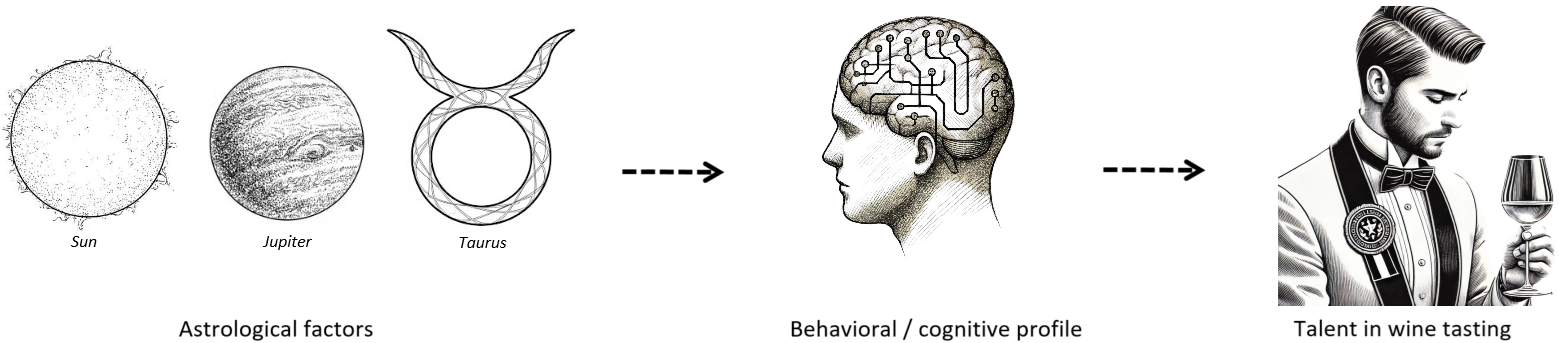
Although the link between astrology and professional activity is complex, it is possible to identify marked dominants — or lack thereof — of certain planets or zodiac signs. Among experts in a specific field, certain personality traits or aptitudes may appear more frequently than in the general population.
Professional and cognitive aptitudes are sometimes influenced by astrological dominants, depending on how they are expressed in the individual. For example, Uranus and intensive power are overrepresented among Fields Medalists, while Mars and Saturn tend to dominate among chess grandmasters — along with a notable weakness in Neptune and the Sun.
These astro-statistical findings suggest a dual correlation: between the natal chart and the group’s aptitudes, and between those aptitudes and the corresponding professional activity. Conversely, the absence of statistical results does not imply that astrological influence is absent, but rather that no clear correlation can be demonstrated between astrological conditioning and the behavioral or cognitive traits of a particular group.
The Best Sommeliers of France
The population cohort brings together 28 of the 31 winners of the “Best Sommelier of France” title. For three of them — among the earliest recipients — no birth data (“BD”) could be retrieved: no information other than their names and the year they received the title was found on the website of the Union de la Sommellerie Française. Even the association itself, along with local federations contacted, were unable to recover their dates and places of birth. Nonetheless, the cohort remains substantial enough to provide a relevant and valuable sample for analysis.
Below is the list of the Best Sommeliers of France, listed chronologically by year of title:
- 1961: Jean Chauchée, BD unknown
- 1962: Henri Guygot, born on 30 October 1921 at 15:00 in Saint-Nazaire
- 1963: M. Rouby, full name and BD unknown
- 1964: Guy Blandin, BD unknown
- 1966: Paul Brunet, born on 20 April 1935 at 19:45 in Migné-Auxances
- 1967: Louis Le Bail, born on 18 July 1922 at 05:30 in Bulat-Pestivien
- 1968: Armand Melkonian, born on 19 May 1938 at 02:45 in Paris
- 1970: Gérard Renoux, born on 13 January 1939 at 07:00 in Le Raincy
- 1972: Jean-Marie Stoeckel, born on 24 December 1944 at 17:30 in Sainte-Marie-aux-Mines
- 1974: Jean-Claude Jambon, born on 11 September 1942 at 02:00 in Mâcon
- 1976: Albert Golay, born on 21 March 1935 at 14:10 in Champagnole
- 1978: Philippe Bourguignon, born on 13 June 1951 at 08:30 in Saint-Pierre-lès-Nemours
- 1980: Georges Pertuiset, born on 31 October 1941 at 09:30 in Lugrin
- 1983: Serge Dubs, born on 14 February 1953 at 17:45 in Strasbourg
- 1986: Philippe Nusswitz, born on 11 March 1963 at 02:00 in Colmar
- 1988: Philippe Faure-Brac, born on 25 February 1960 at 03:15 in Marseille
- 1990: Olivier Poussier, born on 27 April 1964 at 18:40 in Chatou
- 1992: Eric Beaumard, born on 5 November 1963 at 22:45 in Fougères
- 1994: Lionel Leconte, born on 3 February 1965 at 05:20 in Chalon-sur-Saône
- 1997: Richard Bernard, born on 14 December 1971 at 09:30 in Clermont-Ferrand
- 2000: Franck Thomas, born on 17 January 1972 at 04:30 in Cannes
- 2002: David Biraud, born on 7 August 1972 at 18:50 in La Roche-sur-Yon
- 2004: Dominique Laporte, born on 17 November 1972 at 05:12 in Le Blanc-Mesnil
- 2006: Pascal Léonetti, born on 12 September 1977 at 01:45 in Bastia
- 2008: Manuel Peyrondet, born on 14 February 1980 at 09:15 in Autun
- 2010: Benjamin Roffet, born on 8 March 1981 at 08:20 in Feurs
- 2012: Romain Iltis, born on 19 December 1981 at 05:30 in Colmar
- 2014: Jonathan Bauer Monneret, born on 25 July 1985 at 06:00 in Strasbourg
- 2016: Gaëtan Bouvier, born on 15 August 1984 at 07:00 in Voiron
- 2018: Pascaline Lepeltier, born on 9 January 1981 at 23:00 in La Rochelle
- 2020: Florent Martin, born on 22 September 1987 at 03:45 in Paris
- 2022: Xavier Thuizat, born on 28 December 1985 at 20:00 in Vichy
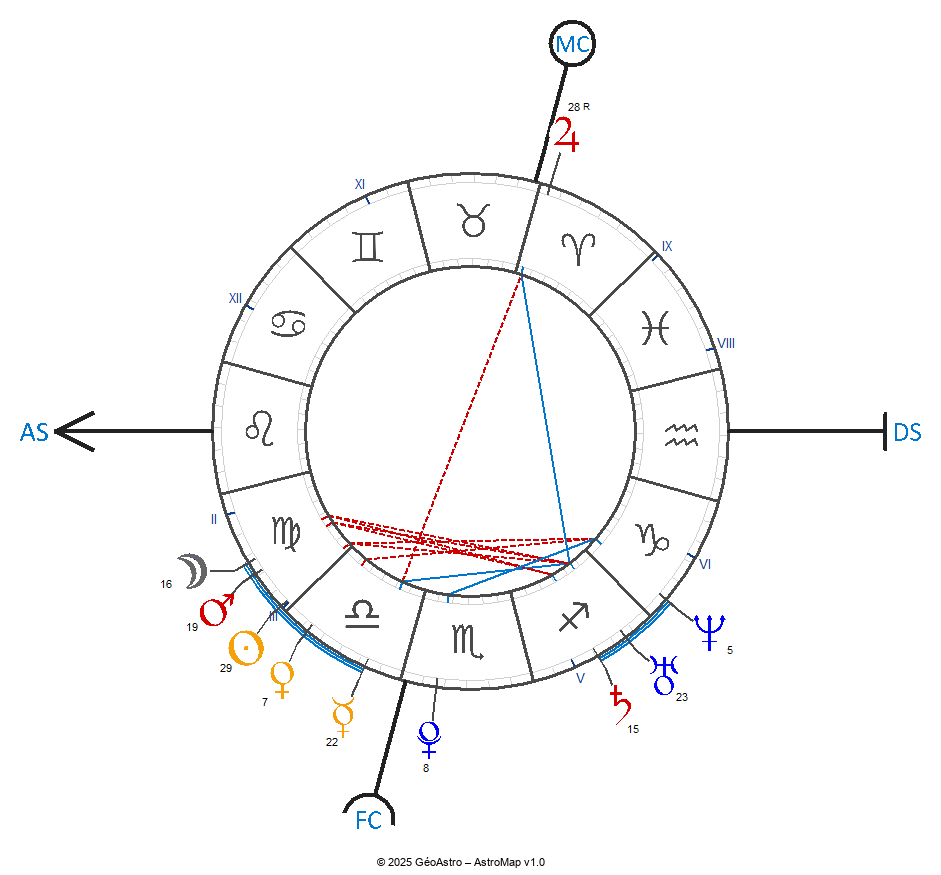
The 2020 recipient of the title, Florent Martin, was born under an opposition between Jupiter at the Midheaven and Mercury and Pluto at the Imum Coeli. In terms of zodiac signs, the “fast” planets are located in Virgo and Libra, making these the most emphasized signs in his chart. Florent Martin appears as both pragmatic and organized, dynamic and expansive (Jupiter); a sociable, talkative sprite with a thirst for varied human contact (Mercury); and a lucid, enigmatic figure with critical detachment and carries a deep-rooted skepticism (Pluto).
Zodiacally speaking, the subject is also marked by what we call the “Sense of Contrasts”1 — an ability to perceive both a thing and its opposite: to evaluate something and its contrary (Virgo), or to assess situations through subtle distinctions (Libra).
Dominant Planets Among the Best Sommeliers of France
Unusual Planetary Emphases
The chart below shows, on the y-axis, the probability (ranging from 0% to 100%) of obtaining lower planetary ranking scores from random distributions. The planets in the natal chart, from the Moon to Pluto, are listed along the x-axis.
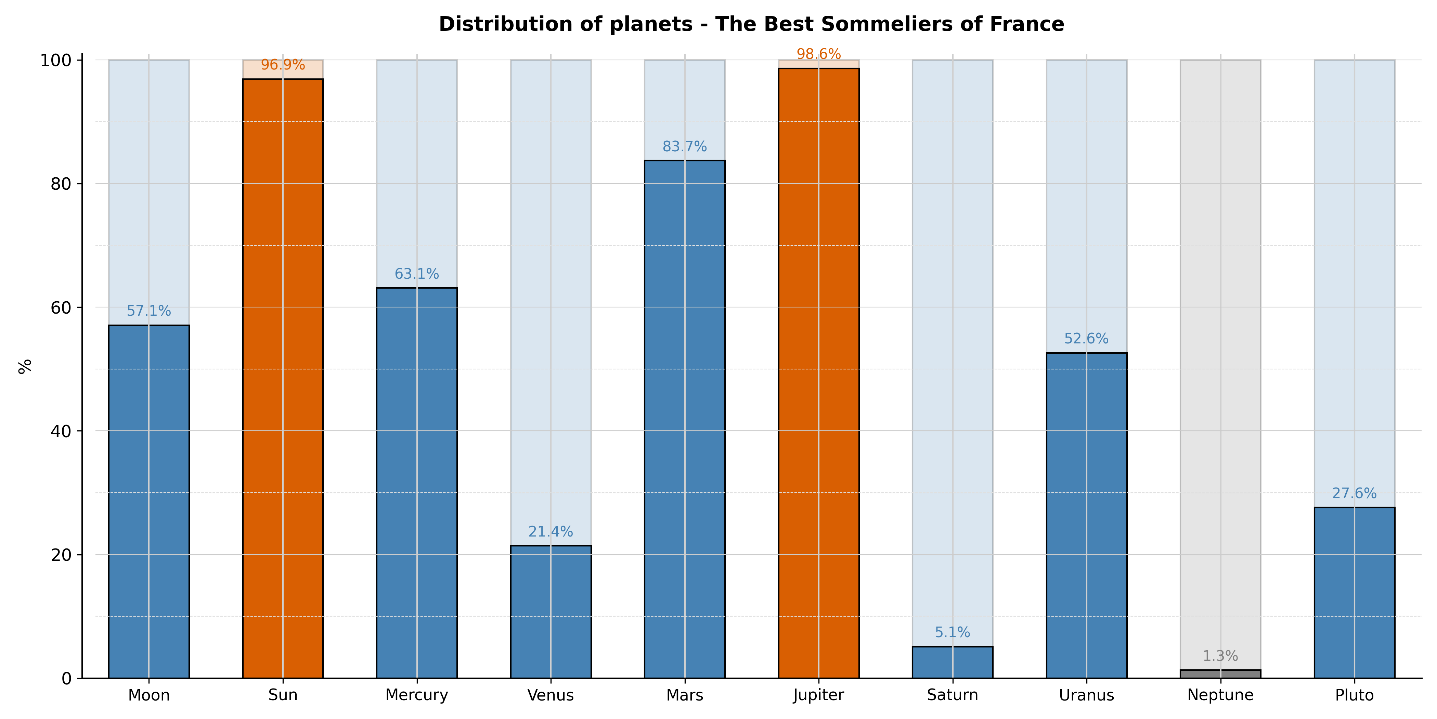
Three planets exhibit results that deviate significantly from what would be expected by chance:
- The Sun is overvalued: 96.9 out of 100 simulations;
- Jupiter is overvalued: 98.6 out of 100 simulations;
- Neptune is under-valued: 1.3 out of 100 simulations.
Compared to a random sample, there is approximately a 97% chance of observing a lower emphasis on the Sun, a 98% chance for Jupiter, and only a 1% chance for Neptune. Saturn, with a probability of 5%, shows a slight statistical weakness, although it does not fall into the underemphasis threshold.
Unusual Emphases of RET Planetary Families
The next chart, based on the same statistical method, shows the probability of obtaining lower statistical scores for the RET planetary families.
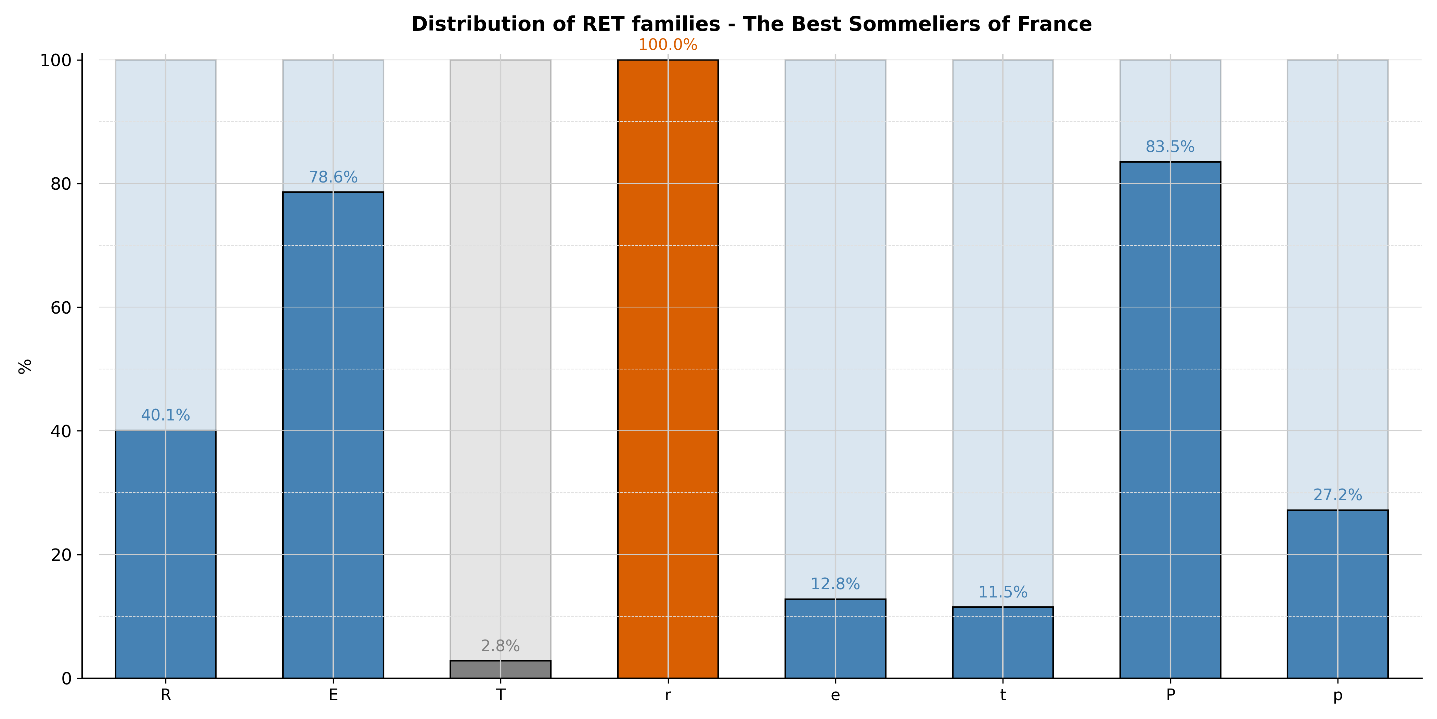
Two planetary families stand out with atypical results:
- The “extensive transcendence” family (T) is under-valued: 2.8 out of 100 simulations;
- The “intensive representation” family (r) is overvalued: 100 out of 100 simulations.
Compared to a random sample, there is a 3% chance of observing a lower emphasis on the extensive transcendence family and a statistical certainty (100 out of 100 chances) of observing a stronger emphasis on the intensive representation family.
Planetary Profiles of the Best Sommeliers of France
Relational Psychology
The Sun and Jupiter are both significantly overrepresented among the Best Sommeliers of France. These two planets belong to the "intensive representation" family (or “r”), which is also statistically overrepresented in the group. According to conditionalist astrology, both the Sun and Jupiter lean toward the “r” level: the Sun from the extensive representation (“R”) source level, and Jupiter from the extensive existence (“E”) level.
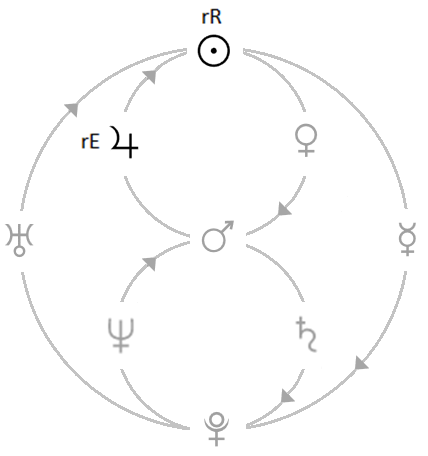
With the Sun, we are in the realm of maintaining an absolute unity (“rR”): the known, the singular, and the repetition and renewal of established models. With Jupiter (“rE”), raw facts, observable phenomena, and tangible experiences are distilled into norms, principles, and knowable symbols.
Why are these planets, along with the “r” family, so strongly emphasized among the Best Sommeliers of France? Do they contribute to the development of a particular talent essential to this professional field? To address these questions, we will primarily refer to the book Sommeliers – L’éloquence du goût2, and seek to establish a connection between, on the one hand, the sommelier’s work and psychological traits, and on the other, the two planets mentioned above.
High Social Intelligence
The sommelier is described as a people person: attentive, precise, and organized. Self-possessed, he knows how to mask fatigue or worries while remaining attuned to others. Writings on the profession highlight the sommelier’s relational psychology and the range of social skills that allow him to interact effectively with others: observing human behavior, reading mental states, articulate speech, memory for names and faces, situational judgment, and mastery of social codes.
These psychological traits common among the best sommeliers can be closely correlated with the personality type associated with a strong Sun–Jupiter influence in the natal chart. To support this, here is a brief excerpt3 describing a harmonious aspect between these two planets:
“You have a very high opinion of your role and the part you play in your sphere of activity. Willful, ambitious, and determined, you know how to present yourself and gain recognition without causing a stir, thanks to your eloquence, your pursuit of excellence, and your skills as a negotiator or diplomat. Pragmatic, realistic, organized, and self-confident, you often serve as a standard-bearer for the common good. Your respect for hierarchy and your appreciation of stable values make you a reliable point of reference. You exert your undeniable authority with paternalism, good sense, and enough magnanimity to maintain the consensuses you hold dear. You are perfectly at ease within the codes, laws, and regulations that structure and cement social life. Your sense of timing and opportunity is truly exemplary. You live with cheerfulness and self-satisfaction in a world of certainties that seem self-evident to you.”
In short, the sommelier possesses what psychology refers to as high “social” or “interpersonal” intelligence—an ability closely related to a Sun–Jupiter dominant in conditionalist astrology. This type of intelligence can be defined as the capacity to understand the behaviors, thoughts, and emotions of others, and to interact effectively with them. Someone with strong social intelligence will understand and get along with those around them, adapt to different social environments, and be appreciated on a human level. They will be able to read a situation and respond appropriately, all while adhering to the social conventions that govern us.
The profession of sommelier is fundamentally rooted in relational psychology. A sommelier must quickly gain the trust of clients and grasp their desires. Advising clients goes far beyond simply matching wine to food. The sommelier must listen, observe, and analyze their clients—their expectations, age, background, budget, the setting (business lunch or casual dinner), and their openness to novelty or preference for the familiar. Within minutes, the sommelier must craft appropriate suggestions tailored to each individual and situation.
A Wine Culture to Share
A dominant Sun–Jupiter profile often leads to total dedication to one’s profession, even a strong identification with the social role it entails. Individuals influenced by these planets develop a deep passion for their interests and are driven to constantly expand their knowledge. Naturally inclined toward communication, they enjoy sharing their expertise and excel in describing and persuading.
Once the sommelier has understood the client’s taste and budget, they must be able to suggest a wine tailored to that person, in pursuit of gastronomic harmony. They will then present their suggestion with arguments drawn from a deep knowledge of the wines offered, the character of different vintages by region, the specifics of the grape varieties used, and the unique processes behind each wine.
Here we find the wine professional’s passion, their cultivated knowledge, and their refined sensory awareness. The sommelier introduces the recommended wine and discusses it. A top sommelier’s key skill is being able to describe a wine in just a few words for the consumer. This calls for a well-crafted presentation and the ability to speak simply and precisely.
The sommelier also plays a role in educating the client’s palate, helping them discover new flavors while respecting their existing preferences. They must remain a guide—convivial and respectful of each customer’s taste.
The sommelier highlights a wine’s qualities while transmitting a certain joy to the public. Some even describe the sommelier as a poet of wine, capable of evoking hints of redcurrant, blackcurrant, or linden blossom by linking them to sensory memories. The aim is not to push for consumption, but to enchant the client, making them eager to return.
Sensory Expertise
One of the sommelier’s essential talents lies in their ability to perform sensory analysis of wines. They must, in effect, be a polyglot of taste. Their job is first and foremost to identify wines and be able to classify and categorize them: by grape variety, geographical origin or appellation zone (wine region, terroir), wine name, producer, vintage, and quality characteristics such as freshness, fruitiness, lightness, color, acidity, and the presence or strength of tannins.
The best sommeliers possess a deep mastery of wine and its subtleties. Thanks to this expertise, they can suggest food and wine pairings tailored to the menu, the ambiance, the client's budget, and personal preferences.
Here again, the planetary dominants in our sample—Sun and Jupiter—as well as the overrepresented “intensive representation” family, play a facilitating role. From a cognitive perspective, the “r” planetary family is associated with synthesis, classification, ordering, and organizing: the ability to reduce and schematize, to bring structure, to describe, and to apply norms4. The Sun primarily relates to the body of knowledge within a discipline—the acquired expertise in wine evaluation that one seeks to represent accurately. Jupiter, meanwhile, corresponds more to the transformation of sensory perceptions—gustatory and olfactory—into standardized and conceptual frameworks that allow for identification and classification.
Wine analysis, which lies at the core of the sommelier’s craft, is therefore a quintessential exercise in intensive representation. The goal isn’t to question or formulate new hypotheses (which would belong to the ‘t’ level of intensive transcendence), nor is it to simply feel and live the experience emotionally (the ‘e’ level of intensive existence). Rather, it is to identify, describe, and categorize the object of their profession—wine—making it a clear expression of the “r” level within the RET model.
Sommellerie also includes a wide range of competitions, organized by the Union of French Sommeliers: Best Sommelier of France, Best Craftsman of France – Sommelier, Best Young Sommelier of France, Master of Port, and more. While these contests involve various challenges (such as correcting a flawed wine list or suggesting a dish to enhance a particular wine), the most decisive test remains the blind identification and precise description of different wines through visual, olfactory, and taste analysis.
Once again, we encounter the skill set tied to intensive representation. According to experts, the key to excelling in these tests lies in the ability to assess wine quality and describe it—even when it’s unfamiliar. Sommeliers must then propose a food pairing and justify their recommendation. This requires an excellent memory—not only of flavors and aromas but also of wine lists and their structure.
For the winners, these competitions represent a kind of professional consecration: recognition by their peers and a validation of their knowledge.
A Prestige Manager
On a very different note, one might say that the sommelier profession — or at least what it symbolizes — has a special affinity with the Sun and Jupiter. This professional typically operates in high-prestige settings such as fine dining restaurants and renowned wine cellars. The Sun and Jupiter are precisely the planets associated with socially esteemed and prestigious activities — those perceived as refined, desirable, or exclusive.
At its heart, the sommelier’s profession revolves around wine service and client satisfaction. They present the wine list, advise on food and wine pairings, and ensure perfect service — including the choice of glasses and serving temperature. Their expertise adds a sense of luxury and exclusivity to gourmet establishments.
The reputation of top-tier restaurants is often linked to the skill of their sommelier. In the finest dining environments, wine service becomes one of the primary conveyors of the establishment’s public image (at the level of “representation” in the RET framework). Ultimately, the sommelier’s role is justified by the profitability they bring to their venue. As professionals like to say, “a good sommelier doesn’t cost money — they make money.” They must justify their salary and actively generate revenue and profit for their employer.
A Strong Need for Distinction
The report The Sommelier — A Mediator, Artisan of Taste5 offers numerous valuable insights into the professional trajectory of sommeliers.
Humble Origins
The study first seeks to determine whether a sommelier’s entry into this professional world is rooted in their personal, family, or social background. Among the fifteen interviews conducted, the author notes the following:
- Three sommeliers reported having a direct and significant familial connection to the world of wine or hospitality;
- Six of them emphasized, on the contrary, that nothing in their background predisposed them to this path, and that it was through the twists and turns of school and career training that they eventually found themselves in sommellerie.
The collected testimonies reveal that sommeliers are often among those apprentices who, more than others, sought to escape the routines of kitchen work or dining room service, or who developed a genuine enthusiasm for oenology classes.
When asked about their paths, some sommeliers openly spoke about past academic failure, which initially led them to pursue vocational training in the hospitality sector — a precursor to their later calling as sommeliers. Those who succeeded in turning this path into a career sometimes expressed a negative self-perception, as if their professional commitment was, at least partly, a way to make up for an earlier educational trauma.
Their professional drive may, therefore, stem in part from a desire to take revenge on a difficult school experience. The study shows that sommeliers often have ambitions that go well beyond the average. Passionate about the art of living and the world of luxury, their love of wine often reflects a deep desire for social distinction.
While sommeliers move in elite circles and work closely with the world of gastronomy, the majority paradoxically come from less privileged backgrounds. Their social origins may actually shape their vocation, as they often display a desire to rise within this world and interact with clients typically associated with affluent or upper-middle-class environments.
Frequently coming from modest backgrounds and having struggled in school, these sommeliers strive for upward social mobility. Their passion for wine often reveals a profound longing to integrate into high society and adopt the codes of the upper classes — an environment where self-presentation and symbolic expression play a central role.
A Quest for Social Prestige
The analysis also explores how individuals from humble origins manage to integrate into and succeed within this elite profession. From an astrological perspective, this need for social distinction and aspiration to rise into privileged circles aligns with the influences of Jupiter and the Sun.
As discussed earlier, these two planets are known for heightening one’s sensitivity to social roles and the function one occupies in their professional sphere. For someone with a strong Sun-Jupiter influence, it becomes essential to be on center stage, to hold a socially valued position, and to receive public recognition. Since both planets gravitate toward the realm of what is said, seen, and symbolically represented (intensive representation), the social mask or persona becomes a key element in the way one evaluates their own worth.
An individual strongly marked by the Sun and Jupiter who comes from a privileged background will generally have easier access to prestigious studies and careers. Conversely, for a sommelier of modest origins, success often requires a determined will to stand out. Such a person may seek out inspiring role models beyond their immediate environment and pour all their energy into professional advancement. The Sun, Jupiter, and the “r” level of representation help channel ambition, willpower, dynamism, and commitment — enabling them to exceed their limits and reach the heights they aspire to.
Natives marked by the Sun and Jupiter are frequently drawn to prestige, luxury, and elite spheres. By its very nature, the sommelier’s profession embodies this desire for distinction and a sense of belonging to elite social circles. As a high-end restaurant ambassador, the sommelier embraces their codes and traditions.
An Impersonal Standard of Taste
The planet Neptune, along with the planetary family “extensive transcendence” or “T” to which it belongs, is underrepresented among France’s top sommeliers. According to conditionalist astrology, Neptune originates from the source level “T” of the RET model and tends toward the end level “e,” or “intensive existence.” A Neptunian profile is typically described as intuitively inspired, emotionally perceptive, and prone to experiencing the world through vivid sensory impressions.
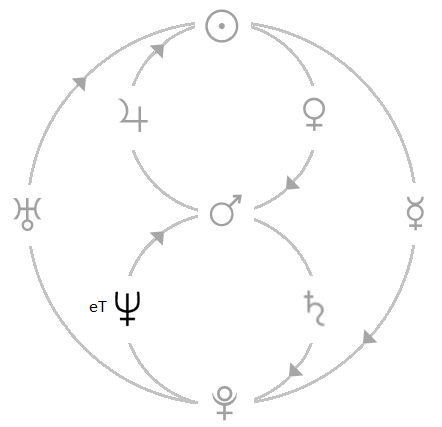
But why is this planet and its associated family underrepresented in the natal charts of top sommeliers? To answer this, we must again draw from the sociological analysis of the sommelier profession outlined in the previously cited study.
A Heavily Conditioned Judgment
Sommeliers strive to express a “refined” taste, seemingly free of external influence. However, their judgment is deeply shaped by their professional environment and ongoing interactions — with winemakers, wine merchants, fellow sommeliers, oenologists, chefs, and clients. These exchanges subtly but significantly affect how they perceive and evaluate wines.
These social and economic determinants of taste are often denied or minimized by sommeliers, who tend to maintain the illusion of a universal and unconditional way of discerning what is good. Most sommeliers interviewed in the study took care to distance themselves from the idea that taste could be culturally constructed, seeking instead to project a valorizing image of their role and professional authority.
Far from accepting that “all tastes are equal,” the author of the study investigates how certain actors, those with the necessary economic, social, or symbolic capital, manage to impose a legitimate definition of taste. This definition does not necessarily reflect their personal preferences but instead serves their broader social interests by shaping what is considered “good taste.”
Sommeliers maintain close ties with producers, restaurateurs, and clientele. These relationships give each group a formative role in shaping taste norms. The excellence or mediocrity of a wine is not inherent but emerges through a complex web of commercial and social interactions that establish ever-shifting standards.
What sommeliers often fail to realize is that their ability to judge wines is tightly bound to the conditioning they undergo — conditioning that leads them to evaluate wines according to criteria they rarely perceive as relative. When they agree on the excellence of a wine, it is not necessarily because the wine is objectively outstanding, but rather because it aligns with the profession’s established standards of excellence — standards that, in turn, shape how sommeliers judge in the first place.
According to the author, 3 this helps explain why a strong convergence of evaluation criteria and gustatory hierarchies exists within the profession. Most apprentice sommeliers, at some point in their journey, have encountered legendary figures they consider role models, or they have passed through the doors of prestigious institutions that serve as de facto schools of excellence.
The many sommelier competitions also function as rites of passage. They consolidate professional identity by standardizing knowledge and establishing common benchmarks. In doing so, they reinforce the alignment of tasting criteria and evaluation methods across the field.
The Eclipse of Subjectivity?
Recognition of tasting expertise in the world of wine depends on a perfect internalization of a certain taste hierarchy and the value system that governs it. But how does this relate to the underrepresentation of Neptune, particularly in its "intuitive-inspired" or "T" expression?
When Neptune and the "T" planetary family are dominant and well-integrated in a birth chart, they encourage creativity and inspiration. Such a configuration is often found in the horoscopes of great fashion designers and renowned painters. A gifted Neptunian is typically drawn to professions that allow them to express their inner world through original, imaginative work. They favor settings where they can bring forth personal creativity and individual flair.
Among sommeliers, however, a "blind" Neptune hinders imagination and inspiration. Their gustatory judgment depends almost entirely on socio-economic interdependence. The most celebrated sommeliers are often those who conform most strictly to the established order. There is little room for initiative, innovation, or instinct—qualities that a true Neptunian would naturally seek to express.
On the contrary, the sommelier must align with a codified hierarchy of taste values and accept the psychological influence exerted by their professional group—leading to a form of self-dispossession (a hallmark of a weak Neptune). Their training resembles a process of acculturation to dominant taste norms (under the influence of Sun/Jupiter), and their work involves replicating a collective opinion structured by the profession’s most powerful figures.
The weak Neptunian influence in sommeliers thus highlights a lack of personal inspiration and creativity. Rather than asserting a subjective, individual perspective, they appear more inclined to adopt the dominant norms of their profession.
During interviews, most sommeliers acknowledged that their perception of wine changes depending on context. In competitions, for instance, they favor "clean wines"—those without obvious flaws. As such, their dependence on the influential players in the wine world leads them to adopt a homogenized vision, one stripped of personal judgment and distinctive style—a trend indicative of a diminished Neptune and a weakly expressed "T" function.
In the Conditional
In conclusion, it could once again be said that the use of statistical tools in astrology proves to be powerful and genuinely worthwhile. However, one should not lose sight of the fact that results generated by statistical software must be accompanied by a detailed analysis aimed at clarifying the relationship between those results and the activity of the group under study.
It would also appear that the astrological analysis of a given population cohort necessarily calls for a multidisciplinary approach. In this case, we relied heavily on the sociological environment in which sommeliers operate. Nevertheless, astrological interpretation could also draw on the biological, psychological, or historical conditioning specific to the group concerned, depending on the nature of the findings.
Each individual may in fact be regarded as a point where multiple influences converge—biological, astrological, sociological, psychological, and so on. To refine their analysis, the astrologer would benefit from considering what can be observed about a person’s social background, education, psychological balance, intelligence, and way of life.
The conditionalist astrologer’s method would consist first in mastering their discipline, then setting aside that knowledge temporarily during the analysis of an individual or group in order to form a comprehensive overview. This broad approach would then allow the astrologer to reintegrate and refine their astrological understanding, with observation serving as an inexhaustible source of insight.
More broadly, it is not so much the chart that reveals how a person functions, but rather the observation of their personality and the way they live their chart. A subject expresses their astrological conditioning not only through the integration capacities of their individual nervous system, but also through the countless other influences they are exposed to throughout their life.
Methodological note — update
This article was originally based on analyses carried out using the AstroStat software developed by Julien Rouger. Since its publication, we have continued this work within the GeoAstro statistical engine, which follows the same methodological logic while adopting a more synthetic approach.
Minor differences may therefore appear between the results obtained with AstroStat and those generated in GeoAstro, without affecting the main trends discussed in this article.
The charts presented here were generated afterwards using GeoAstro, based on the same cohorts, in order to provide a consistent visual representation of the results.
Appendix: The Meilleurs Sommeliers de France – Intensive representation (r)
This appendix presents additional statistical elements concerning the Meilleurs Sommeliers de France, based on graphical representations not included in the main article. These results aim to broaden the analytical perspective and to support a more nuanced interpretation of the data.
The result presented here corresponds to the most pronounced statistical deviation observed within the group and is provided as an illustrative example of the statistical evaluation method applied to all planets.
Gaussian Distribution Curve
A Gaussian function is an exponential function used to represent the distribution of a dataset based on the density of its values. The following Gaussian curve illustrates the probability of observing, in the general population, a lower valuation of Intensive Representation (r) than the one found among the Meilleurs Sommeliers de France.
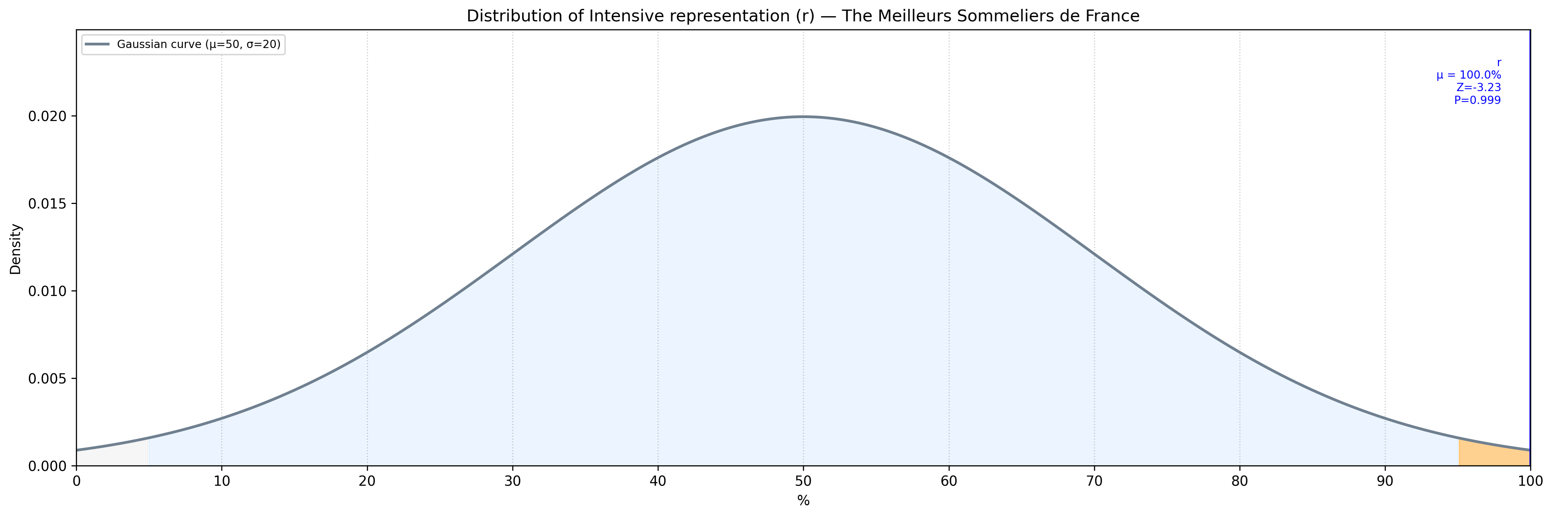
The graph above shows the following results for Intensive Representation (r):
- Empirical probability: 100.0% of simulations yield a lower score.
- Z-score: -3.23, indicating that the result is statistically significant.
- Theoretical p-value: 0.999, indicating the relative position of the observed result within the theoretical distribution expected under the null hypothesis.
Kernel Density Estimation Curve (KDE)
In statistics, kernel density estimation (KDE) is a non-parametric method used to estimate the probability density function of a random variable based on observed data. The KDE curve is based on hierarchical rank values, as the software computes probability estimates from the empirical distribution of these ranks.
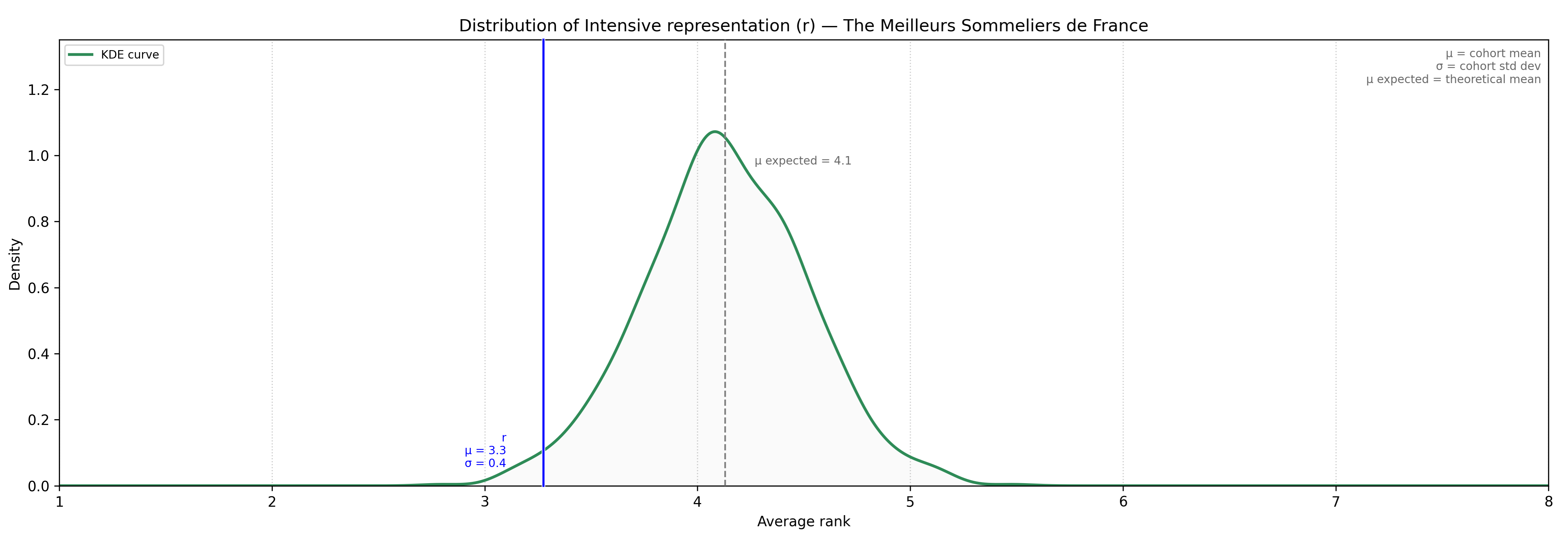
The graph above shows the following results for Intensive Representation (r):
- Cohort rank: 3.3 on a scale from 1 to 8.
- Cohort standard deviation: 0.4, indicating the dispersion of values around the mean rank.
- Expected rank: 4.1, corresponding to the theoretical average under a null hypothesis.
The Gaussian and KDE curves provide a statistical representation that complements the global histograms, allowing a more detailed examination of the rank distribution for a given element and its relative position within the studied population.
Notes
1Read the section Signes et saison and the article Les trois phases du zodiaque on AstroAriana.com.
2“La fabrique du goût”; Interview with Jean Hansmaennel; Politiques de communication 2015/2 (No. 5), in the dossier “Le sommelier – un médiateur, artisan du goût” by Stéphane Olivesi.
3According to the author, “the training of future sommeliers reveals processes of socialization that are inseparable from processes of domination, requiring deference to masters who end up co-opting the most compliant—those most willing to reproduce the established taste hierarchy.”
4See also “Soleil-Jupiter” by Richard Pellard, on AstroAriana.com.
5Read on AstroAriana: “Soleil-Jupiter-Uranus : représentation intensive”.