Champions of Speed
Formula 1 Drivers
By Manuel da Costa — GeoAstro
Under the authority of the Fédération Internationale de l’Automobile (FIA), Formula 1 is a racing championship held on closed circuits. These single-seaters, engineered with cutting-edge technology, reach staggering speeds.
Since 1950, Formula 1 Grands Prix have ranked among the world’s most widely covered sporting events. Among the French drivers who have competed in these races, twelve have won at least one Grand Prix, with one of them, Alain Prost, claiming the world champion title four times.
Do these exceptional performances stem solely from talent and training, or could more subtle factors—such as astrological configurations—also play a role in shaping predispositions in this field? Like Fields Medalists and top-level chess players, do Formula 1 drivers exhibit distinct planetary dominances compared to the general population?
As in previous chapters, we turn again to statistical analysis to assess the influence of celestial bodies on human behavior and examine the objectivity of astrological influence.
A Conditional Astrological Influence
Statistical analysis in astrology helps identify potential correlations between specific planetary or zodiacal dominances and an individual’s professional domain. However, an astrological chart primarily reflects psychology and behavior rather than professional skills.
Indeed, within the same field, individuals display a variety of psychological and behavioral profiles, each shaped by their unique astrological influences. Likewise, people with similar cognitive abilities may exhibit different astrological dominances. The influence of an astrological chart is neither mechanistic nor deterministic—it depends largely on the individual’s capacity for integration, as they interpret these influences through their own nervous system.
Nevertheless, among those engaged in highly specialized activities or possessing exceptional cognitive abilities, certain astrological configurations may appear more or less frequently compared to the general population. By selecting a group of individuals based on very specific criteria, it becomes possible to observe a significant astrological effect.
In general, certain abilities—whether professional, cognitive, or otherwise—can be correlated with planetary or zodiacal dominances. However, this correlation depends on whether the individual’s nervous system enables the expression of these influences. For this reason, to observe a meaningful astrological effect, the selection criteria for birth data (DN) should be as precise as possible. The statistical results will also be more compelling if the individuals in the studied cohort belong to the elite of a given field.
To assess an astrological effect within a group, one can estimate that approximately 38%1 of individuals have an angular planet (such as Mars, Jupiter, or Mercury) or a planet strongly positioned in their planetary hierarchy. However, when selecting groups of individuals randomly, this exact result is almost never obtained. Due to chance, the outcomes will sometimes be higher (45%, 50%, 55%...) and sometimes lower (35%, 30%, 25%...). The question, then, is to determine the threshold at which a statistical deviation becomes significant, suggesting an astrological influence beyond mere coincidence.
Speed Demons
The selected cohort consists of the twelve French Formula 1 drivers who have won at least one Grand Prix in the F1 World Championship. The birth data (DN) selection is therefore highly specific, increasing the likelihood of observing significant astrological results, despite the limited number of individuals.
The selected French F1 drivers are:
- Alain Prost, born on February 24, 1955, at 11:45 in Lorette
- René Arnoux, born on July 4, 1948, at 21:30 in Pontcharra
- Jacques Laffite, born on November 21, 1943, at 22:15 in Paris
- Didier Pironi, born on March 26, 1952, at 05:40 in Villecresnes
- Maurice Trintignant, born on October 30, 1917, at 08:00 in Sainte-Cécile-les-Vignes
- Patrick Depailler, born on August 9, 1944, at 14:00 in Clermont-Ferrand
- Jean-Pierre Jabouille, born on October 1, 1942, at 03:55 in Paris
- Patrick Tambay, born on June 25, 1949, at 14:30 in Paris
- François Cevert, born on February 25, 1944, at 04:00 in Paris
- Jean-Pierre Beltoise, born on April 26, 1937, at 07:15 in Boulogne-Billancourt
- Jean Alesi, born on June 11, 1964, at 19:00 in Avignon
- Olivier Panis, born on September 2, 1966, at 13:15 in Lyon
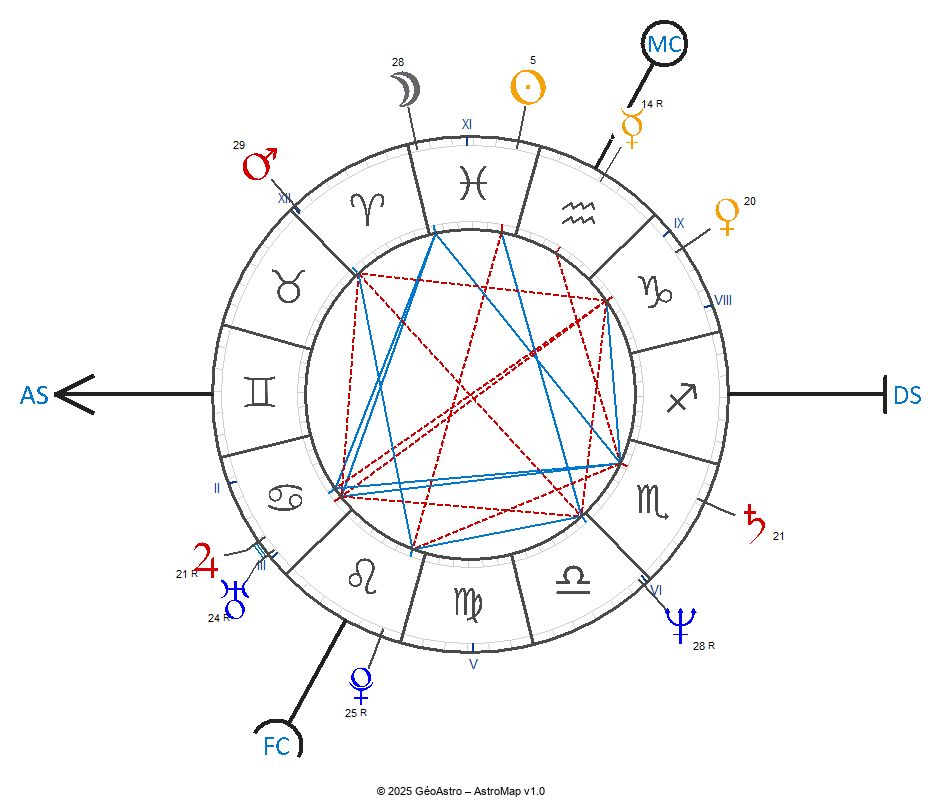
As an example, Alain Prost was born under a Sun-Mercury dominance at the Midheaven, squared by Saturn near the Descendant and opposed by Pluto at the Imum Coeli, all set against a wintery background (Pisces and Aquarius). The dominant planetary families in his chart are “R” (extensive representation) and “t” (intensive transcendence).
This reveals a personality that is both sociable and communicative ("R" of Sun-Mercury), while being driven by a deep skepticism, a tendency to question, and a sharp critical mind ("t" of Mercury, Saturn, and Pluto).
Dominant Planets Among F1 Drivers
The AstroStat Software
The AstroStat software analyzes the astrological data of Formula 1 drivers by evaluating the probability that a random group would yield similar results. To achieve this, it generates 10,000 simulations, randomly redistributing birth dates and times, then compares the observed planetary dominances in the F1 driver group with expected random values to assess the statistical significance of deviations.
Data evaluation is based on the average planetary rankings (from 1 to 10) and planetary family rankings (from 1 to 8). A result with a probability below 5% is considered too improbable to be due to chance, indicating a potential astrological effect.2
Unusual Planetary Emphases
The following graphs display the probabilities of obtaining the planetary and RET planetary family dominances observed among F1 drivers, compared to normal distributions.
Planetary Dominances
This graph shows, on the y-axis, the probability (ranging from 0% to 100%) of obtaining lower planetary rankings through random distributions, and on the x-axis, the planets in the astrological chart, from Moon to Pluto.
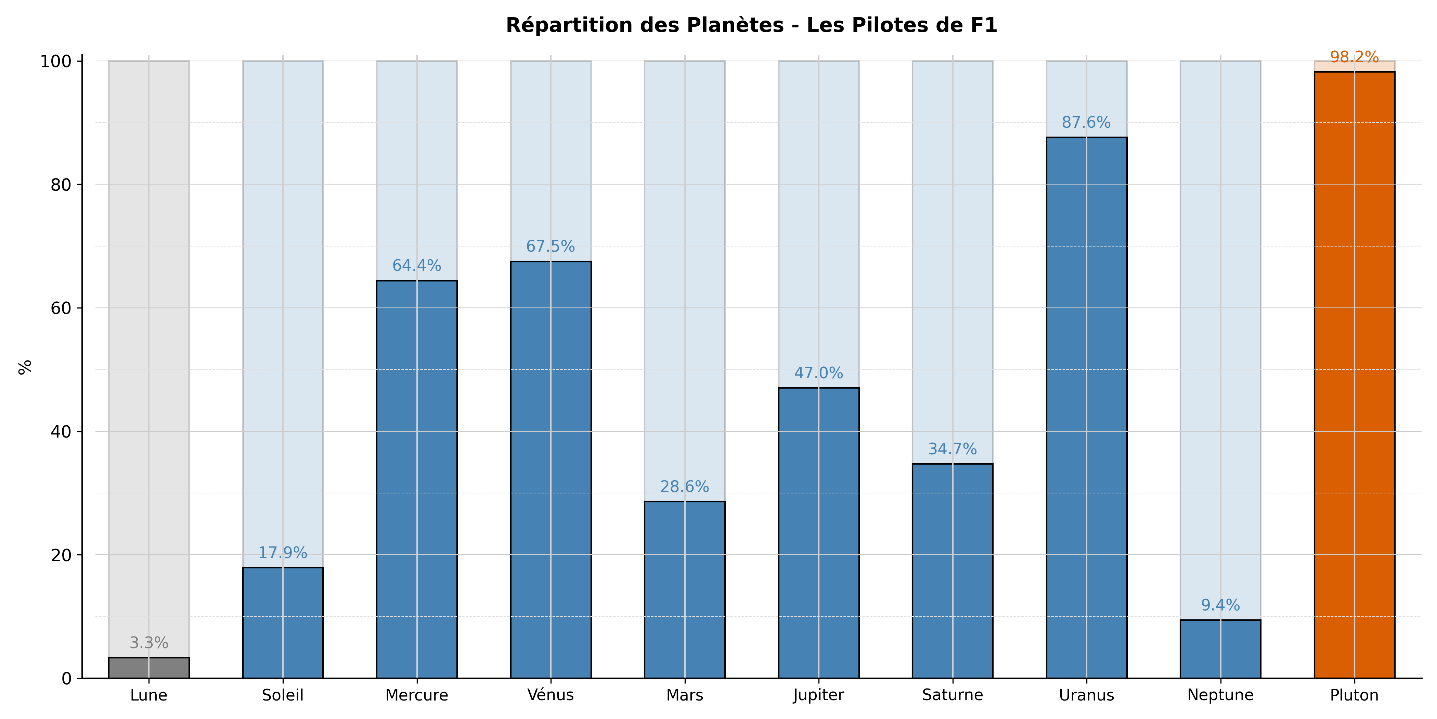
Each bar corresponds to a planet and reflects the probability observed in relation to the random simulations. Values consistent with the laws of chance (between 5% and 95%) appear in blue, underrepresentations in grey, and overrepresentations in orange.
Among F1 drivers, two planets exhibit atypical results:
- The Moon is under-valued: 3.3 out of 100 simulations;
- Pluto is overvalued: 98.2 out of 100 simulations.
Thus, compared to a random sample, there is only about a 3.3% chance of observing reduced emphasis on the Moon and a 98.2% chance of observing a stronger emphasis on Pluto.
RET Planetary Families
The following graph indicates the probability of obtaining statistically lower results for the RET planetary families, using the same method.
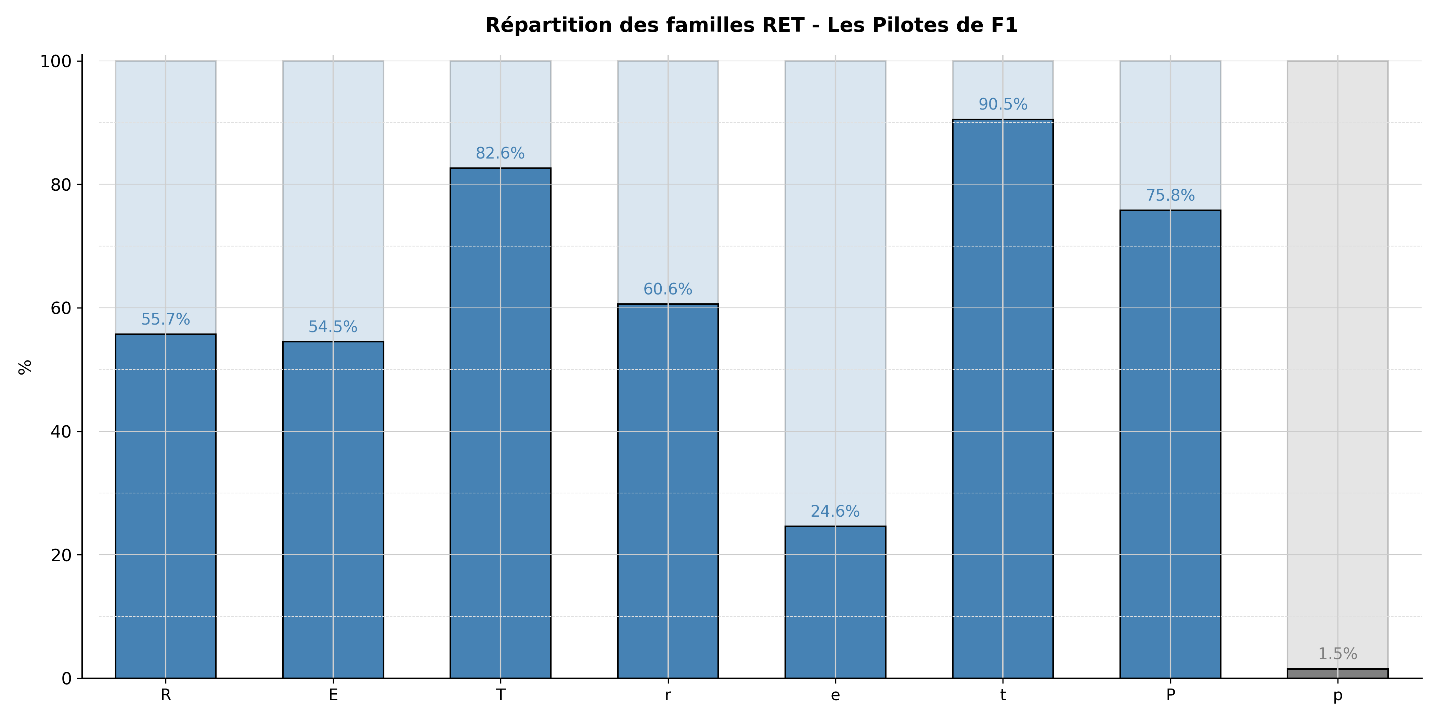
It is interpreted in the same way as the previous graphs, showing the probabilities associated with each RET family, expressed as percentages.
Only one planetary family displays an atypical result:
- The "intensive power" family (p) is under-valued: 1.5 out of 100 simulations.
Compared to a random population sample, there is approximately a 1.5% chance of observing a lower emphasis on the intensive power ("p") family.
Planetary Profiles of Formula 1 Drivers
An Immersive Reality
Pluto is the only planet showing over-valorization among Formula 1 drivers. According to Conditionalist Astrology, Pluto originates from the extensive transcendence source level ("T") and moves toward the intensive transcendence goal level ("t"). This transition represents a shift from multiplicity, unseen and complex realities, toward questioning, hypotheses, and unprecedented perspectives.
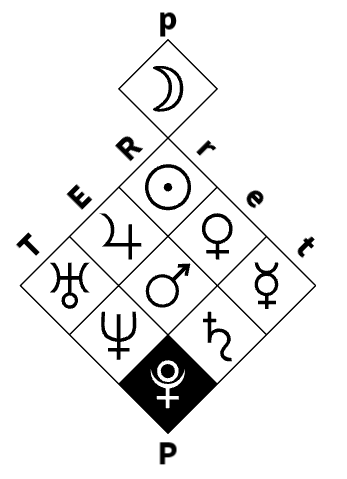
How can we explain the overemphasis on this planet in astrological terms among F1 drivers? In what way does Pluto contribute to reaching the highest level in this elite motorsport discipline?
Consider this brief psychological description of Pluto2: "Maintaining hidden mysteries, an authenticity of being that is inexpressible in words or actions. Seeking absolute objectivity and maximum lucidity. Harboring no illusions or preconceived notions about anything or anyone. Positioning oneself outside of any reference system: choosing one’s own truth, values, and path based on an instinctive self-awareness that is impossible to define, justify, or share. Feeling at home in the unknown, the shadows, the complexities. Withdrawing from the world, retreating into unreachable and inaccessible depths. Being cold, skeptical, marginal, resistant to any form of indoctrination or conventional wisdom."
From the subject's perspective, Pluto sensitizes one to their inner world, the depths of the psyche, and being itself. It fosters a profound capacity for introspection and makes one receptive to the most subtle signals: the labyrinths of inner life, the whispers of the subconscious, the fine perception of environmental details, the intuition of the long term, and the complexities of reality.
A Formula 1 driver controls a high-performance vehicle on a closed circuit, at an average speed exceeding 230 km/h, with peak speeds reaching up to 365 km/h. In their cockpit, they interact within a three-dimensional space at high speed, without fully grasping the reality around them. In this immersive environment, the driver must sustain intense physical effort and withstand exceptional physical demands (centrifugal acceleration), while maintaining absolute focus on their surroundings.
According to an interview with Ayrton Senna3, driving a Formula 1 car also requires considerable psychological effort. The driver must be able to enter their bubble, clear their mind, and shut out any external distractions. They must demonstrate exceptional mental resilience, accurately assess all elements within their conscious awareness, intuitively sense the behavior of other drivers, anticipate all obstacles, and estimate the speed at which they approach a goal.
In this almost-virtual environment where everything happens at accelerated speed, it’s no longer the muscles or the senses that control the action, nor even a rational relationship with their surroundings, but rather intuitive reflexes, a total immersion in a physically sensed reality rather than one perceived. Drivers describe a state in which the subconscious takes over, where only instincts dominate, and where they must respond through instinctive reflexes.
Astrologically, the plutonian function more than any other favors the ability to isolate oneself in their bubble and remain focused on their field of cognitive perception. Overemphasized in F1 drivers, it strengthens their ability to act instinctively and develop intuitive reflexes suited to the demands of the race. The planet fosters this "intrapersonal" intelligence, linked to introspection, the ability to resist pressure, and mentally anticipate all possibilities that may arise.
Finally, according to various studies, top-level drivers are also endowed with a highly developed visual-spatial intelligence, which is a key condition for developing their talent in the sport. This intelligence is defined as the ability to mentally represent space, visualize shapes, project mental images, and recognize structures. People with this intelligence generally have a good visual memory and a keen sense of perspectives and proportions, which recalls the psychological attributes of the transcendence extensive ("T") family to which Pluto belongs.
The Repressed Instinct for Self-Preservation
The Moon and the "intensive power" RET family are under-valued among Formula 1 drivers who have won a Grand Prix in a World Championship. This suggests a consistent weakness of lunar function in this population.
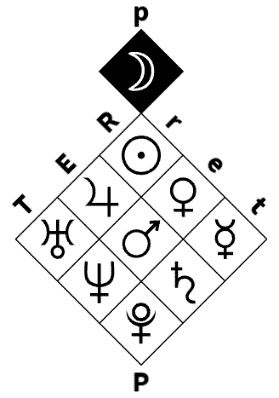
According to Conditionalist Astrology, the Moon stands apart from other planets by forming a planetary family on its own. Unlike other planets, which are grouped into triplets, the Moon functions as a unifying and harmonizing force among the otherwise fragmented planetary influences. It creates a homogeneous whole, acting as an intensive RET function in contrast to the extensive RET nature of other planets.
Psychologically, when the Moon is dominant, it enhances an individual’s sensitivity to well-being, inner peace, and security. It encourages one to seek stability, avoid disruptions, and maintain a sense of equilibrium. Conversely, when the Moon is weak in the planetary hierarchy, as observed in Formula 1 drivers, the individual may struggle to manage mental and physical health, downplaying the risks of overexertion and existential struggles.
This lack of self-preservation instinct can manifest in various ways, including fatigue, anxiety, stress, and health deterioration.
For F1 drivers, the Moon’s weak influence (along with the low prominence of "intensive power") likely reflects a disregard for the inherent dangers of motorsport—a field where driving at extreme speeds is routine. With little inclination toward self-protection, drivers with a weak Moon influence may underestimate the risks associated with their sport, where a single accident can be fatal.
Among the twelve drivers studied, two tragically lost their lives on the track: François Cevert during the United States Grand Prix practice at Watkins Glen in 1973, and Patrick Depailler during private testing at Hockenheim in 1980, after a crash at 280 km/h.
Among the other drivers in our study, Maurice Trintignant was involved in a terrible accident in 1948 during the Swiss Grand Prix; Jean-Pierre Beltoise fell into a coma and suffered a severe injury to his left arm after an accident on a circuit in Reims in 1964; Jean-Pierre Jabouille fractured both of his legs following a suspension failure that sent him into a wall during the Canadian Grand Prix in 1980; Didier Pironi suffered a terrible accident during the German Grand Prix in 1982, which would end his career; Jacques Laffite was seriously injured during the British Grand Prix in 1986.
Marked by a collectively weak lunar influence, Formula 1 drivers appear to reject safety concerns, making them prone to reckless behavior and diminishing their self-preservation instinct. Unaware—or dismissive—of life-threatening situations, they push their cars to the absolute limit, focusing only on race management without always considering the dangers involved.
However, a weak Moon influence or low intensive power in an astrological chart does not necessarily indicate a tendency toward risk-taking behavior. Rather, the nature of Formula 1 as a sport selects individuals who naturally suppress lunar tendencies. To fully embrace their passion, drivers must detach from lunar dispositions, which otherwise encourage setting personal limits, regulating energy, conserving strength, and recovering.
A Dialectic Between extensive and intensive power
The planets forming the "extensive power" family (Sun-Mars-Pluto) and the "intensive power" family (Moon) facilitate different states of concentration on one's environment and field of perception. The planets in these families start from a source level and tend toward an identical goal level: "rR" for the Sun, "eE" for Mars, "tT" for Pluto, and "p" for the Moon, which constitutes a planetary family on its own. They thus maintain maximum concentration on a given level of reality.
At the solar level, the individual is focused on their outward appearance. Concentration is maximized on social interactions and the role they must play within them. From this perspective, what matters is living up to one's persona in all circumstances.
This concept closely relates to Jung’s "Persona," the aspect of personality that structures an individual's relationship with society or the social mask. The negative aspect of this formula leads individuals to identify their ego with their Persona, to mistake themselves for how they are perceived by others, and to lose sight of their true self.
At the Martian level, concentration is maintained on tangible elements of the environment, observable facts, and cause-and-effect phenomena. From this viewpoint, what matters is understanding the realities on the ground in order to adapt to circumstances and act effectively.
At the Plutonian level, concentration is directed toward one's inner being, subconscious labyrinths, and the perception of details or anticipated elements in the environment. What matters at this level is maintaining one's authenticity and staying connected to one's inner world.
This ability to internalize allows Formula 1 drivers to achieve an exceptionally high level of performance in their sport. Racing requires a state of heightened concentration on internal perceptions to instinctively react to all stimuli within the field of vision and to let the subconscious become the dominant control mechanism.
More generally, Pluto enhances vigilance toward the invisible and the implicit. Those who master its influence at a high level are often drawn to domains related to pure transcendence or long-term forces, such as the laws of the species, the workings of destiny, the relationship between ideals and reality4, or deep psychology (Universal Unconscious, Will5, or Will-to-Live). On a more common scale, metaphysical beliefs flourish, including past lives, UFOs, synchronicities, interpretative delusions, moving tables, black cats, and ominous ravens.
At the lunar level, concentration on the environment is undifferentiated. The individual perceives the external world in a holistic and homogeneous way, feeling intimately connected with it in a state of symbiosis. From a lunar perspective, the key is to assimilate the environment as much as to be assimilated by it, allowing oneself to let go, be carried along, and maintain inner balance.
We have explained that the Moon is very weak among Formula 1 drivers because they need to be as little influenced as possible by these dispositions to be effective in high-speed racing. From another perspective, one could also argue that this diffuse concentration on the environment is at odds with the psychological skills required to reach an elite level in motorsport.
Top-level drivers compete in high-speed races that demand a state of extreme concentration on their inner world, with Pluto being dominant. Driving at this level appears incompatible with diffuse concentration and a symbiotic relationship with the surroundings, which are characteristic of lunar influence. What matters for a high-level driver is to precisely assess their visual environment, react with instinctive reflexes, anticipate obstacles, and not merge with their surroundings or passively let themselves be carried along by them.
Going Further
With a small population cohort, as is the case with Formula 1 drivers, it is primarily possible to assess the statistical probabilities of the group's planetary dominants. In such cases, a particular planet may be strongly or weakly emphasized in the collective planetary hierarchy.
Regarding the RET planetary families, it is more challenging to find significant results with such a small cohort. Since planets form families in trios, a larger cohort is preferable to observe any abnormal valorizations. Most often, abnormal RET family emphases generally emerge when two planets of the same family are involved, except for the Moon and "intensive power," which can be valued on their own.
To deepen the analysis, it would be relevant to study the zodiac signs as well as other components of the astrological chart: astrological houses, angular zones in the local sphere, planetary aspects… However, analyzing these elements would require a larger population cohort.
In an individual chart, only two or three zodiac signs out of twelve are generally emphasized. With a cohort of about ten people, it is difficult to obtain a statistically significant distribution for each sign. To analyze zodiac signs properly, a larger cohort would be needed, ensuring that all signs are represented by randomly redistributing the birth dates and times of the individuals studied.
Small cohorts remain relevant for studying astrological planets and are easy to constitute. Certain elite populations, such as Fields Medalists or Formula 1 drivers, consist of only a few individuals, making them suitable for targeted analysis of planetary dominants. Conversely, larger population cohorts allow for a broader analysis of all astrological chart elements and require more extensive studies.
Statistical astrology makes it possible to explore the links between a natal chart and specialized groups, thus offering a better understanding of planetary—and even zodiacal—influences on individual trajectories. Finally, the tools of conditionalist astrology are the most suitable for analyzing the observed statistical results. Thus, our school of astrology ultimately seeks to reclaim (unconditionally!) this entire branch of the discipline, which remains, for now, a vast and uncharted territory.
Methodological note — update
This article was originally based on analyses carried out using the AstroStat software developed by Julien Rouger. Since its publication, we have continued this work within the GeoAstro statistical engine, which follows the same methodological logic while adopting a more synthetic approach.
Minor differences may therefore appear between the results obtained with AstroStat and those generated in GeoAstro, without affecting the main trends discussed in this article.
The charts presented here were generated afterwards using GéoAstro, based on the same cohorts, in order to provide a consistent visual representation of the results.
Appendix: The Formula 1 drivers – Pluto
This appendix presents additional statistical elements concerning the members of the Formula 1 drivers, based on graphical representations not included in the main article. These results aim to broaden the analytical perspective and to support a more nuanced interpretation of the data.
The result presented here corresponds to the most pronounced statistical deviation observed within the group and is provided as an illustrative example of the statistical evaluation method applied to all planets.
Gaussian Distribution Curve
A Gaussian function is an exponential function used to represent the distribution of a dataset based on the density of its values. The following Gaussian curve illustrates the probability of observing, in the general population, a lower valuation of Pluto than the one found among Formula 1 drivers.
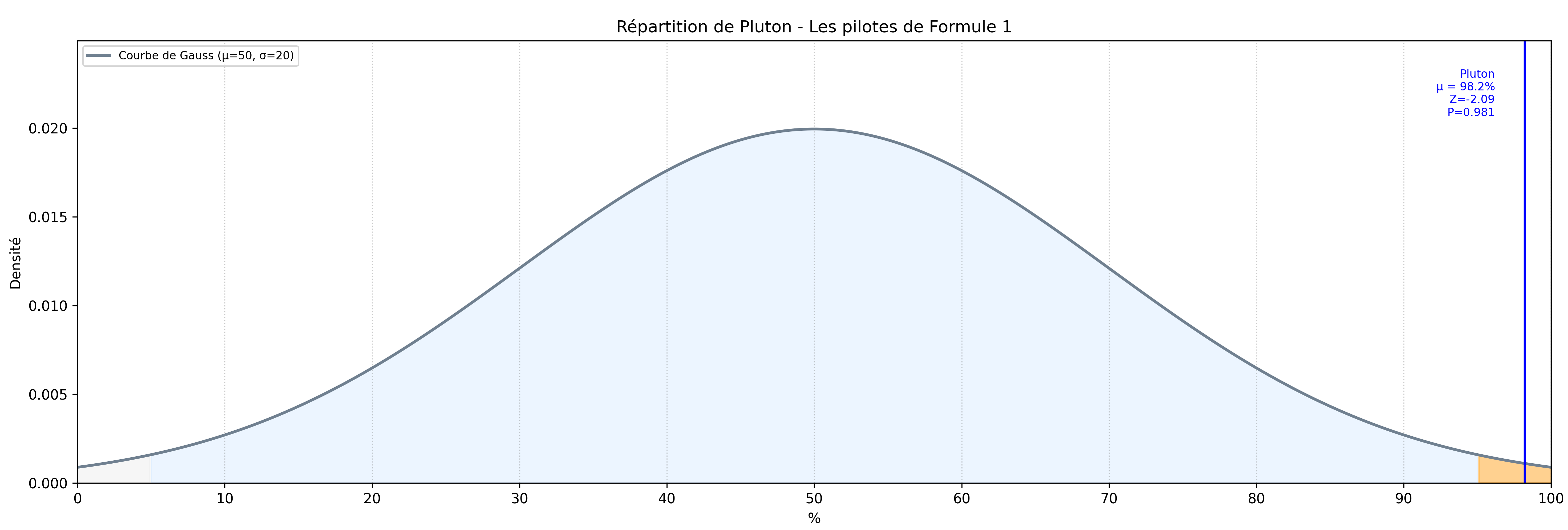
The graph above shows the following results for Pluto:
- Empirical probability: 98.2% of simulations yield a lower score.
- Z-score: –2.09, indicating that the result is statistically significant.
- Theoretical p-value: 0.981, indicating the relative position of the observed result within the theoretical distribution expected under the null hypothesis.
Kernel Density Estimation Curve (KDE)
In statistics, kernel density estimation (KDE) is a non-parametric method used to estimate the probability density function of a random variable based on observed data. The KDE curve is based on hierarchical rank values, as the software computes probability estimates from the empirical distribution of these ranks.
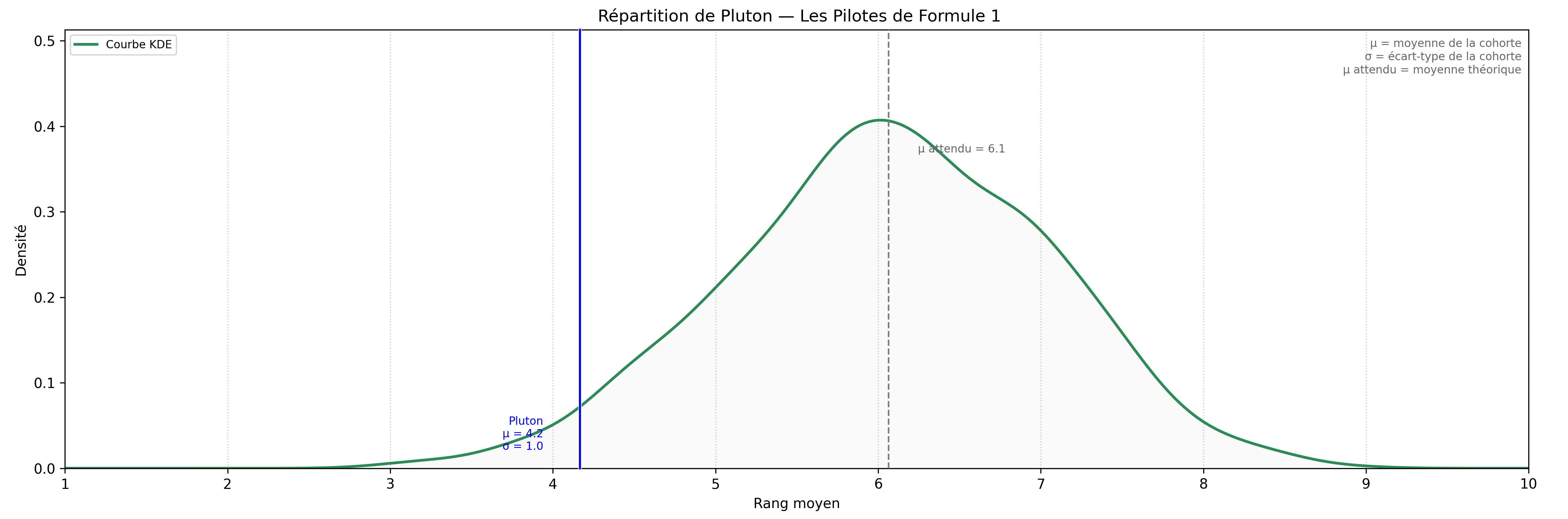
The graph above shows the following results for Pluto:
- Cohort rank: 4.2 on a scale from 1 to 10.
- Cohort standard deviation: 1.0, indicating the dispersion of values around the mean rank.
- Expected rank: 6.1, corresponding to the theoretical average under a null hypothesis.
The Gaussian and KDE curves provide a statistical representation that complements the global histograms, allowing a more detailed examination of the rank distribution for a given element and its relative position within the studied population.
Notes
1The entirety of the angular zones (AS, MC, DS, FC) covers 138°, which represents 38.3% of the zodiacal circle (138/360). This percentage remains indicative, as it does not take into account variations in the rotation speeds of domitude zones or planetary revolution durations.
2Richard Pellard, La fonction plutonienne “tT” (Transcendence of Transcendence), Astroariana.com.
3“Psychologie du Pilote de course”, interview with Ayrton Senna, Nextgen-Auto.com.
4This concerns the question of the existence of a reality independent of human knowledge or perception.
5References to ideas such as the Universal Unconscious and the philosopher Arthur Schopenhauer’s concept of Will — the intimate essence of the world, the “thing-in-itself” behind the multiplicity of phenomena, sometimes interpreted as the Will-to-Live.