Hands of Light
The Great Painters
By Manuel da Costa — GeoAstro
Since the late 18th century, art has been primarily associated with the “fine arts.” Our contemporary society recognizes nine major arts, inspired by the nine muses of Greek mythology: architecture, sculpture, painting, music, poetry, theater, cinema, photography, and comics.
Among these, painting holds a central place, allowing artists to capture the world around them through color, light, and composition. In doing so, they seek to convey their vision of the world, whether real or imagined. From the Renaissance to the modern avant-gardes, artistic movements have followed one another, reflecting the cultural and philosophical evolutions of human societies.
But what if certain astrological factors played a role in the blossoming of talent and artistic inspiration? Are there common astrological configurations among the greatest painters? A statistical analysis of their birth charts might offer some answers to this question.
At the Crossroads of Multiple Influences
It is important to remember that an astrological chart allows us to identify their psychological and behavioral structure but provides much more uncertain information regarding the activities that might interest them or in which they may have particular aptitudes:
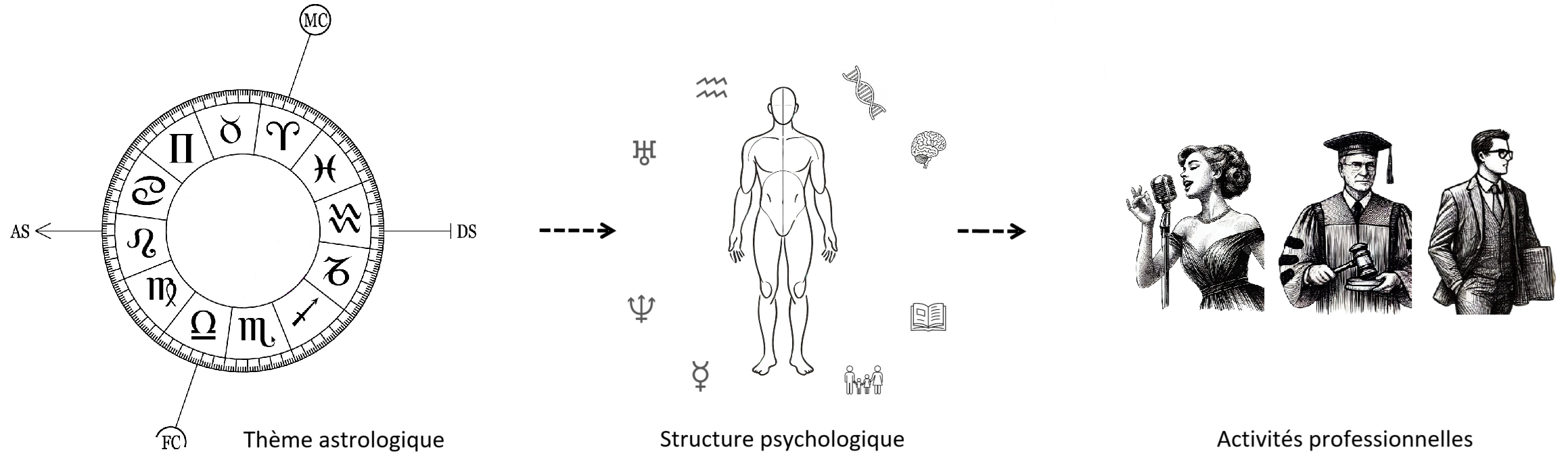
The relationship between an astrological chart and the chosen activity is not linear. The chart influences the individual's personality, but other factors come into play, including biological, sociological, and educational influences. Nevertheless, astrological portraits allow us to highlight the general traits of a personality.
Furthermore, personality does not automatically lead to a specific vocation. Two individuals with similar psychological profiles may follow very different paths, and the same field often brings together personalities with varied aptitudes. That said, certain psychological tendencies may be more common in a specific group than in the general population. This is why our analyses have revealed astrological trends specific to certain professional groups.
The Fingers of Light
Identifying the greatest painters in history involves a subjective dimension. For this study, we have selected artists featured in three major works:
- Chefs-d’œuvre de la peinture, Karen Hosack Janes, Flammarion, 2018
- Le Petit Larousse des Grands Chefs d’Œuvre de la Peinture, Larousse, 2020
- 3 minutes pour comprendre - 50 œuvres marquantes de l’histoire de l’art, Le Courrier du Livre, 2019
The following list includes the 30 painters whose birth date and time are known:
- T.G. Masaccio, born on December 30, 1401, at 08:00 in San Giovanni Valdarno (Italy)
- Léonard De Vinci, born on April 23, 1452, at 21:40 in Vinci (Italy)
- Michel-Ange, born on March 15, 1475, at 01:45 in Caprese Michelangelo (Italy)
- Albrecht Durer, born on May 30, 1471, at 11:00 in Nuremberg (Germany)
- Raphaël, born on April 5, 1483, at 21:30 in Urbino (Italy)
- Joshua Reynolds, born on July 16, 1723, at 09:30 in Plympton (Great Britain)
- Antonio Canova, born on November 1, 1757, at 10:00 in Possagno (Italy)
- Caspar David Friedrich, born on September 5, 1774, at 03:30 in Greifswald (Germany)
- Edouard Manet, born on January 23, 1832, at 19:00 in Paris (France)
- Vincent Van Gogh, born on March 30, 1853, at 11:00 in Zundert (Netherlands)
- Mary Cassatt, born on May 22, 1844, at 23:55 in Pittsburgh (United States)
- Paul Cézanne, born on January 19, 1839, at 01:00 in Aix-en-Provence (France)
- Henri Matisse, born on December 31, 1869, at 20:00 in Le Cateau-Cambrésis (France)
- Umberto Boccioni, born on October 19, 1882, at 15:15 in Reggio di Calabria (Italy)
- René Magritte, born on November 21, 1898, at 07:30 in Lessines (Belgium)
- Piet Mondrian, born on March 7, 1872, at 06:00 in Amersfoort (Netherlands)
- Pablo Picasso, born on October 25, 1881, at 23:15 in Málaga (Spain)
- Frida Kahlo, born on July 6, 1907, at 08:30 in Coyoacán (Mexico)
- Andy Warhol, born on August 6, 1928, at 06:30 in Pittsburgh (United States)
- Gustave Courbet, born on June 10, 1819, at 03:00 in Ornans (France)
- Edgar Degas, born on July 17, 1834, at 20:30 in Paris (France)
- Georges Seurat, born on December 2, 1859, at 01:00 in Paris (France)
- Paul Gauguin, born on June 7, 1848, at 10:00 in Paris (France)
- Ernst Ludwig Kirchner, born on May 6, 1880, at 06:30 in Aschaffenburg (Germany)
- Salvador Dali, born on June 11, 1904, at 08:45 in Figueras (Spain)
- Jean-Baptiste Corot, born on July 16, 1796, at 01:30 in Paris (France)
- Auguste Renoir, born on February 25, 1841, at 06:00 in Limoges (France)
- Franz Marc, born on February 8, 1880, at 10:00 in Munich (Germany)
- Marcel Duchamp, born on July 28, 1887, at 14:00 in Blainville-Crevon (France)
- Fernand Léger, born on February 4, 1881, at 13:00 in Argentan (France)
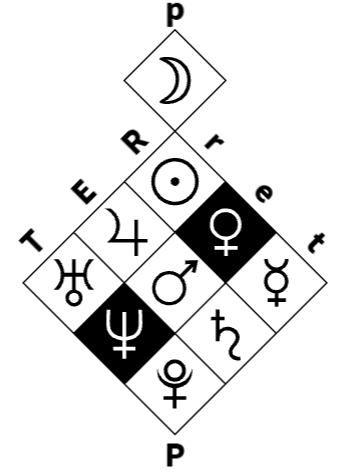
Paul Gauguin was born with the Moon in Virgo, dominant at the Ascendant, forming a square with Venus in Gemini, angular and conjunct to the Sun at the Midheaven. Pluto is near the Midheaven, and Neptune occupies an angular position at the Descendant. This configuration reveals an artist capable of maintaining serenity and coherence (Moon in Virgo), a sensitive individual receptive to emotions and images of the world (Venus conjunct Sun), and an intuitive person sensitive to collective and universal values (Pluto and Neptune).
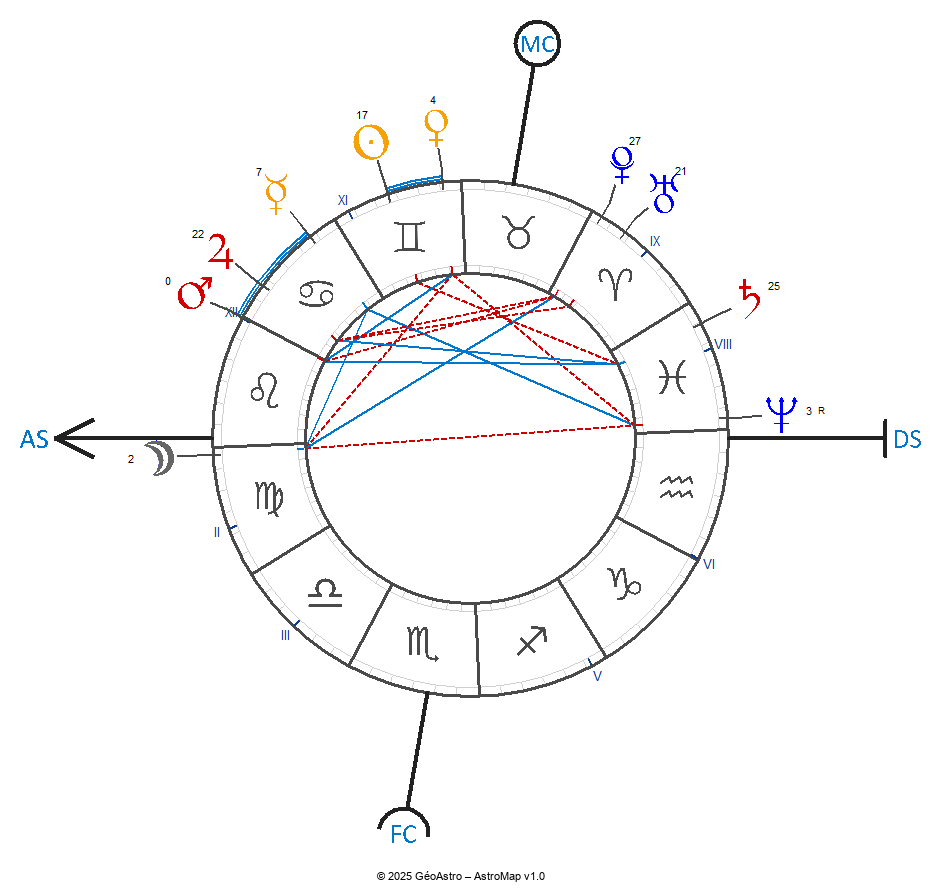
Paul Gauguin was born with the Moon in Virgo, dominant at the Ascendant, forming a square with Venus in Gemini, angular and conjunct to the Sun at the Midheaven. Pluto is near the Midheaven, and Neptune occupies an angular position at the Descendant. This configuration reveals an artist capable of maintaining serenity and coherence (Moon in Virgo), a sensitive individual receptive to emotions and images of the world (Venus conjunct Sun), and an intuitive person sensitive to collective and universal values (Pluto and Neptune).
In Gauguin’s chart, as with many other painters, Venus and Neptune dominate the theme, while Mars and the “E” family are weaker. However, these tendencies are primarily collective: the statistical results observed pertain to the majority of them.
The Dominant Planets of the Great Painters
The following charts show the probabilities that the planetary valuations and the valuations of RET planetary families for the great painters could be due to chance, based on random distributions.1
Planetary Valuations
The chart below indicates, on the vertical axis, the probability (ranging from 0% to 100%) of obtaining lower planetary ranking positions from random distributions. On the horizontal axis, the astrological planets are distributed, from the Moon to Pluto.
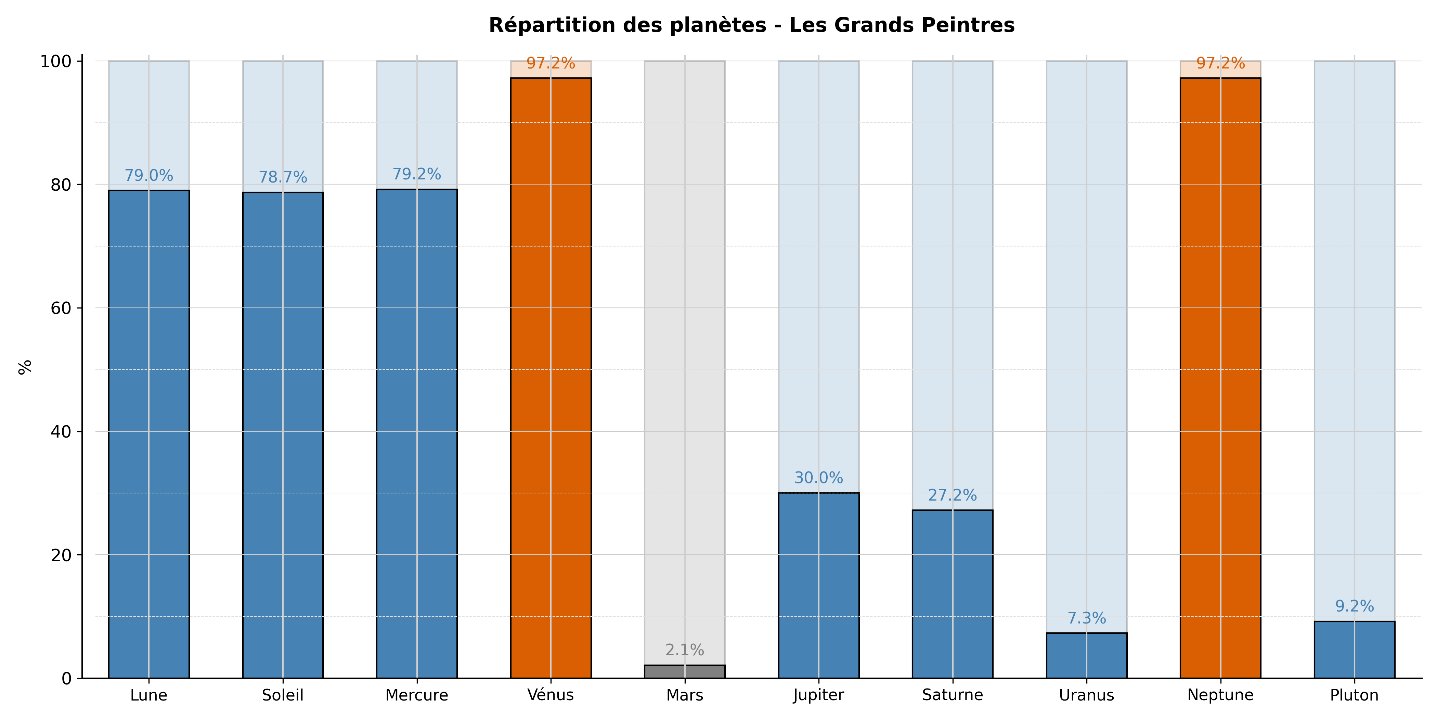
It is evident from this chart that three planets exhibit atypical results:
- Venus is overvalued: 97.2 out of 100 simulations;
- Mars is undervalued: 2.1 out of 100 simulations;
- Neptune is overvalued: 97.2 out of 100 simulations.
Compared to a random sample, there is about a 97 chances out of 100 of obtaining a lower valuation for Venus or Neptune, and about a 2 chances out of 100 for Mars.
Valuations of Planetary Families
The following chart shows the probability of obtaining lower statistical results for the RET planetary families, using the same method.
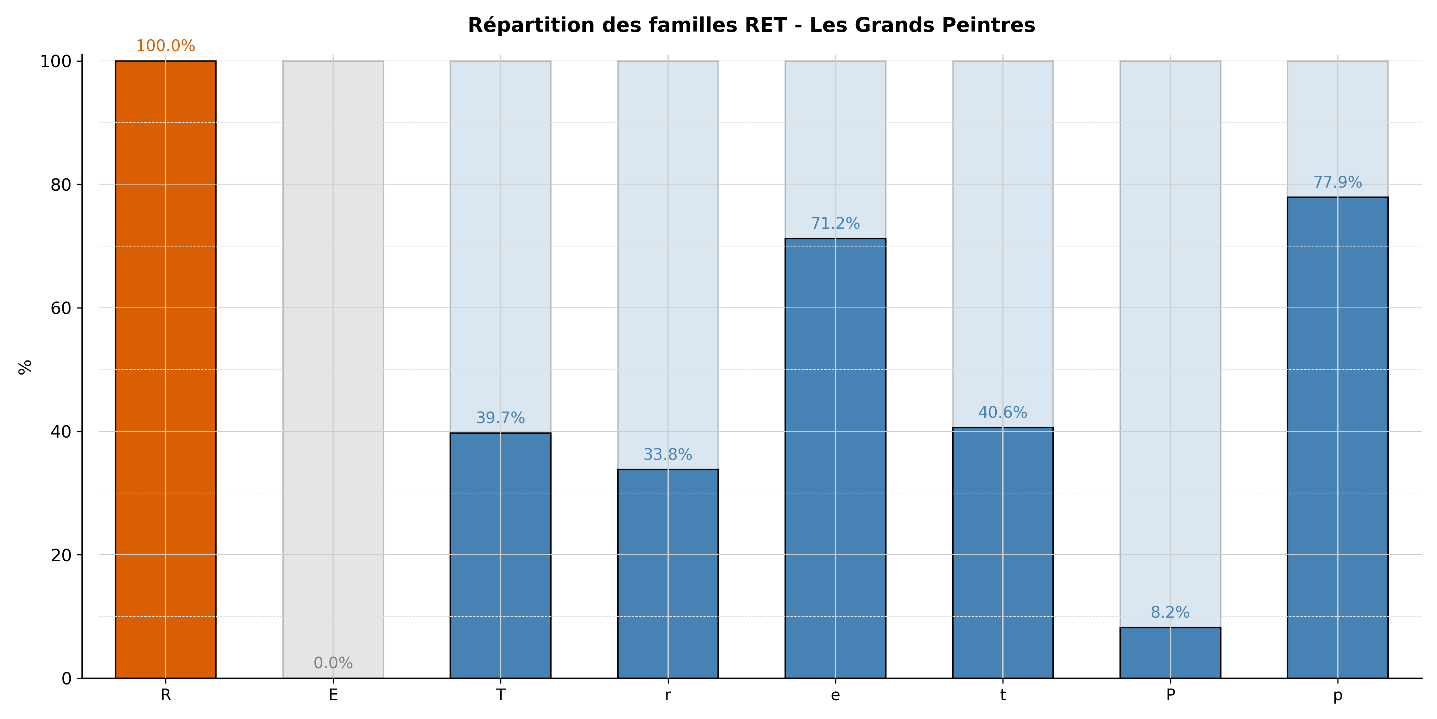
Two planetary families display atypical results:
- The "extensive representation" (R) family is overvalued: 100 out of 100 simulations;
- The "extensive existence" (E) family is undervalued: 0 out of 100 simulations.
Compared to a random sample, there is almost a 100 chances out of 100 of observing a lower valuation for the extensive representation family and no chance of observing a lower valuation for the extensive existence family.
Some of the observed results can be linked: Venus belongs to the extensive representation (R) family, and Mars belongs to the extensive existence (E) family of RET. Therefore, it is essential to prioritize the interpretation of an overvalued Venus "R" and an undervalued Mars "E".
The planetary profiles of great painters
Two astrological planets show a prominent overvaluation in the profiles of great painters: Venus and Neptune. These two planets share the existential level "e," which pertains to the realm of sensations, emotions, and sensory experiences. Venus originates from the "R" level of the visible, known realities, while Neptune comes from the "T" level, dealing with the invisible and underlying truths of existence.
From the appreciation of beauty to the "Platonic idea"
The influence of Venus and Neptune in painters can be understood through their connection to aesthetics and transcendence, a theme that is illustrated in various philosophical concepts of art.
Complementary views
Until the 18th century, aesthetics referred to the "science of beauty." Thinkers like Hume and Diderot saw art as a means of idealizing reality. Art was considered a search for harmony, symmetry, order, and measure. Beauty was viewed as the representation of the soul's experience during an aesthetic encounter.
Philosopher Schopenhauer, directly influenced by Kantian idealism, believed that art provided direct knowledge of "ideas"1. An artwork’s role, then, was to bring us closer to understanding the "ideas" in the Platonic sense—representing the essence of things, their deep symbolic nature.
The painting of a historical event, for example, seeks to capture a fleeting moment to extract a timeless idea, offering not the individual, but the Platonic idea, one that will endure and remain unchanged through time. Similarly, a carefully crafted representation of human nature aims to reveal the essence of its species, guiding our gaze from the individual to the pure form.
By contemplating beauty, we grasp the essential and primordial forms of things, their universal value. Art implies that a unique case applies to a thousand others. For idealists, art is primarily a contemplation of things, transcending mere reason. And the purely objective apprehension of things constitutes the true gift of the artist.2
These two concepts are especially relevant in explaining the astro-statistical results. In this context, art is defined both as an expression of beauty (for the ancients) and as a means to express the essence of things (for the idealists). One perspective would emphasize the "R" level of the RET and is easily linked to Venus' "eR" function. The other would lean more toward the "T" level and is aligned with Neptune's "eT" function.
This overvaluation of Venus suggests that great painters pursue an aesthetic interpretation of life, a place, or an idea. A masterpiece should first captivate the viewer’s eye. The observer should appreciate the aesthetic quality, technical mastery, the use of colors, light intensity, and the depth of the scene. They should feel the impressions ("e") the image ("R") evokes.
The overvaluation of Neptune, on the other hand, highlights the painter’s search for deeper meanings, whether related to a particular era, culture, or event. After appreciating the aesthetic quality of the painting, the viewer should be moved by its underlying significance. It should allow them to grasp the essential, universal form and the historical and collective dimension of the depicted scene.
A prime example
Consider Pierre-Auguste Renoir’s Luncheon of the Boating Party (1881). From the outset, the viewer is struck by the technique, the vibrant colors, the light, and the expressions on the faces. The aesthetic quality is undeniable.
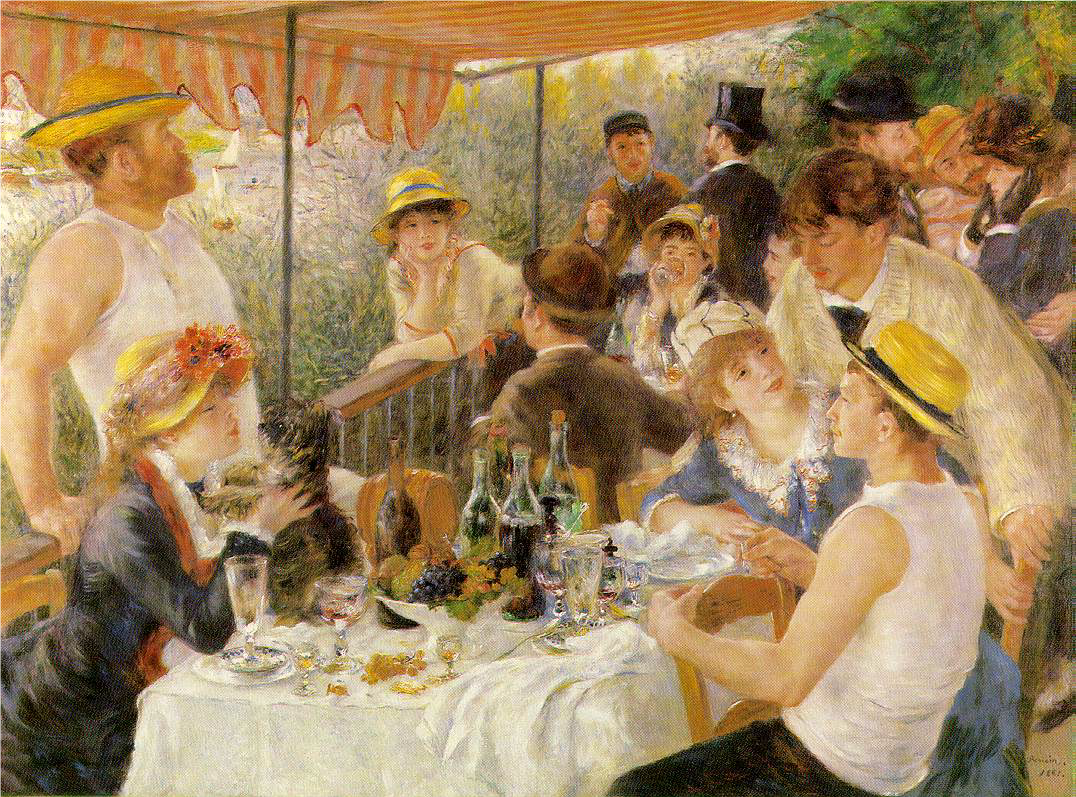
Once this initial reaction settles, the observer should be able to feel what the artist sought to convey through this scene. This painting captures the carefree Sundays spent in waterfront taverns, where boaters and their companions gathered for lunch. Renoir presents a unique scene aimed at revealing the essence of a particular time. The viewer is invited to contemplate the intellectual and cultural climate of an era, finding universal truths in a moment frozen in time.
This example clearly reflects the Venus-Neptune dialectic discussed earlier. First, the aesthetic quality (Venus) of the painting strikes the observer, reminding them of the Impressionist style of the late 19th century. After this initial reaction, the observer is drawn into the "idea" or transcendent dimension (Neptune) of the scene—the leisure activities of the bourgeoisie of the time, immortalized by the work of a master.
In the Objet referential, Venus' function concerns images ("R") that provoke sensation, emotion, and aesthetic experience ("e"). Neptune’s function is concerned with the way subtle and invisible realities ("T") are perceptible through our senses and emotions ("e").
Art and the language of the aesthete
The painting of great painters would thus primarily be governed by a dominant Venus-Neptune, enabling an aesthetic account (Venus) of the essential and primordial forms of things (Neptune). From a complementary point of view, one could imagine that the "artistic object" generally falls under the Neptunian function2. In this regard, it would be interesting to observe the dominant astro-planetary features found in other categories of artists: musicians, lyric artists, poets... while painting in particular would be an expressive medium falling under the Venusian function. Art would thus immortalize the collective values of an era, and painting would become a medium to testify to them through images.
This view is based on the observed astro-statistical results: among great painters, the family of extensive representation, or "R," is overvalued. In contrast, the family of intensive existence, or "e," which includes both Venus and Neptune, shows no overvaluation. One observes a very dominant Neptune on one side, and a very strong "R" Venus on the other. It thus seems coherent to distinguish art as falling under the Neptunian function, and painting as falling more specifically under the Venusian function.
A captivating image
Painting would thus primarily fall under the planet Venus and its "R" attributions of the planetary function. This predominance emphasizes image over perceived emotion. It would be a means of communicating, interpreting, or translating a fact, an idea, a concept, a value, or a sentiment. The extensive representation function, as a function, sensitizes to visible realities, language, and symbols.
Art also idealizes the natural world: imperfections are erased, and beauty is accentuated. Painters combine multiple representations of what they seek to depict, crafting the most beautiful part of each. This process is known as "composition," the assembly of different elements into a cohesive whole.
Painting is often seen as the most expressive of the plastic arts, a non-verbal form of expression that evokes feelings and ideas. It awakens the senses and emotions ("e") and thus serves as a means to explore the world through the lens of intensive existence. Both "R" and "e" functions align with Venus’ role in art.
An image that provokes thought
Art also has a clear connection to Neptune’s function: it expresses, through a material medium ("e"), reflections on an era, the emergence of new times, and the collective values of a society ("T"). An artwork is the expression of ideas and values, societal changes, and ideological currents. Great works of art often precede and shape intellectual movements of their time.
Artists like Salvador Dalí and René Magritte, in the second half of the 19th century, painted symbolic and dreamlike representations that anticipated the rise of psychoanalysis and concepts such as the unconscious and archetypes. Early 20th-century movements like Cubism and Abstract Art, with Picasso and Braque, analyzed and deconstructed objects, laying the groundwork for movements such as geometric abstraction and futurism. Some even suggest that the greatest artists foresee in their works the discoveries of intellectuals, psychologists, and moralists.
These major artistic movements can be found in all major forms of artistic expression: painting, sculpture, music, architecture, and theater. Many of history's great works have entered collective memory. In the social sciences, art is considered part of a culture’s material culture—a living testimony ("e") to the past ("T"), or the way collective values are manifested in a society.
Psychology of the artist-painter
How do Venus and Neptune influence the personality of painters? In the Subject referential, the Venusian is described as voluptuous, sensual, seeking pleasure and emotional connections, with relationships governed by instincts of sympathy and antipathy. The Neptunian, on the other hand, is intuitive, driven by deep aspirations, guided by inspiration and intuition.
Does this resonate with the psychological analysis of painters? Essayist Lucien Arréat explored this in his work Psychologie du peintre3. He paints a broad picture of artists, examining their behavior, intelligence, vocation, and sensory-motor perceptions.
Exaggerated sensations
Arréat emphasizes the aesthetic nature of the painter's psychology. The artist is highly sensitive to visual stimuli, reacting strongly to light, color, movement, form, and tonal harmony. This heightened sensory awareness and emotional sensitivity fuel creativity and shape the artist’s relationship with form and color.
The painter’s ability to admire is an active and aesthetic form of curiosity. Admiring—characteristic of the "R" level in conditional astrology—means creating beauty in things. The artist creates because they admire and are moved ("e") by the world. Images ("R") have a sensory impact ("e") on the painter. They maintain a unique relationship with the world, experiencing objects and space both physically and visually.
The description of the painter's aesthetic character, central to their psychology, aligns with the attributions of the Venusian function "eT": painting manifests a return to sensory and emotional experience, expressing the potentialities inherent to Venus.
An Overflow of Imagination
The author also emphasizes the imaginative nature of great painters. They do not merely copy what they see with precision, but rather aim to translate a world they intuitively perceive. Objects are “not depicted for their own sake, but to contain, beneath a natural appearance, the echoes they have stirred within the artist’s mind.” The painter transfigures reality in order to extract the beauty that lies within art.
While great painters possess a particularly refined aesthetic eye, they also stand out through their ability to contemplate the world, to commune with nature, and through their tendency to dramatize and amplify their emotions. This sensitivity allows them to capture collective trends and the unspoken undercurrents of their time. Their vivid awareness of the present enables them to immortalize a scene that encapsulates the essence of an era, a culture, or a society.
These abilities perfectly reflect Neptunian values: great painters intuitively perceive ("e") the spirit of their time and what lies beyond the visible ("T"). The Neptunian type—often described as inspired, even visionary—is deeply connected to their inner aspirations and the manifestations of their unconscious. They instinctively seek out activities that allow them to express their talents, creative originality, and to convey a meaningful message.
Although intensive existence does not stand out statistically, Venus and Neptune both belong to the same planetary family. Numerous studies4 show that the activity of great painters is rooted in the world of feeling, emotion, and lived experience.
Their inner world is marked by sorrow, anxiety, and destabilizing intuitions... Intense emotions—whether positive or negative (joy or sadness)—stimulate creativity far more than emotionally neutral states. Artistic creation thus becomes a way to regulate these emotions and restore balance.
Homeostasis refers to the process by which the body maintains its biochemical equilibrium, including emotional regulation. For instance, hunger drives us to seek food in order to reestablish balance. In the same way, artistic creation helps to soothe intense emotions.
Existentialism in the Blind Spot
Our statistical findings also reveal a consistent underemphasis of the planet Mars. Among great painters, all three planets associated with intensive existence show atypical valorizations: Venus and Neptune are overemphasized, while Mars is underemphasized.
In the RET system, Mars moves from the level of extensive existence ("E")—associated with raw facts—toward the level of intensive existence ("e"), related to felt experience and inner states. Additionally, the extensive existence family ("E"), linked to realism and a concrete sense of the world, also appears underrepresented in our data.
The Martian "E" type is described as a realist who acknowledges only what he has personally experienced as true. He seeks to confront factual reality in order to act in a practical and effective way. This archetype is associated with constructive thinking, organizational abilities, and a strong will to build tangible results.
So why are the Martian function and extensive existence underemphasized among great painters? Could it be that their artistic discipline demands a metaphysical and aesthetic perspective, rather than a mere engagement with reality?
As many writings suggest, great painters do not merely replicate what they see. The nature that serves as their model is often not the one we perceive. On the Venusian and “R” levels, they tend to recombine the most beautiful elements of every scene they observe, creating an exalted version of reality. On the Neptunian level, they have a propensity to perceive and illuminate the unspoken, the implicit values hidden behind surface appearances.
Rather than pursuing strict realism, these artists favor an aesthetic and metaphysical approach. Confronted with a world they refuse to merely imitate, they seek to perceive it differently—highlighting dimensions of reality governed by Venus and Neptune.
If painters were limited to a simple face-to-face encounter with reality (Mars), their role would be to inspect, observe, and understand the mechanics of phenomena. However, the painter engages in a subtle, interpretive dialogue with their work. In the silent contact with nature, there is no mere confrontation, but rather a longing for what lies within the visible (Neptune) and an urge to recreate a “super-visible” reality (Venus).
For the painter, the tangible world remains an enigma (a blind Mars): to exist is not enough to master it. Painting thus becomes a unique language, rich with symbolic depth. The artwork aims to usher us into a world that is not exactly our own (weakened Mars), but that—through aesthetic interpretation (Venus)—reveals previously hidden aspects of the world we inhabit (Neptune). Great works of art do not simply imitate reality; they invite us to discover a world magnified, transfigured through the artist’s gaze.
On a psychological level, this blind Martian “E” may be connected to the existential fragility often linked to painters, and with artists more broadly. According to many scholars, the artist’s muse—the creative impulse that guides them—draws its strength from personal suffering and hardship.
The greatest painters may need to repress the impulse to build solid foundations and ground themselves in reality, as would be typical of a dominant Martian “E,” in order to fully unleash their creativity. Loosely connected to the practical side of life, they may unconsciously maintain themselves in a state of existential fragility—an instability that, by intensifying their inner turmoil, nourishes their creative force.
About the Artist’s Muse
Painting is stronger than I am. It forces me to do what it wants. — Pablo Picasso
The artist follows an inner call and expresses symbols bearing hidden meanings. According to the psychoanalyst Jung5, the artist's muse is a personification of the Anima, a projection of his unconscious femininity. It would connect the artist's conscious mind to the deep sources of his unconscious, rich with symbols.
From this psychoanalytic perspective, the artist does not create out of his own impulse but acts as a medium for an archetypal creative force. The archetypes would use the artist to express the necessary changes in attitude to counterbalance the one-sided options of human society.
The authentic artist expands collective consciousness by revealing new spiritual and ideological perspectives. Just as in the individual, the one-sidedness of conscious attitude is corrected by unconscious reactions, such as dreams, art represents, in the life of nations and eras, a process of spiritual self-regulation.
Each era, like the human soul, has a particular conscious situation and calls for compensation. The collective unconscious can provide this compensation through an artist or visionary who brings what the era deeply needs.
The orientations of art thus bring what is most necessary to the atmosphere of an era, compensating for the imperfection and partiality of the spirit of its time. Great works of art are a manifestation of the collective unconscious and hold prophetic significance. The true artist expresses the unconscious and active soul of their time.
The importance of art's role as a factor in the development of human consciousness is undeniable. Artistic activity is linked to the emergence and expansion of human consciousness. Art continually contributes to the education of the spirit of its time by bringing forth the forms that are most lacking.
What psychological traits predispose an individual to be chosen to artistically express the essential elements for the evolution of collective consciousness? The hypothesis is made that archetypes choose certain individuals to express their symbolic contents.
The authentic artist is one who powerfully feels (“e”) the great forces within and responds to their demands (“T”). They feel inhabited by an inner call ("T") that dictates the task to be accomplished ("e"). The call of the muse would be "a force of nature pursuing its ends," as C.G. Jung puts it, which is reminiscent of the attributions of the Neptunian function "eT" in conditional astrology.
Methodological note — update
This article was originally based on analyses carried out using the AstroStat software developed by Julien Rouger. Since its publication, we have continued this work within the GeoAstro statistical engine, which follows the same methodological logic while adopting a more synthetic approach.
Minor differences may therefore appear between the results obtained with AstroStat and those generated in GeoAstro, without affecting the main trends discussed in this article.
The charts presented here were generated afterwards using GeoAstro, based on the same cohorts, in order to provide a consistent visual representation of the results.
Appendix: The great painters – Venus
This appendix presents additional statistical elements concerning the members of the great painters, based on graphical representations not included in the main article. These results aim to broaden the analytical perspective and to support a more nuanced interpretation of the data.
The result presented here corresponds to the most pronounced statistical deviation observed within the group and is provided as an illustrative example of the statistical evaluation method applied to all planets.
Gaussian Distribution Curve
A Gaussian function is an exponential function used to represent the distribution of a dataset based on the density of its values. The following Gaussian curve illustrates the probability of observing, in the general population, a lower valuation of Venus than the one found among great painters.
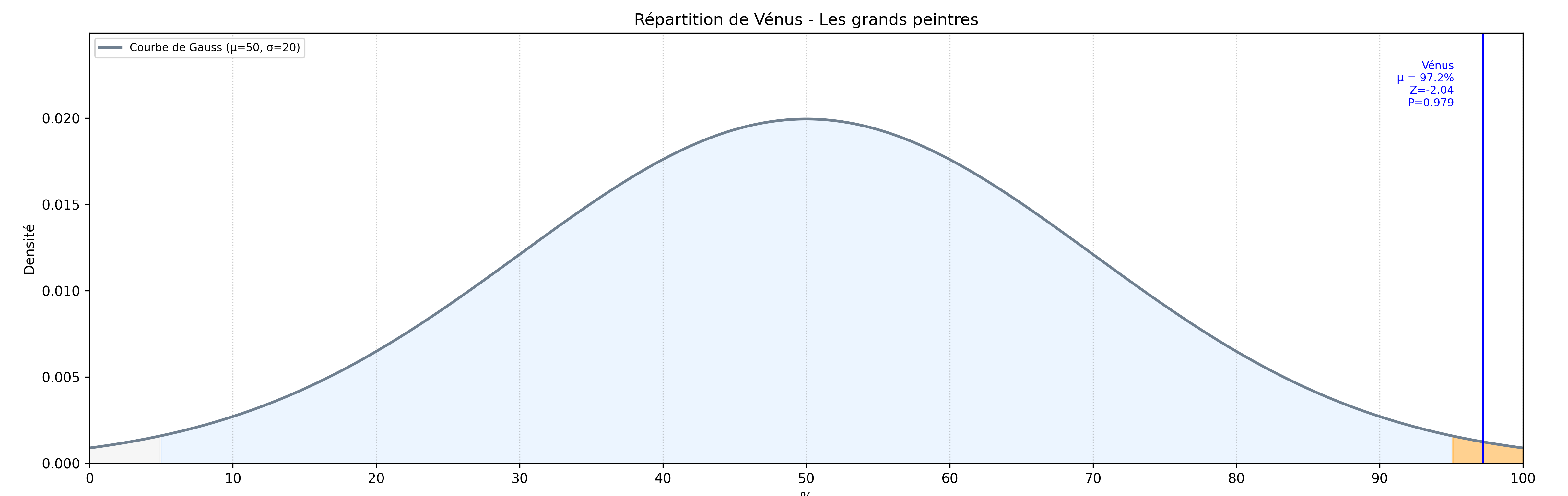
The graph above shows the following results for Venus:
- Empirical probability: 97.2% of simulations yield a lower score.
- Z-score: –2.04, indicating that the result is statistically significant.
- Theoretical p-value: 0.979, indicating the relative position of the observed result within the theoretical distribution expected under the null hypothesis.
Kernel Density Estimation Curve (KDE)
In statistics, kernel density estimation (KDE) is a non-parametric method used to estimate the probability density function of a random variable based on observed data. The KDE curve is based on hierarchical rank values, as the software computes probability estimates from the empirical distribution of these ranks.
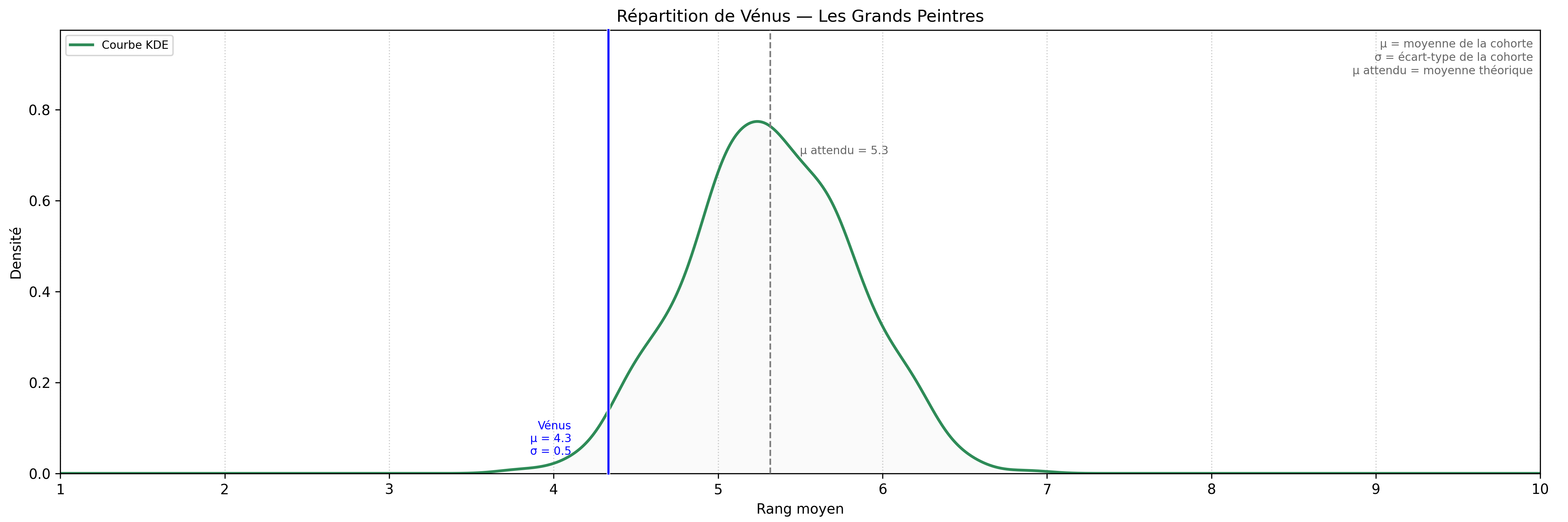
The graph above shows the following results for Venus:
- Cohort rank: 4.3 on a scale from 1 to 10.
- Cohort standard deviation: 0.5, indicating the dispersion of values around the mean rank.
- Expected rank: 5.3, corresponding to the theoretical average under a null hypothesis.
The Gaussian and KDE curves provide a statistical representation that complements the global histograms, allowing a more detailed examination of the rank distribution for a given element and its relative position within the studied population.
Notes
1Arthur Schopenhauer, Parerga & Paralipomena, “Dissertation on the Metaphysics of Art and Aesthetics.”
2Hypothesis referring to the Neptunian dimension of the artistic object and its possible expression across other artistic fields such as music, poetry, or lyric arts.
3Lucien Arréat, Psychologie du peintre, Félix Alcan Éditeur.
4Marion Botella, “Le créateur face à ses émotions”, Cerveau & Psycho, May 2015.
5C. G. Jung, Problems of the Modern Soul, Part 4: “Poetry and Art.”