
The Fields Medalists
An Elite of Mathematics
By Manuel da Costa — GeoAstro
The Fields Medal is a prestigious award given for outstanding work in mathematics, often compared to the Nobel Prize. It is awarded every four years at the International Congress of Mathematicians to a maximum of four mathematicians under the age of 40, in recognition of their contributions.
Fourteen Fields Medalists are French, placing France second only to the United States, which has fifteen. “Cocorico!” — the iconic French rooster cry — as the French proudly say.
Do the greatest mathematicians share common astrological traits? Can astrology reveal specific aptitudes for mathematics? This statistical study aims to answer these questions by analyzing the astrological charts of Fields Medal winners.
The Statistical Tool in Astrology
The statistical tool is a study instrument that, in astrology, helps determine whether there is any correlation between the astrological chart and the activity practiced. However, it is important to clarify that the astrological chart only provides information about the psychological and behavioral structure of the subject, and does not reveal a vocation.
This point is crucial: it is not a matter of directly linking the astrological chart to the activities undertaken. The study of the astrological chart merely helps determine individual behavioral aptitudes. From these broad outlines, we then focus on the activity performed.
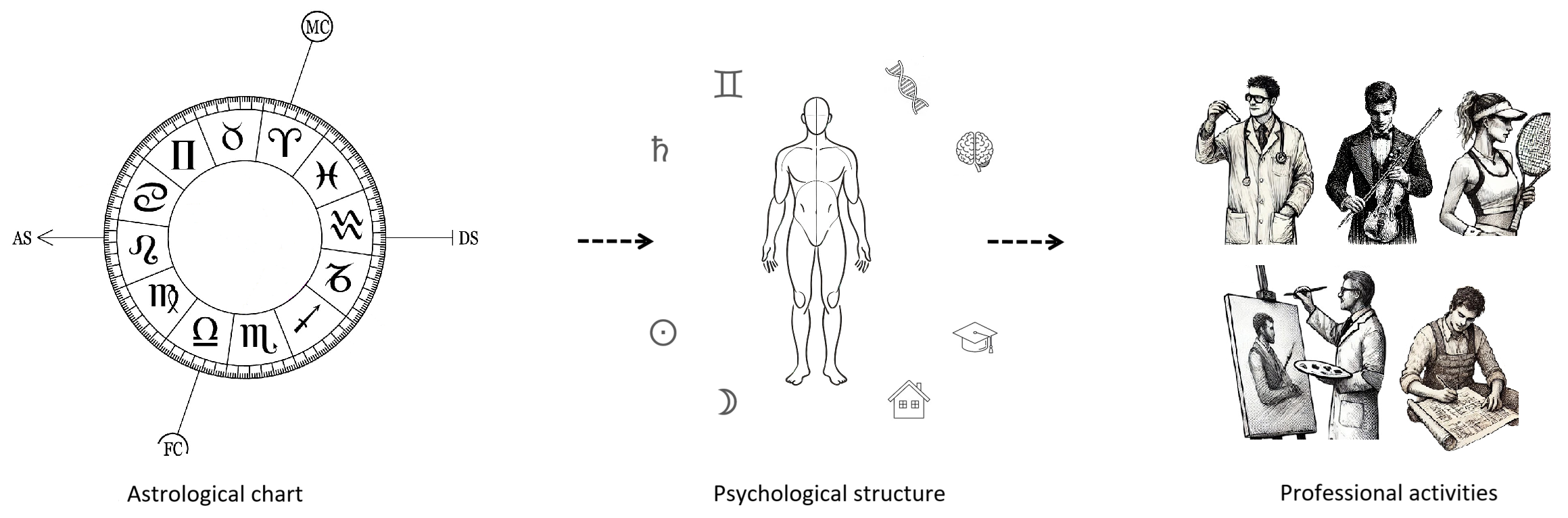
As shown in the diagram above (first link), the astrological chart determines the psychological structure of the subject observed. This first link is already conditional. Astrological influence works alongside other factors, including biological, sociocultural, educational, and environmental influences. Each of us is shaped by a multitude of influences, which we in turn express in unique ways. However, while astrological influence is conditional, it is possible to create “typical” astrological profiles that we can recognize ourselves in.
Next (second link), we look at the influence of the subject's psychological structure on the activities they engage in. This second link is complex to establish. The correlations between psychological structure and preferred activity are not immediately obvious and may have multiple origins. The simplest observation shows that within any socioprofessional group, one may encounter people who are psychologically very different from one another.
So how does the statistical tool in astrology work? For an astro-statistical study to yield meaningful results, certain behavioral or cognitive aptitudes (associated with a planetary or zodiacal function) must be overrepresented or, conversely, underrepresented in the activity being studied. While the same profession or activity may often include very diverse profiles, certain aptitudes may still appear more or less frequently than in the general population.
In other words, for an astro-statistical study to present significant results, there must be clearly marked correlations—or conversely a clear lack of correlations—between a personality type and the activity under examination.
Finally, what is the value of the statistical tool in astrology? Astro-statistical studies seek to determine whether astrological influence can be observed in a population group. If we identify a significant correlation between psychological structure and the dominants (or non-dominants) of the astrological chart, we can conclude that astrology influences psychology and human behavior. If no significant result emerges, it simply means that no psychological profile is overrepresented in the population group—not that astrological influence is ineffective.
An Elite of Mathematics
To conduct a statistical study in astrology with rigor, it is necessary to establish a population cohort by selecting the most gifted individuals in a given activity. Obviously, the more elitist the population cohort, the more likely we are to observe significant astro-statistical results. With individuals of average ability, we can reasonably expect similar results—though likely less pronounced—or none at all.
Here, the individuals selected for this study have won the Fields Medal. The advantage? Their mathematical excellence is unquestionable. The drawback? This selection criterion results in a very small sample size.
The French Fields Medalists1 are as follows, according to the year of award:
- 1950 : Laurent Schwartz, born on March 5, 1915 at 14:00 in Paris
- 1954 : Jean-Pierre Serre, born on September 15, 1926 at 00:15 in Bages
- 1958 : René Thom, born on September 2, 1923 at 00:10 in Montbéliard
- 1966 : Alexandre Grothendieck, born on March 28, 1928 at 00:45 in Berlin (Germany)
- 1982 : Alain Connes, born on April 1, 1947 at 10:00 in Draguignan
- 1994 : Pierre-Louis Lions, born on August 11, 1956 at 18:00 in Grasse
- and Jean-Christophe Yoccoz, born on May 29, 1957 at 11:10 in Paris
- 1998 : Maxim Kontsevich, born on August 25, 1964 in Khimki (Russia), time unknown
- 2002 : Laurent Lafforgue, born on November 6, 1966 at 10:30 in Antony
- 2006 : Wendelin Werner, born on September 23, 1968 in Cologne (Germany), time unknown
- 2010 : Cédric Villani, born on October 5, 1973 at 19:25 in Brive-la-Gaillarde
- and Ngô Bào Châu, born on June 28, 1972 in Hanoi (Vietnam), time unknown
- 2014 : Artur Avila, born on June 29, 1979 in Rio de Janeiro (Brazil), time unknown
- 2022 : Hugo Duminil-Copin, born on August 26, 1985 at 16:00 in Châtenay-Malabry
Among the 14 French Fields Medalists, birth times are known for only 10 of them. To complete the population cohort, we can include the two Fields Medalists of Belgian nationality whose full birth data is known:
- 1978 : Pierre Deligne, born on October 3, 1944 at 07:15 in Brussels (Belgium)
- 1994 : Jean Bourgain, born on February 28, 1954 at 13:40 in Oostende (Belgium)
To conduct a comprehensive astro-statistical investigation, it is preferable for the population cohort to be large enough to obtain significant results. Given the limited birth data available, the study will focus on whether statistically significant patterns can be observed among planetary dominants. An analysis of zodiac signs would require a larger cohort, as an individual chart usually highlights only two or three signs out of twelve.
This astro-statistical study of Fields Medalists will therefore focus only on planetary dominants, with the laureates whose charts are known totaling twelve1.
The Dominant Planets of Fields Medalists
The AstroStat Software
To analyze the astrological data extracted from the Fields Medalist group, the AstroStat2 software evaluates the probability that a randomly selected population sample could yield identical results.
The software first generates a comparison sample by randomly combining the birth dates and times of the medalists. By generating 10,000 comparison samples, the software allows the calculation of normal distribution probabilities for each planet using the same birth dates.
The evaluation criterion used by the software is the average rank in the planetary hierarchy (from 1 to 10 for 10 planets) and in the RET planetary families (from 1 to 8 for 8 planetary families).
Next, the software calculates the probabilities of obtaining the observed average hierarchical ranks of planets and RET planetary families for the Fields Medalist group, comparing them to the average ranks obtained from random distributions. In other words, the software estimates how likely it is that the results observed in the study group occurred by chance.
Regarding the interpretation of the obtained probabilities, it is generally considered in statistics that a result is mathematically improbable if it falls below the 5% probability threshold: results below this threshold are considered too unlikely to be due to chance.
Abnormal Planetary Valuations
The following charts show the probabilities of obtaining the planetary valuations and RET planetary family valuations of the Fields Medalists based on normal distributions.
The Dominant Planets
The chart below shows, on the vertical axis, the probability (from 0% to 100%) of obtaining lower planetary hierarchical ranks through random distributions. On the horizontal axis, the planets of the astrological chart are listed, from the Moon to Pluto.
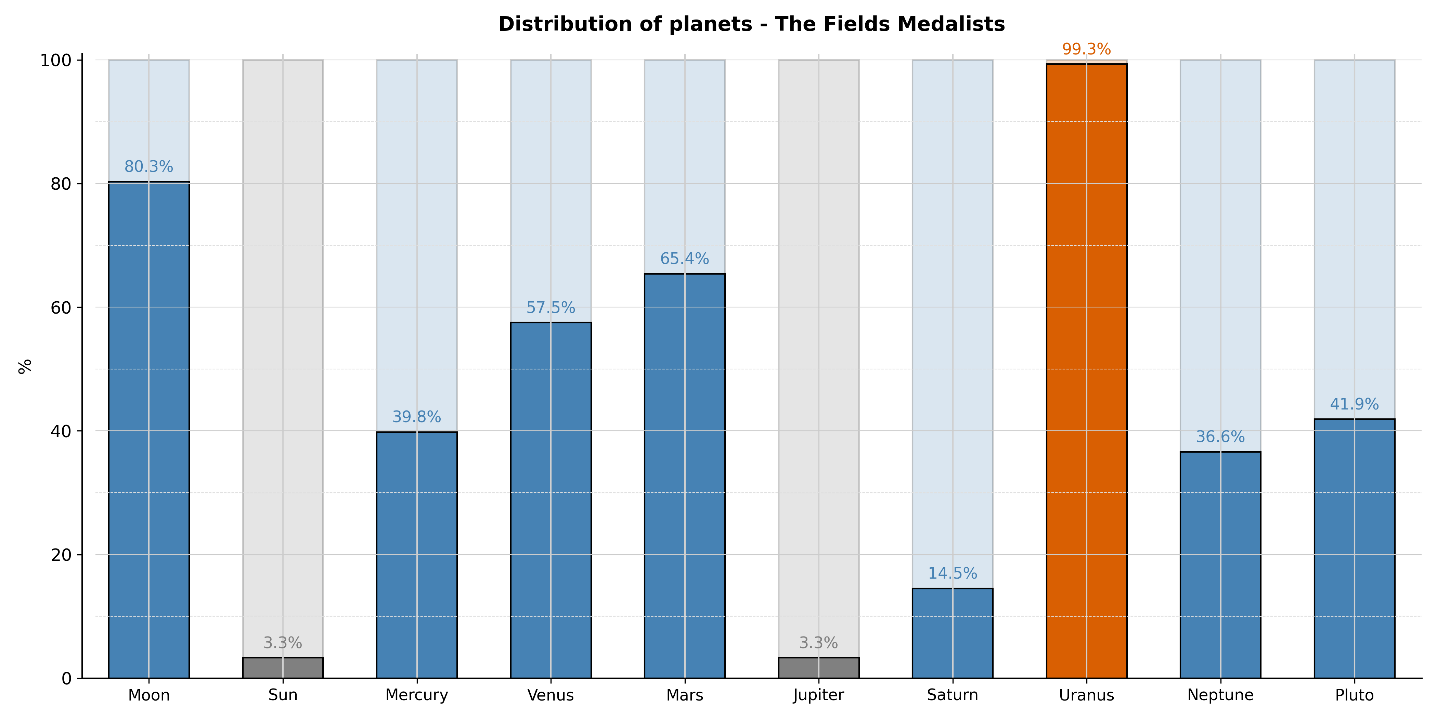
Values between 5% and 95% are shown in blue and correspond to probabilities expected under random distribution. In contrast, probabilities below 5% or above 95% are highlighted using a specific color code: grey for underrepresentations, and orange for overrepresentations. These findings suggest a notable astrological effect in the cohort analyzed.
For example, a probability of 80.3% for the Moon indicates that in nearly 80% of the random simulations, the Moon is less prominent than it is among Fields medalists.
Three planets among the Fields Medalists show atypical results:
- The Sun is undervalued: 3.3 out of 100 simulations;
- Jupiter is undervalued: 3.3 out of 100 simulations;
- Uranus is overvalued: 99.3 out of 100 simulations.
Compared to a random population sample, the likelihood of a lower emphasis on the Sun and Jupiter is about 3 in 100, while it exceeds 99 in 100 for Uranus.
The RET Planetary Families
The following chart illustrates the probability of obtaining statistical results lower than those of the Fields Medalists for the RET planetary families, using the same method.
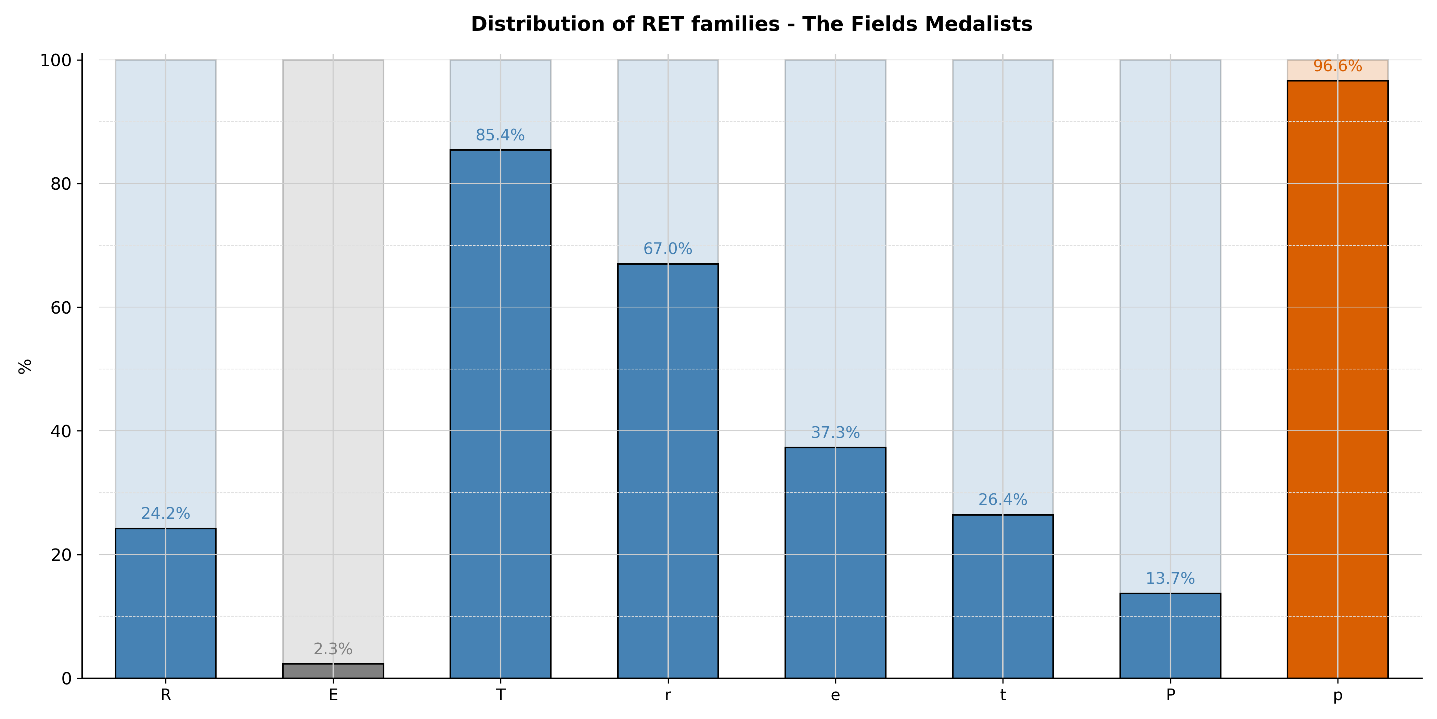
Each bar represents the probability that a random distribution would assign a lower value to the corresponding family than that observed among Fields medalists. For instance, for the “p” family (intensive power), this probability is approximately 96.6%, suggesting a marked astrological effect within this population.
Two planetary families show atypical results:
- The “intensive power” family (p) is overvalued: 96.6 out of 100 simulations;
- The “extensive existence” family (E) is undervalued: 2.3 out of 100 simulations.
Thus, compared to a random sample, there is about a 97% chance of observing a lower valuation for the “intensive power” family, while there is about a 2% chance of observing a lower valuation for the “extensive existence” family.
The Planetary Profiles of the Fields Medalists
Uranus, the Promethean
Uranus is the only planet to show overvaluation among Fields Medalists. According to conditionalist astrology, Uranus starts from the level of extensive transcendence ("T") and moves toward the level of intensive representation ("r"). Thus, it moves from the multiple to the unique, from the plural to the singular. The Uranian is therefore described as a resolute voluntarist, with a cold personality and a conceptual, cerebral nature. It is also associated with qualities such as originality, individualism, emancipation, and universality.
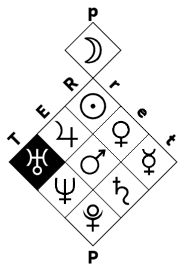
A brief excerpt from Le Grand livre de l’astrologue describes Uranus3: “This planet governs the transformation of the plural into the singular. Such a function gathers scattered forces into a single, omnipotent one. It mobilizes, concentrates, focuses, and polarizes. Similarly, the invisible becomes lightning, the many becomes One... Positive, this elitist-reductive planet reveals the unknown, formulates the unformulable, and represents complex realities in the form of new codes and languages, unrelated to the sensitive faculties (pure ideation, mathematical language).”
How might this planet foster mathematical talent, a characteristic of the Fields Medalists? On a universal level, Uranus translates complexity into simple models, structuring the abstract and the invisible. It transforms the multiple into clear representations. In short, it moves from the “T” level of multiplicity to the “r” level of representation.
Now, what are mathematics4? According to the Larousse dictionary, mathematics is “an abstract science, essentially deductive in nature, built by reasoning alone... Its language, both very general and codified, is a powerful instrument for simplification and normalization, applicable to all branches of mathematics.” Or, “a science that studies by means of deductive reasoning the properties of abstract entities (numbers, geometric figures, functions, space, etc.) and the relations that exist between them.”
These definitions highlight two main elements: mathematics is first the study of abstract entities constructed purely by reasoning (“T”), and second, it is a language of codification, normalization, and simplification (“r”). In this sense, mathematics appears to correspond with Uranus's function: structuring the invisible, modeling complexity, and codifying abstract elements.
This alignment could explain the overvaluation of Uranus among Fields Medalists. They might be on the “right wavelength,” possessing the type of cerebral intelligence best suited for this discipline. Of course, only the most gifted Uranian individuals can achieve such a level in mathematics, as having a valorized Uranus in one’s astrological chart is not enough on its own.
Sun–Jupiter or Social Prestige
The two planets underrepresented among Fields Medalists are the Sun and Jupiter, the other two planets in the "intensive representation" family. How can we explain that these two planets show low valuation among Fields Medalists? Does this imply a lack of interest in mathematics, perhaps less developed aptitude in this field, or rather the status of the researcher, marginalized by our society?
One does not typically aim to become a Fields Medalist when pursuing a professional career. The goal is usually to become a researcher in mathematics first. However, it is clear that the profession of researcher, particularly in France, is neither highly valued nor easy to access. For many years, there has been increasing migration of elites: many researchers in various fields leave for better working conditions and compensation abroad. This phenomenon is known as the "brain drain."
How might this explain the undervaluation of the Sun and Jupiter among Fields Medalists? A valorized Sun would indicate a desire for prestige and social recognition. The individual would seek to be a model in their field and attract the interest of others. A valorized Jupiter suggests a need to seize concrete opportunities, prosper materially, and be recognized for one's skills. There is likely also an easier conformity to models of success.
Once again, from Le Grand livre de l’astrologue5, regarding dominant Sun–Jupiter aspects: "Aspect of the radiant hero. They are also considered generous, realistic, magnanimous, and sensible... Their remarkable vitality allows them to bear heavy responsibilities and pursue various public positions, even presidential ones... They also tend to legislate, and often show a strong inclination to create, tailor-made, laws and conceptions to satisfy their large appetites". Thus, these two planets both favor a strong sensitivity to social position and a quest for recognition. These traits do not correspond well to the often discreet status of a researcher.
We might think that individuals with a dominant Sun–Jupiter, when they have strong skills in mathematics, would more often pursue careers that are more visible or provide a better lifestyle. They might prefer to attend prestigious French engineering schools (e.g., Polytechnique, Écoles Centrales) that lead to more recognized professions, rather than pursuing academic research.
Uranus, sharing with the Sun and Jupiter the "r" level (intensive representation), emerges from the "T" level of transcendence. Thus, a Uranian might also find it easier to endure less prestigious, less socially recognized situations. They might also place more importance on professional vocation ("T").
A Non-Material Reality
At the level of the RET planetary families, we observed an overvaluation of the "intensive power" family ("p") and an undervaluation of the "extensive existence" family ("E"). These two families highlight the Moon–Mars axis: homogeneity and duality, or the undifferentiated perception of the environment on one hand, and the perception through the five senses on the other.
Diametrically opposed within the RET system, these two planetary families have very different ways of perceiving reality. How does this relate to mathematics and our Fields Medalists? Our findings indicate that mathematicians tend to favor one mode of perception over the other.
Returning to our definitions, mathematician (and Fields Medalist) Alain Connes explains6: "Though not primarily based on the five senses, our perception of mathematical reality reveals resistance and coherence comparable to that of external reality. The essential difference, fundamental, is that it eludes all forms of localization in time and space... So how do we perceive this reality? Likely with a sense distinct from the others, and more refined. Other sciences focus on the organization of matter at various scales. Like other sciences, mathematics focuses on the organization of reality, except that it is immaterial... Moreover, this reality is an inexhaustible source of information... I am willing to bet that one day we will realize that material reality is actually situated inside mathematical reality".
Thus, mathematics would not rely on the five senses but on an abstract reality outside of time and space. It would concern itself with the organization of a non-material reality. Alain Connes, who probably knows nothing about astrological planetary meanings, describes his discipline as intrinsically a mode of understanding reality focused on "intensive power."
The "intensive power" RET is indeed a concentrated RET. All planetary functions are unified in an undifferentiated and homogeneous way (intensive RET), in contrast to other differentiated planetary functions (extensive RET), organized around the Sun–Mars–Pluto axis. The "intensive power" corresponds to a universal, primordial matrix, a totality of the universe.
Our study's results (the overrepresentation of "p") suggest that mathematics has an affinity with "intensive power." The Moon's intensive RET corresponds to a level of reality beneath the material world, an embryonic system that would deeply structure sensible reality. Thus, mathematicians would invest their conceptual faculties (Uranus) into understanding the organization of a non-sensible reality (intensive power), a reality non-localizable in time and space and non-materialized.
Alain Connes also contrasts mathematics with other sciences, which he unknowingly describes as based on an "extensive existence" mode of perception: other sciences focus on the organization of matter, relying on external reality and on the perception of the five senses. We tend to contrast "pure" sciences like mathematics with "experimental" sciences, the "E" expression itself, such as physical sciences, chemistry, and biology.
In contrast to mathematicians, theorists of experimental sciences would invest their investigative faculties in understanding the organization of a material reality localized in time and space and open to experimentation. The "E" level indeed lies at the center of RET, with the Mars function (eE), dualistic, at the heart of reality.
Finally, Alain Connes is willing to bet that this material reality actually exists inside mathematical reality. He cites the periodic table of elements (Mendeleev’s table), which organizes chemical elements according to their electronic configuration. The "periods" of the classification table indeed have an increasing number of elements (2, 8, 18, 32), which have been shown to result from simple mathematics: 2×1² = 2; 2×2² = 8; 2×3² = 18; 2×4² = 32. Alain Connes thus considers that mathematics exist on their own and are not merely a construct of the human mind.
In conditionalist language, we would translate that material reality, centered on the "E" level, exists inside a mathematical reality at the "p" level. Observable reality ("E") would be inscribed within a homogeneous structure, a matrix that holds within itself, in an undifferentiated way, all possible virtualities of reality ("p").
According to conditionalists, reality can indeed be defined through the various levels of RET, with the Moon–Mars pair occupying a central position. The levels of information in RET communicate with one another and can be confronted with experience. And once again, we find that conditionalist tools allow for many pertinent analyses.
Planetary Transits as Triggers?
One of the main limitations of a statistical study in astrology is that it tends to favor a static approach: it only takes into account the natal chart of the subjects involved. Researching which planetary transits have triggered events for each individual in a large population group would indeed be somewhat… Promethean.
However, we know that the influence of the astrological chart is dynamic. Throughout their life, each of us undergoes the influence of planetary transits, which reactivate the issues posed by our natal chart or life experience, and can significantly alter our reactions to the environment.
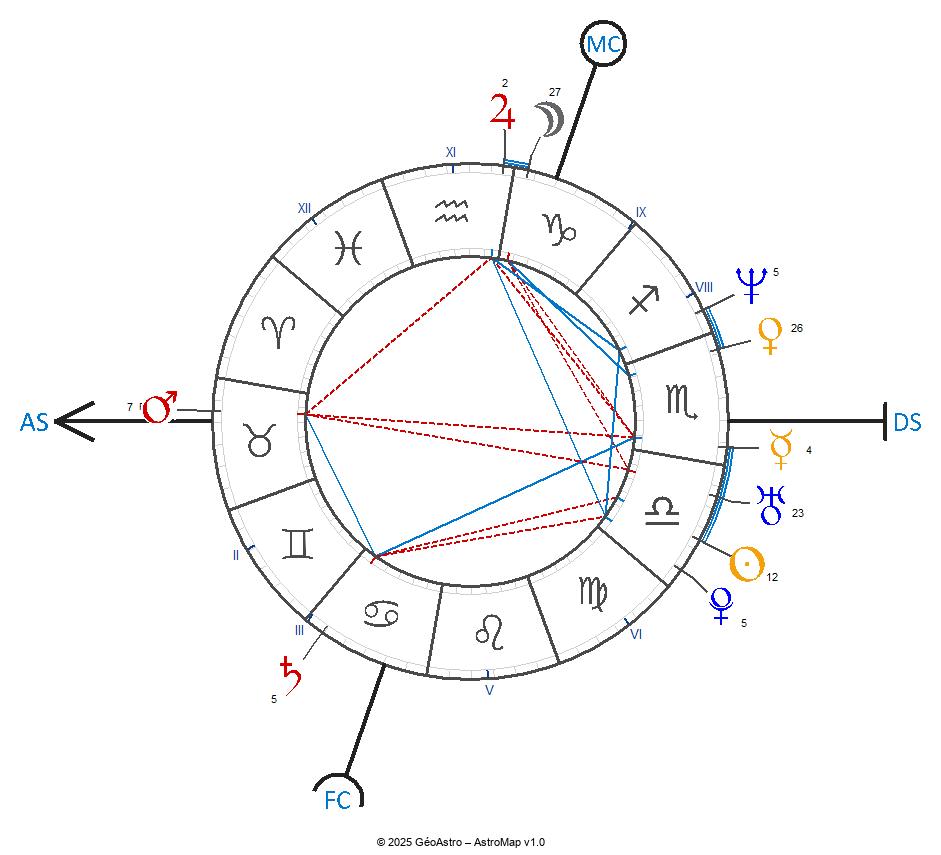
In the context of a short study, it is not forbidden to observe the planetary transits that accompanied the major events in the career of one of the individuals within the studied population group. Let us take the example of Cédric Villani, whose astrological chart was displayed above. The readings available on the subject highlight two key periods in the mathematician’s professional life.
In September 2010, already Director of the Henri Poincaré Institute, Villani became a Professor at Claude-Bernard University Lyon I. He was promoted to the highest rank of university professors: the "exceptional professor" grade, which grants the habilitation to supervise doctoral research. At the height of his career, he also won the prestigious Fields Medal that same year.
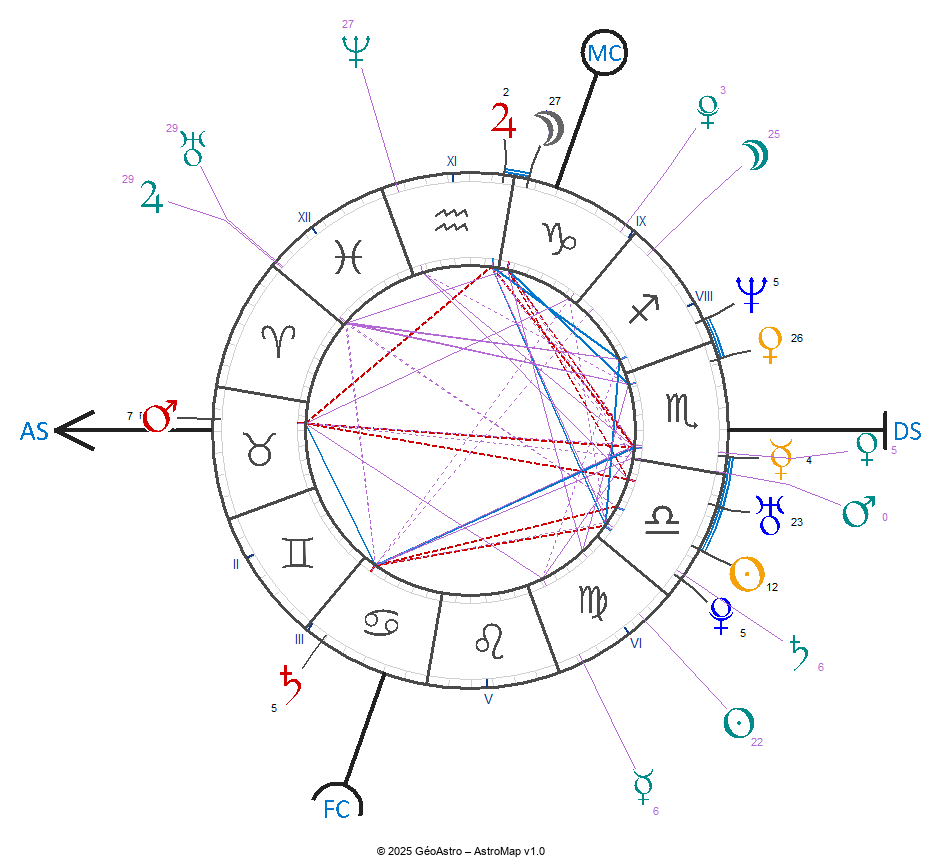
During this first period, Uranus and Jupiter (level "r intensive") came into angularity above the Ascendant7 of the mathematician’s natal chart. Transits of these two planets are known to favor the most significant periods of "representation": social engagements, professional ambitions, the realization of one's aspirations, increased notoriety, appointments to high responsibilities.
In 2010, Villani also engaged in the popularization of mathematics and politics, while stating that he positioned himself neither to the left, nor to the right, nor in the center.
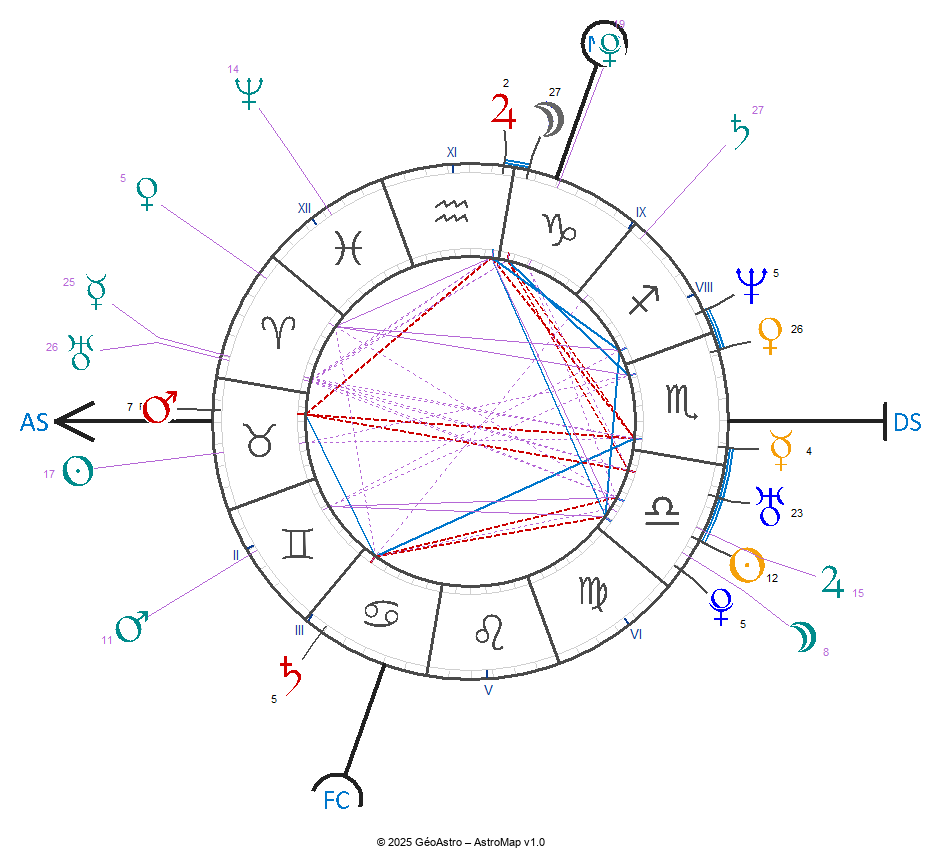
In 20178, Villani supported Emmanuel Macron’s candidacy in the presidential elections and ran as a candidate for La République En Marche in the legislative elections for the 5th district of Essonne. He was elected with over 69% of the votes in the second round, obtaining the highest voter turnout among LREM deputies.
During this second period, the same two planets, Uranus and Jupiter, were in opposition across the Ascendant–Descendant axis of the mathematician’s chart. Once again, he increased his social impact. He was elected President of the Parliamentary Office for the Evaluation of Scientific and Technological Choices (OPECST), presented a report to the National Assembly on the teaching of mathematics in primary and secondary education, and the Prime Minister assigned him a parliamentary mission on artificial intelligence.
In conclusion, one might say that if we admit the influence of astrology at the moment of birth, we must also test the continuity of this influence by observing its effects during planetary transits and the repetition of astrological configurations. The most significant planetary transits are supposed to mark the key periods in an individual’s life. They do not create events, but they highlight the periods when they are most likely to occur.
Regarding Cédric Villani, we saw the importance of the successive influence of two Uranus–Jupiter aspects during the most significant periods of his professional life. Of course, the influence of the planets and the transits closely depends on the subject receiving them: it is the mathematician Villani who is astrologically synchronized with a Uranus "r" and whose nervous system reacts strongly when major transits of this planet occur. To assess the effects of a planetary transit, it is necessary to know both the attributions of the dominant astrological functions and have some information about the subject receiving them. The chart provides a framework, not an absolute prediction. This is one of the fundamental axioms of conditionalism: the horoscope is not the Subject!
Methodological Note — Update
This article was originally based on analyses carried out using the AstroStat software developed by Julien Rouger. Since its publication, we have continued this work within the GeoAstro statistical engine, which follows the same methodological logic while adopting a more synthetic approach.
Minor differences may therefore appear between the results obtained with AstroStat and those generated in GéoAstro, without affecting the main trends discussed in this article.
The charts presented here were generated afterwards using GéoAstro, based on the same cohorts, in order to provide a consistent visual representation of the results.
Appendix: The Fields Medalists – Uranus
This appendix presents additional statistical elements concerning the members of the Fields Medalists, based on graphical representations not included in the main article. These results aim to broaden the analytical perspective and to support a more nuanced interpretation of the data.
The result presented here corresponds to the most pronounced statistical deviation observed within the group and is provided as an illustrative example of the statistical evaluation method applied to all planets.
Gaussian Distribution Curve
A Gaussian function is an exponential function used to represent the distribution of a dataset based on the density of its values. The following Gaussian curve illustrates the probability of observing, in the general population, a lower valuation of Uranus than the one found among Fields Medalists.
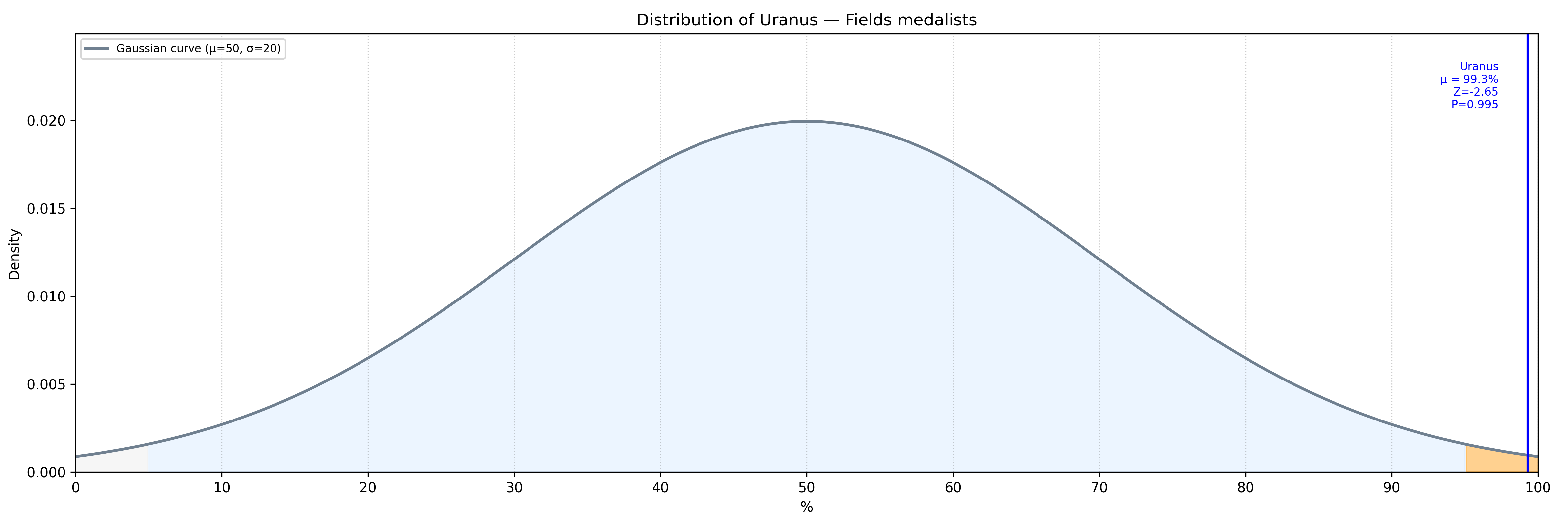
The graph above shows the following results for Uranus:
- Empirical probability: 99.3% of simulations yield a lower score.
- Z-score: –2.65, indicating that the result is statistically significant.
- Theoretical p-value: 0.995, indicating the relative position of the observed result within the theoretical distribution expected under the null hypothesis.
Kernel Density Estimation Curve (KDE)
In statistics, kernel density estimation (KDE) is a non-parametric method used to estimate the probability density function of a random variable based on observed data. The KDE curve is based on hierarchical rank values, as the software computes probability estimates from the empirical distribution of these ranks.
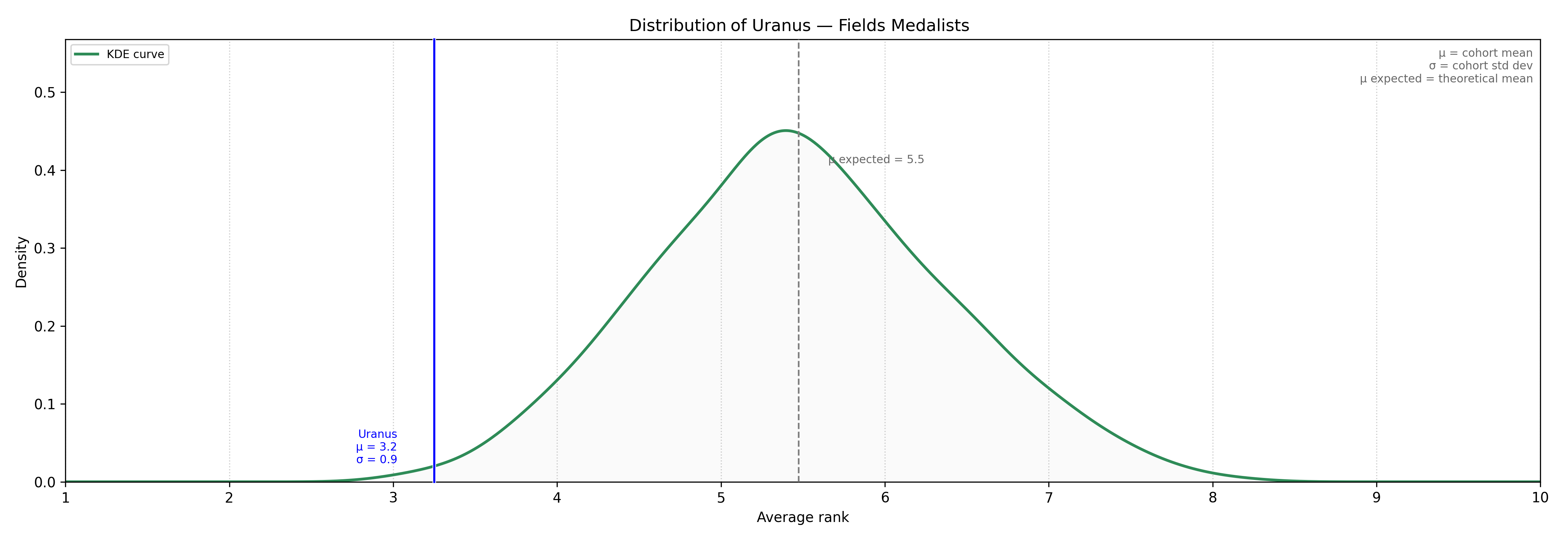
The graph above shows the following results for Uranus:
- Cohort rank: 3.2 on a scale from 1 to 10.
- Cohort standard deviation: 0.9, indicating the dispersion of values around the mean rank.
- Expected rank: 5.5, corresponding to the theoretical average under a null hypothesis.
The Gaussian and KDE curves provide a statistical representation that complements the global histograms, allowing a more detailed examination of the rank distribution for a given element and its relative position within the studied population.
Notes
1Source: Civil status. Same for the two Belgian laureates mentioned.
2AstroStat is an astrology software that evaluates the statistical probabilities of each astrological dominant within a given cohort: planets, RET planetary families, zodiac signs.
3Jean-Pierre Nicola, Le grand livre de l’astrologue, Éditions Sand & Tchou, pp. 49-50.
4On this subject, see “Zoom logoscopique : RET et mathématiques”, Richard Pellard, Fil d’Ariana, no. 20.
5Jean-Pierre Nicola, Le grand livre de l’astrologue, Éditions Sand & Tchou, p.152.
6Alain Connes, “La réalité mathématique archaïque”, La Recherche, Monthly 332, June 2022.
7In September 2010, in the dominion chart, Uranus and Jupiter are located above the Ascendant zone, at about 11° and 12° in the 12th house. This (ecliptic) chart is calculated from the domification of Villani's chart.
8In May 2017, in the dominion chart, Uranus is about 24° in the 12th house (AS), and Jupiter is about 20° in the 6th house (DS). These two planets are therefore angular on either side of the Ascendant–Descendant axis.