
Witty People
Iconic Humorists
By Manuel da Costa — GeoAstro
Humor is generally defined as a form of wit that lightheartedly highlights the comical, absurd, or unusual aspects of reality. It is a way of using language, a means of expression that finds its place in many situations and discourses.
Its form varies according to cultures, eras, and even individuals. It manifests through various techniques such as self-deprecation, puns, dark humor, or even character and gesture comedy. Laughter, according to Rabelais in 1534, helps one gain perspective on life: “It’s better to laugh than to cry.” He also reminded us that laughter is the essence of humanity.
What lies beneath humor’s façade of lighthearted distraction? What are the psychological traits of cult humorists, and what role do they play today from a sociological standpoint?
Just like other previously discussed astrological populations, is it possible to observe abnormal planetary dominances or RET planetary families among them?
A Cohort with Particularities
The decision to study humorists seems fitting: they hold a significant place in our society and leave no one indifferent, regardless of personal sensibilities.
This population group presents several conditions that are likely conducive to obtaining significant astro-statistical results: the list is drawn from a reference work, the humorists included are among the best in the field, and the selection criteria appear precise, although humor encompasses a variety of styles. Moreover, they seem sufficiently “specialized” psychologically and behaviorally to allow for the observation of notable results.
Our cohort — detailed below — presents certain peculiarities, does, however, have certain peculiarities. First, the number of humorists recorded is higher than in other studied groups: the list includes 105 personalities. Second, as previously mentioned, humorists can have very different styles, raising the question of whether they truly form a unit astrologically speaking.
The software AstroStat evaluates the statistical distribution of elements constituting the astrological chart. In the case of our cohort of humorists, despite its size, only the results concerning planets and RET planetary families are statistically significant. These will therefore be the sole focus of our analysis.
As humor is a cultural manifestation linked to its era, as historian Jacques Le Goff pointed out in the preface of his Enquête sur le rire (Inquiry into Laughter), there is great diversity in its forms. However, our study reveals that all these humorists, despite their stylistic differences, follow the same thread from an astro-psychological point of view, allowing them to be grouped into a single category for analysis.
Iconic Humorists
The cohort of humorists for our study consists of the names featured in the book Rire - 100 humoristes cultes!1 (Laughter - 100 Iconic humorists). As the title suggests, it lists around one hundred humorists from both the past and present who are among the most famous2:
- Fernandel, born on May 8, 1903, at 07:00 in Marseille
- Fernand Raynaud, born on May 19, 1926, at 11:30 in Clermont-Ferrand
- Bourvil, born on July 27, 1917, at 11:30 in Prétot-Vicquemare
- Louis de Funès, born on July 31, 1914, at 01:00 in Courbevoie
- Raymond Devos, born on November 9, 1922, at 07:15 in Mouscron
- Jacqueline Maillan, born on January 11, 1923, at 20:00 in Paray-le-Monial
- Robert Lamoureux, born on January 4, 1920, at 05:00 in Paris
- Michel Leeb, born on April 23, 1947, at 16:15 in Cologne
- Alex Métayer, born on March 19, 1930, at 04:30 in Berre-l'Étang
- Guy Montagnier, born on March 6, 1948, at 17:00 in Paris
- Pierre Péchin, born on February 10, 1947, at 09:15 in Montbéliard
- Pierre Repp, born on November 5, 1909, at 16:00 in Saint-Pol-sur-Ternoise
- Sim, born on July 21, 1926, at 15:00 in Cauterets
- Thierry le Luron, born on April 2, 1952, at 05:00 in Paris
- Jean Yanne, born on July 18, 1933, at 01:00 in Les Lilas
- Coluche, born on October 28, 1944, at 18:20 in Paris
- Sylvie Joly, born on October 28, 1934, at 23:00 in Paris
- Guy Bedos, born on June 15, 1934, at 22:00 in Algiers
- Popeck, born on May 18, 1935, at 14:38 in Paris
- Pierre Desproges, born on May 9, 1939, at 15:10 in Pantin
- Roland Magdane, born on July 3, 1949, at 21:45 in Grenoble
- Michel Boujenah, born on November 2, 1952, at 12:00 in Tunis
- Patrick Sébastien, born on November 14, 1953, at 10:30 in Brive-la-Gaillarde
- Philippe Chevallier, born on January 11, 1956, at 03:20 in Redon
- Régis Laspalès, born on February 25, 1957, at 05:00 in Paris
- Muriel Robin, born on August 2, 1955, at 15:30 in Montbrison
- Sophia Aram, born on June 29, 1973, at 20:05 in Ris-Orangis
- Camille Chamoux, born on September 22, 1977, at 23:45 in Paris
- Karine Dubernet, born on August 23, 1974, at 11:35 in Marignane
- Nicole Ferroni, born on March 19, 1982, at 13:50 in Casablanca
- Nora Hamzawi, born on April 29, 1983, at 07:35 in Cannes
- Bérengère Krief, born on April 16, 1983, at 12:45 in Lyon
- Laura Laune, born on July 5, 1986, at 13:31 in Brussels
- Shirley Souagnon, born on October 3, 1986, at 15:05 in Clichy
- Caroline Vigneaux, born on January 27, 1975, at 12:30 in Nantes
- Dominique de Lacoste, born on February 23, 1958, at 15:00 in Villefranche-sur-Saône
- Nicole Avezard, born on January 7, 1951, at 20:00 in Savigny-sur-Orge
- Jean-Marie Bigard, born on May 17, 1954, at 11:30 in Charmont-sous-Barbuise
- Anne Roumanoff, born on September 25, 1965, at 05:50 in Paris
- Didier Bourdon, born on January 23, 1959, at 11:00 in Algiers
- Bernard Campan, born on April 4, 1958, at 16:00 in Agen
- Pascal Légitimus, born on March 13, 1959, at 11:05 in Paris
- Bruno Carette, born on November 26, 1956, at 06:00 in Algiers
- Dominique Farrugia, born on September 2, 1962, at 09:15 in Vichy
- Chantal Lauby, born on March 23, 1948, at 15:00 in Gap
- Alain Chabat, born on November 24, 1958, at 01:30 in Oran
- Patrick Timsit, born on July 15, 1959, at 12:00 in Algiers
- Pierre Palmade, born on March 23, 1968, at 08:45 in Bordeaux
- Chantal Ladesou, born on May 5, 1948, at 13:00 in Roubaix
- Eric Carrière, born on May 24, 1973, at 10:15 in Foix
- Francis Ginibre, born on June 17, 1959, at 10:50 in Toulouse
- Laurent Gerra, born on December 29, 1967, at 10:30 in Bourg-en-Bresse
- Valérie Lemercier, born on March 9, 1964, at 22:20 in Dieppe
- Elie Sémoun, born on October 16, 1963, at 03:30 in Paris
- Dany Boon, born on June 26, 1966, at 07:25 in Argentières
- Franck Dubosc, born on November 7, 1963, at 04:00 in Le Grand-Quevilly
- Jean-Christian Fraiscinet, born on May 14, 1965, at 22:15 in Valençay
- Vincent Dubois, born on June 14, 1964, at 04:30 in Fontenay-aux-Roses
- Gad Elmaleh, born on April 19, 1971, at 11:15 in Casablanca
- Florence Foresti, born on November 8, 1973, at 17:05 in Vénissieux
- Jamel Debbouze, born on June 18, 1975, at 05:40 in Paris
- Nicolas Canteloup, born on November 4, 1963, at 08:30 in Bordeaux
- Gérald Dahan, born on May 17, 1973, at 19:30 in Cognac
- Michaël Gregorio, born on June 10, 1984, at 04:40 in Mulhouse
- Didier Gustin, born on April 26, 1966, at 18:20 in Bar-le-Duc
- Marc-Antoine Le Bret, born on October 2, 1985, at 14:25 in Saint-Brieuc
- Yves Lecoq, born on May 4, 1946, at 18:10 in Paris
- Michel Leeb, born on April 23, 1947, at 16:15 in Cologne
- Dany Mauro, born on October 20, 1972, at 10:50 in Hyères
- Jean Roucas, born on February 1, 1952, at 22:30 in Marseille
- Kev Adams, born on June 30, 1991, at 00:02 in Paris
- Blanche Gardin, born on April 3, 1977, at 17:40 in Suresnes
- Pierre Dac, born on August 15, 1893, at 11:00 in Châlons-en-Champagne
- Francis Blanche, born on July 20, 1921, at 16:00 in Paris
- Roger Pierre, born on August 30, 1923, at 20:25 in Paris
- Jean-Marc Thibault, born on August 24, 1923, at 22:50 in Saint-Bris-le-Vineux
- Jean Poiret, born on August 17, 1926, at 15:20 in Paris
- Michel Serrault, born on January 24, 1928, at 17:45 in Brunoy
- Teddy Vrignault, born on November 22, 1928, at 01:10 in Paris
- André Gaillard, born on December 19, 1927, at 10:15 in Paris
- Sophie Daumier, born on November 24, 1934, at 05:30 in Boulogne-sur-Mer
- Antoine de Caunes, born on December 1, 1953, at 15:40 in Boulogne-Billancourt
- José Garcia, born on March 17, 1966, at 18:40 in Paris
- Dieudonné, born on February 11, 1966, at 11:30 in Fontenay-aux-Roses
- Eric Judor, born on July 25, 1968, at 01:00 in Meaux
- Ramzy Bédia, born on March 10, 1972, at 10:35 in Paris
- Corinne Benizio, born on February 12, 1962, at 14:00 in Dugny
- Gilles Benizio, born on June 1, 1957, at 22:30 in Villerupt
- Olivier Baroux, born on January 5, 1964, at 12:58 in Caen
- Fred Testot, born on February 20, 1974, at 08:40 in Boulogne-Billancourt
- Omar Sy, born on January 20, 1978, at 00:35 in Trappes
- Alex Lutz, born on August 24, 1978, at 23:55 in Strasbourg
- Ary Abittan, born on January 31, 1974, at 12:40 in Paris
- Eric Antoine, born on September 23, 1976, at 04:00 in Enghien-les-Bains
- Jérôme Commandeur, born on April 12, 1976, at 23:20 in Argenteuil
- Olivier de Benoist, born on June 14, 1974, at 13:45 in Reims
- Fary, born on July 7, 1991, at 17:00 in Paris
- Kyan Khojandi, born on August 29, 1982, at 03:20 in Reims
- Baptiste Lecaplain, born on May 23, 1985, at 09:15 in Avranches
- Le Comte de Bouderbala, born on January 6, 1979, at 16:30 in Saint-Denis
- Jeff Panacloc, born on September 8, 1986, at 12:50 in Nogent-sur-Marne
- Florent Peyre, born on May 14, 1980, at 23:00 in Valence
- Elodie Poux, born on September 3, 1982, at 14:35 in Longjumeau
- Ahmed Sylla, born on March 10, 1990, at 19:00 in Nantes
- Arnaud Tsamère, born on March 11, 1975, at 11:00 in Bordeaux
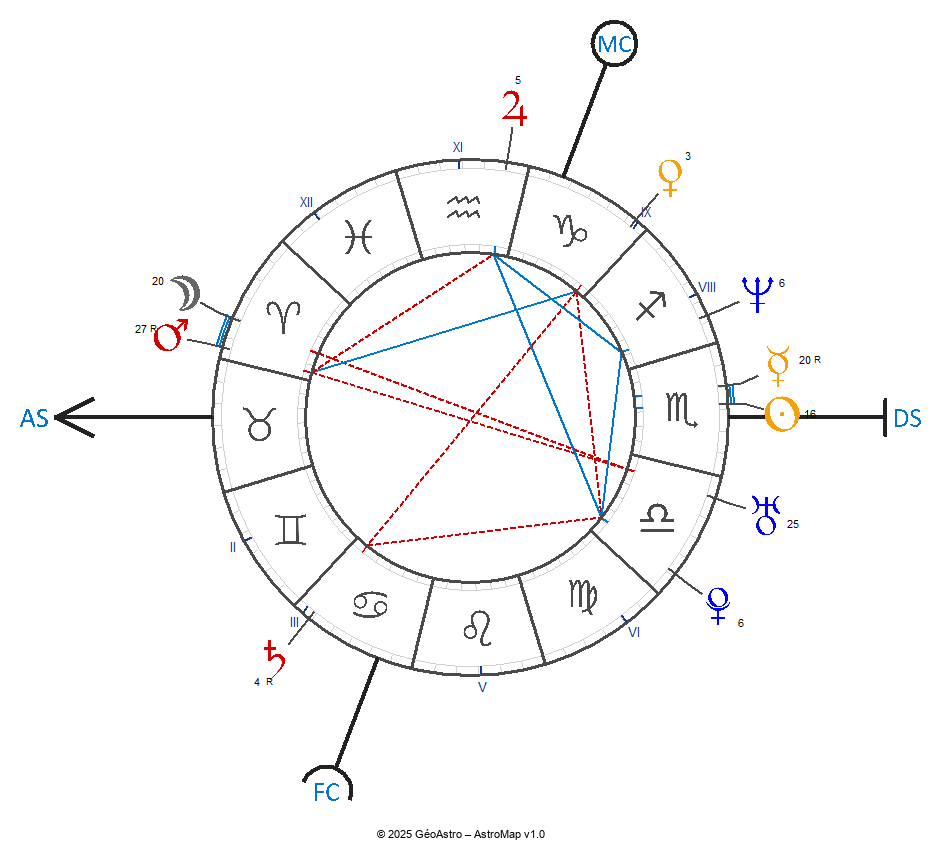
The humorist Florence Foresti was born under a dominant Mars-Moon in Aries above the Ascendant, with Jupiter in Aquarius at the Midheaven and a cluster of Sun-Mercury-Pluto-Uranus at the Descendant, set against a Scorpio backdrop. All of the powers (extensive and intensive) are thus in angular zones in the chart.
With such a configuration, one seeks to be both a person of action, effectively engaging with concrete realities (Mars), a recognized figure triumphing through appearances (Sun), and remaining authentic under all circumstances (Pluto).
A tough perspective, indeed: to want to be at once the "King" admired, the "Warrior" who speaks on behalf of experience, and the "Sorcerer" navigating the secret labyrinths of reality... Finally, the angular Moon should also make the humorist adept at maintaining inner peace and knowing how to shield herself from whatever might disrupt her personal balance.
Astrological Dominants of Humorists
The following graphs indicate the probabilities of obtaining the planetary and planetary family RET valuations observed in humorists, compared to normal distributions.
Planetary Valuations
The graph below presents the probability, on the y-axis, of obtaining planetary hierarchical ranks lower than those of a random distribution (from 0% to 100%). On the x-axis, the planets in the astrological chart, from the Moon to Pluto, are shown.
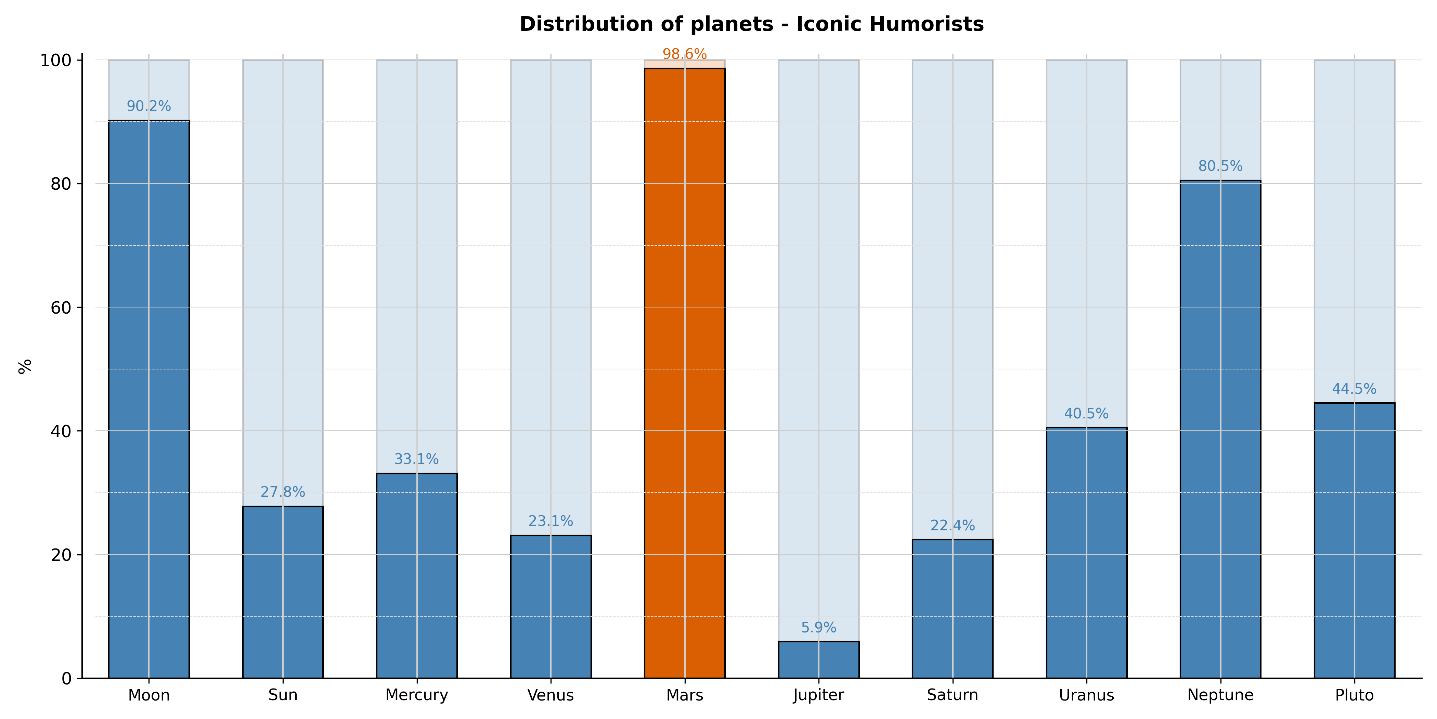
Only one planet presents an atypical result:
- Mars is overvalued: 98.6 out of 100 simulations.
Compared to a random population sample, there is approximately a 99% chance of observing a lower valuation of Mars. It is also noted that Jupiter shows a relatively low probability (6%), but does not reach a significant threshold of undervaluation.
Valuations of Planetary Families
The following graph presents the probability of obtaining lower statistical results for the planetary RET families, using the same method.
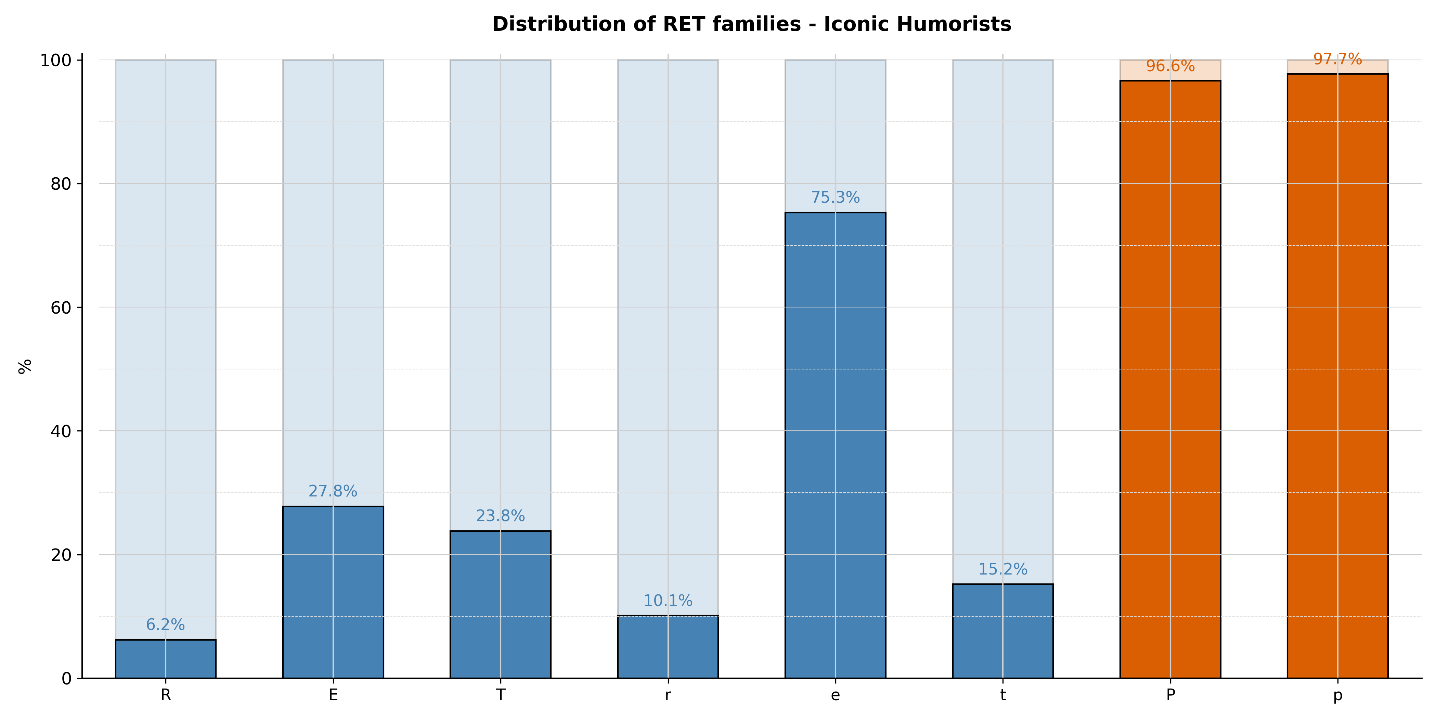
Two planetary families exhibit atypical results:
- The “extensive power” family (P) is overvalued: 96.6 out of 100 simulations;
- The “intensive power” family (p) is overvalued: 97.7 out of 100 simulations.
Compared to a random population sample, we observe about 97 out of 100 simulations of obtaining a lower valuation for both the intensive power family and the extensive power family.
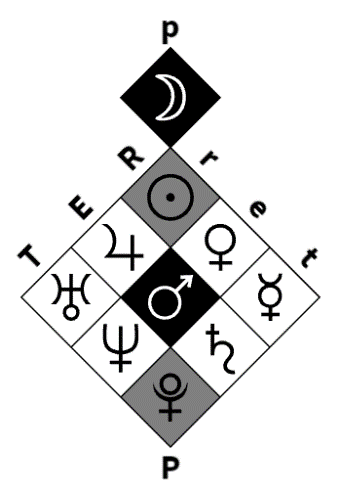
It is interesting to note that these two astro-statistical results are correlated: Mars, which is overvalued, belongs to the extensive power family ("P"), which is also overvalued. The main interpretation thus highlights a dominant Mars "P," which should be emphasized in our analysis of humorists.
After exploring the manifestations of visible powers (Sun) and invisible powers (Pluto) in our society3, let us now turn to the expression of tangible powers (Mars) and homogenization (Moon) through the particular case of humorists.
A Political and Social Power
Actors in Public Debate
When we talk about humor, we primarily refer to the witty remarks that animate our conversations, dispel boredom, and promote conviviality. However, for professional humorists, this lighthearted aspect conceals a true power of influence, particularly in terms of persuasion. According to recent social science research4, this seemingly "carefree" occupation actually has a political and social implication. The very existence of humorists is proof that society delegates a form of power to them and endorses their approach.
What is this approach? It is the act of publicly denouncing socially and politically condemnable facts. Performing on stage or in the media to convey a humorous message requires a certain form of manipulation of ideas. Captivating the audience, provoking laughter, stimulating reflection, leaving a lasting impression... Thus, humorists impose themselves as key players in public debate. Each one offers their vision of the world, their perspective, and their distanced and situated interpretation of our society.
By giving them our attention, even if only to laugh with them, we engage socially and politically. Whether we share their point of view or not, we listen to them, participate in their debates, and enter their game. The humor practiced by professionals carries a reflective view of the world. It uses laughter to offer an alternative perspective and contribute to social transformations.
But how can this ideological and societal engagement be connected to Mars in astrology, specifically to its "extensive power" aspect? In our previous study on members of the Académie française, we noted that Mars, from the perspective of powers, concerns the economic actor, who makes decisions regarding a country's economy and manages material goods. One can equally associate this planet with the social role of humorists.
The Martian power, symbolically that of the warrior, concerns managing interactions with the environment, defending one's personal interests and those of one's group. In this regard, it translates into a struggle for a fairer experience, for a society more in line with its aspirations, and a commitment against social, ethnic, cultural, or ideological inequalities. In this sense, it expresses a dynamic of transformation in its exchanges and confrontations with the outside world.
By offering an alternative perspective and participating in societal debates, humorists indeed exert an influence on the management and organization of their environment (Martian extensive power). They defend a society that takes into account everyone's concerns and interests and promotes greater freedom of thought and action.
The humorous word, through its power of influence, is an essential tool for our critical thinking. It has the duty "to correct men while entertaining them," as Molière once said. Humorists are said to shape the ideas of their time (Mars "P"). To such an extent that this power of influence is sometimes perceived as a threat. In countries where freedom of expression is stifled by dictatorship, the artists of laughter become rare, hide, or even end up in prison.
On the Evolution of Humor in France
Depending on the era and social upheavals, the subjects and styles of humor evolve. The work of humorists, which involves highlighting social representations and denouncing inequalities and abuses, evolves according to the context and collective issues. Let’s continue our investigation by looking at the evolution of humor in France over the past few decades5. Let’s examine how the Marsian power of political and social influence manifests in different environments.
The humor of the 1970s and 80s questions social classes and opposes the established order and the bourgeois elite. Coluche is an iconic figure of this political humor: “The Chamber of ‘Depitees,’ half are good for nothing, the other half are ready to do anything,” or “Politicians, they’re the kind who, to shine in society, would eat shoe polish.” A critical observer, he seeks to reveal the manipulations of the ruling power. Pierre Desproges, in the same spirit, also plays the role of counter-power: “When a politician gives his speech, everyone is convinced except himself.”
In the 1990s, what sociologists call the “politics of identity” emerged. With the proliferation of café-theaters, the comedic scene diversified. Muriel Robin and Pierre Palmade exemplify humor that depicts different imaginary characters in short sketches. Questions of cultural differences and stereotypes then came into play, illustrated by characters with strong identities, like Madame Sarfati, played by Élie Kakou, a caricature of the Jewish mother trying to marry off her daughter, or the Beur President, played by Smaïn, who plays on his Arab origin.
In the 2000s, when talking about one’s identity could be seen as communitarianism, humorists embraced a new genre where they talk about themselves and their differences. This opened up space for minorities to deconstruct prejudices. Jamel Debbouze, for example, addresses issues of social class and plays with stereotypes: “In Trappes (his hometown), the social elevator is stuck in the basement” and in the basement “it smells like piss!” Later, with the Jamel Comedy Club, he encouraged the multiplication of registers and identity expressions where stereotypes were desacralized.
The 2000s-2010s saw the rise of female humorists. Florence Foresti, through various characters, portrays her inability to fit into gender norms. It’s not just about denouncing sexism, but also about questioning the binary of male and female, which doesn’t account for the diversity of identities. Blanche Gardin offers a different perspective and plays on the codes of female respectability, contradicting what is expected of traditional femininity: “Nothing is happening in my life anymore... Oh wait, I’m wearing necklaces. Since I won’t get laid, I might as well look like a woman of letters.”
For several decades now, humorists have held a prominent place in the media, radio, and television. They have become fully-fledged actors in the public debate (Mars “P”). The space of counter-power in which they express themselves allows them to offer a distanced view of society and contribute to social transformations, clearly reflecting the astrological signature of Marsian extensive power.
If laughter is a social barometer, it also reflects the reactions allowed to certain topics. Humor can be subversive, but it is also riskier: when it questions the established order too much, it is rarely tolerated for long. In this way, the role of humorists delimits the space of laughter or, by extension, the latitude of expression granted to Mars power “P” in our society. True freedom of expression never truly exists.
An Inclusive and Recreative Function?
Social Link
The planetary family "intensive power" is also overvalued in iconic humorists. If the political and social power exercised by these humorists largely overlaps with the attributions of a Mars "P", how can we explain that the intensive power family or "p", diametrically opposed to this formula in the RET diagram, is itself overvalued?
"Intensive power" has the function of gathering, homogenizing, and including. It heightens sensitivity to the community of belonging, to the group within which one feels intimately integrated. When this function is well assimilated, one feels familiar, supports, and solidarizes with others. One organizes their daily life according to the norms of their group, sharing in its habits and forming a network of privileged relationships and support.
According to many authors6, humor strengthens social bonds and creates a sense of belonging among people, reflecting the values of the intensive power planetary family. Through adapted communication, humor connects individuals, develops conviviality, a space for sharing based on common values, and creates a sense of familiarity.
Humor preferences give the feeling of being part of the same group, of feeling comfortable and understood. This sense of belonging allows individuals to reunite and develop meaningful connections, foster quality relationships, and enhance comfort and confidence in expressing themselves. Humor fosters connection by subtly challenging shared social codes and references.
In the image it projects of social reality, humor participates in the construction of common sense from a particular angle (intensive power "p"), even more so when individuals belong to the same social group, age group, ethnic origin, or share similar religious or philosophical beliefs. Humor deliberately fosters inclusion and the reinforcement of a "common us," allowing everyone to locate themselves socially and culturally.
Thus, privileged social classes tend to enjoy humor with double meanings, which distances itself from social hierarchies, while less culturally privileged classes prefer humor based on gags and jokes. The antics of the British humorist Mr. Bean would not make people over 65 laugh, as they would not appreciate his cynicism; the humor of Charlie Hebdo would not appeal to those under 30, as it is considered anarchist and hostile to any form of authority.
Our humor preferences reflect and reinforce our worldview and sense of self, while highlighting aesthetic and moral norms. They reveal a set of social representations linked to lifestyles, customs, models, and norms that are valued or rejected within the group. They strengthen the sense of belonging and cohesion, embodying the logic of inclusion inherent in the lunar intensive power.
A Liberating Power
From another point of view, intensive power can be correlated with the derision allowed by humor, which helps bear certain realities while denouncing their absurdity and the resignation they impose. Humor is also a defense mechanism and has a therapeutic effect: we laugh at hunger, poverty, and social inequality. It underscores the need for distance from a way of life that brings anxiety, sometimes injustice.
The Moon, which forms the family "p" on its own, also has a function of "homogenization, globalization, and global regulation, fluidification and harmonization of the conflicts and latent tensions induced by the heterogeneity of the extensive power7." When this planetary family is well integrated, the individual knows how to maintain serenity, tranquility of being, and avoid excessive confrontations with the outside world. By extension, intensive power concerns what protects, regenerates, and the liberating paths from what may hinder personal balance.
In 1905, Freud8 wrote that he considers humor to be "the highest of defense achievements" and that, unlike other defense mechanisms, it "disdains removing the content of representation attached to painful affect from conscious attention." The existential role of humor makes it an indisputable force to deflect negative emotions (fear, doubt, suffering...) and plays a cathartic function. It allows one to shift the frightening nature of experience, to release certain unspeakable social tensions or intimate personal conflicts.
Laughter defuses problems and renders them more bearable. A true liberation, it dissolves accumulated tensions, fosters distance, and lightens what weighs on mental balance (intensive power "p"). Its use indicates a need for detachment from reality, support, or remedy and becomes a guarantee of well-being. Humor lightens the weight of realities and serves as an excellent way to manage negative emotions.
Thus, humor has a strong "intensive power" component, as it plays a recreative role and frees from negative emotions and daily anxieties. It allows one to recognize these disturbing thoughts and emotions, express them, and liberate oneself from them, thus avoiding being overwhelmed. In short, it contributes to better internal economy (Lunar "p").
Humor also constituted a form of resistance to persecutions endured by certain less privileged societies in the past. This has notably been the case for Jewish communities, whose history allowed for the creation of Jewish humor, often intended to laugh rather than cry.
The Jews have had, in many countries, a unique history, incomparable to that of other human groups. While tragedies are hardly something to laugh at, Jewish humor has often been a means of resilience in the face of persecutions and misery endured over the centuries. Humor allowed them to transcend these painful trials and draw from them a source of hope and inspiration (lunar power).
Finally, positive psychology9 suggests that those who can show humor in difficult circumstances (depression, loneliness, illness, accidents in life…) find a true remedy and a means of resilience. Humor would have a beneficial effect on the body’s defenses ("p" intensive) and belong to the skills that make us individuals with good mental health, alongside self-esteem, optimism, and a sense of security.
A Probabilistic Framework and Conditional Results
The cohort of humorists we selected allowed us to observe and analyze significant astro-statistical results. We mentioned in the introduction the specificities of this cohort, particularly the variety of comedic styles and the generational diversity of its members, conditions that were not ideally suited to our study. However, these specificities did not prevent us from obtaining atypical statistical results and successfully conducting this investigation.
It’s all a matter of probability: a cohort with diverse styles has less chance, but not no chance, of generating statistically significant results. At first glance, there was simply less chance of observing such results, as the cohort did not meet all the favorable conditions beforehand. On the other hand, a cohort meeting all of these conditions may not produce any notable results if probability does not play in its favor.
If the astro-statistical environment is probabilistic and not systematic, the results obtained are by nature conditional and relative. When an element of the chart is abnormally emphasized within a cohort, does that mean this result will be present in every individual that makes up the group? In reality, these overvaluations have primarily a collective dimension and concern the entire group.
Many humorists have a dominant Mars and the planetary families "P" and "p," but others do not. The former, the majority, have developed the necessary behavioral and cognitive skills for professional humor based on these astrological dominants. The latter, however, have acquired these same skills from other astrological dominants. This is perfectly possible, but they are simply fewer in number.
In an Object reference frame, we can say that the work of humorists inherently possesses a Martian dimension, "P" and "p," since these planets and planetary families are overemphasized within the cohort. Yet, some humorists have acquired these skills without these dominants being present in their chart. This depends on their ability to adapt, especially since humor takes many different forms.
We know that the link between the astrological chart and an individual’s psychological structure depends on various determinisms (genetic, sociocultural, educational…). We now see that the relationship between psychological structure and professional activity is non-linear and can have multiple origins. Individuals with different psychological structures can thus end up in the same activity. Astrological influence is, by nature, conditional.
Methodological Note — Update
This article was originally based on analyses carried out using the AstroStat software developed by Julien Rouger. Since its publication, we have continued this work within the GeoAstro statistical engine, which follows the same methodological logic while adopting a more synthetic approach.
Minor differences may therefore appear between the results obtained with AstroStat and those generated in GeoAstro, without affecting the main trends discussed in this article.
The charts presented here were generated afterwards using GeoAstro, based on the same cohorts, in order to provide a consistent visual representation of the results.
Appendix: Iconic Humorists – Extensive Power (P)
This appendix presents additional statistical elements concerning the members of the Iconic humorists, based on graphical representations not included in the main article. These results aim to broaden the analytical perspective and to support a more nuanced interpretation of the data.
The result presented here corresponds to the most pronounced statistical deviation observed within the group and is provided as an illustrative example of the statistical evaluation method applied to all planets.
Gaussian Distribution Curve
A Gaussian function is an exponential function used to represent the distribution of a dataset based on the density of its values. The following Gaussian curve illustrates the probability of observing, in the general population, a lower valuation of Extensive Power (P) than the one found among iconic humorists.
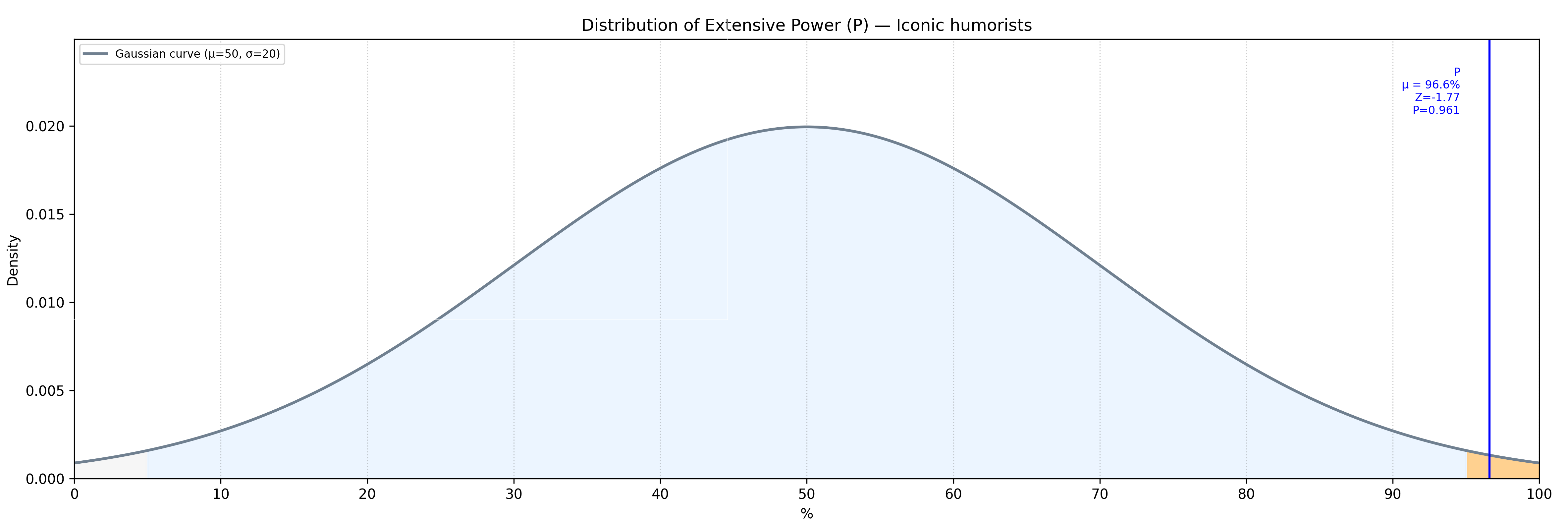
The graph above shows the following results for Extensive Power (P):
- Empirical probability: 96.6% of simulations yield a lower score.
- Z-score: –1.77, indicating that the result is statistically significant.
- Theoretical p-value: 0.961, indicating the relative position of the observed result within the theoretical distribution expected under the null hypothesis.
Kernel Density Estimation Curve (KDE)
In statistics, kernel density estimation (KDE) is a non-parametric method used to estimate the probability density function of a random variable based on observed data. The KDE curve is based on hierarchical rank values, as the software computes probability estimates from the empirical distribution of these ranks.
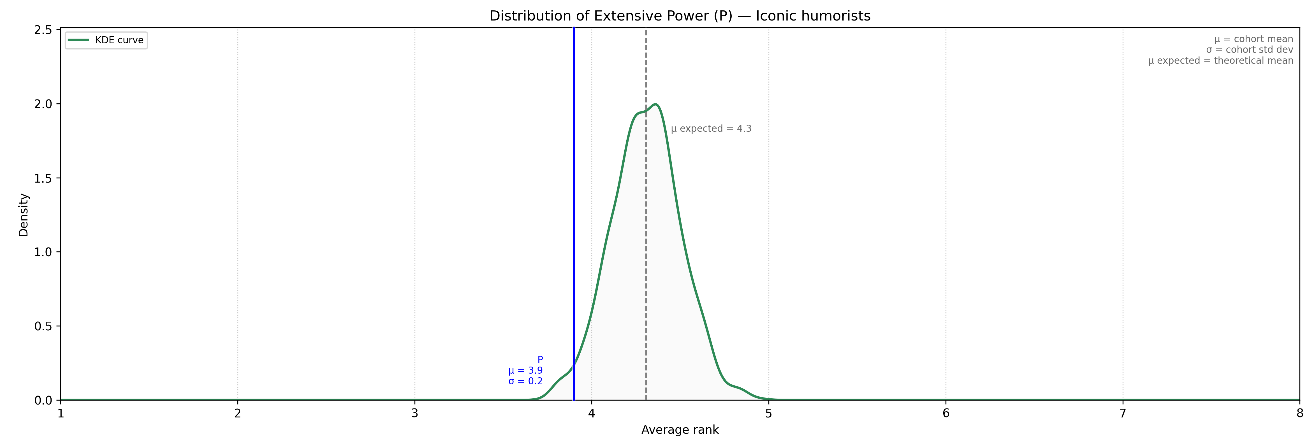
The graph above shows the following results for Extensive Power (P):
- Cohort rank: 3.9 on a scale from 1 to 8.
- Cohort standard deviation: 0.2, indicating the dispersion of values around the mean rank.
- Expected rank: 4.3, corresponding to the theoretical average under a null hypothesis.
The Gaussian and KDE curves provide a statistical representation that complements the global histograms, allowing a more detailed examination of the rank distribution for a given element and its relative position within the studied population.
Notes
1Rire - 100 humoristes cultes !, Christine Dauphant, Hugo Image, 2019.
2The book also mentions the following names, whose full birth details are not known: Garcimore, Elie Kakou, Zouc, Laurence Arné, Constance, La Bajon, Léa Lando, Nawell Madani, Laurie Peret, Nadia Roz, Gaspard Proust, Bruno Counard, Vincent Counard, Kad Merad, Bruno Sanches, Vincent Dedienne, Jérémy Ferrari, Haroun. Some were born abroad, making their time of birth unavailable. For others, civil records could not find an entry at the known date.
3See the previous text: The Immortals – The Members of the Académie française.
4De l’importance du pouvoir politique et social des humoristes, Christelle Paré, Professor of the History of Humor, interview for Le Journal de Québec, April 2018.
5Le pouvoir de l’Humour, Nelly Quenemer, Éditions Armand Colin, 2014.
6« L’humour, ressource personnelle et collective dans l’action sociale », Geneviève Besson, Vie Sociale, 2010/2.
7« Lune : pouvoir intensif », Richard Pellard, AstroAriana.com.
8Sigmund Freud, Le mot d’esprit et sa relation avec l’inconscient, Gallimard, 1905.
9Norman Cousins, La Volonté de guérir, Éditions du Seuil, 1981.