Checkmate
Grandmaster Chess Players
By Manuel da Costa — GeoAstro
Chess is a strategy game in which two players face off on a 64-square board of alternating black and white squares. Each player starts with sixteen pieces: one king, one queen, two rooks, two bishops, two knights, and eight pawns. The objective is to deliver “checkmate” to the opponent—putting their king in a position where it is under attack with no possible escape.
Introduced to Europe in the 10th century by the Arabs, the exact origins of the game remain uncertain. Today, it is played by millions and is considered one of the most popular strategy games in the world—often referred to as the "king of games" due to its tactical complexity and historical prestige.
The title of Grandmaster (GM), established in 1950, is awarded to players with an exceptionally high ELO rating, reflecting their competitive performance. Granted by the International Chess Federation (FIDE), it is the highest distinction in the sport.
But what if the strategic brilliance of top chess players were partly shaped by astrological influences? Which planets and RET planetary families show the strongest and weakest prominence at the time of their birth? Can astrology offer insights into the activities where an individual is likely to excel—or struggle? Let’s put this to the test.
Cognitive Abilities Correlated with the Astrological Chart?
It is difficult to establish a direct link between an astrological chart and cognitive abilities. As with any activity, a chart does not allow us to pinpoint an individual's cognitive capacities directly. Instead, it primarily provides insights into behavior and psychological tendencies. Cognitive abilities, on the other hand, depend much more on the subject's intrinsic properties, which cannot be reduced to a zodiacal-planetary influence.
For instance, top-level mathematicians tend to have an overemphasis on the planet Uranus. However, one might also expect a similar prominence of Uranus among computer scientists1, whose field requires different cognitive abilities than mathematics. Why do these differences exist? The answer does not lie in astrological conditioning itself but in how the individual translates that astrological influence, particularly through their genetic predisposition.
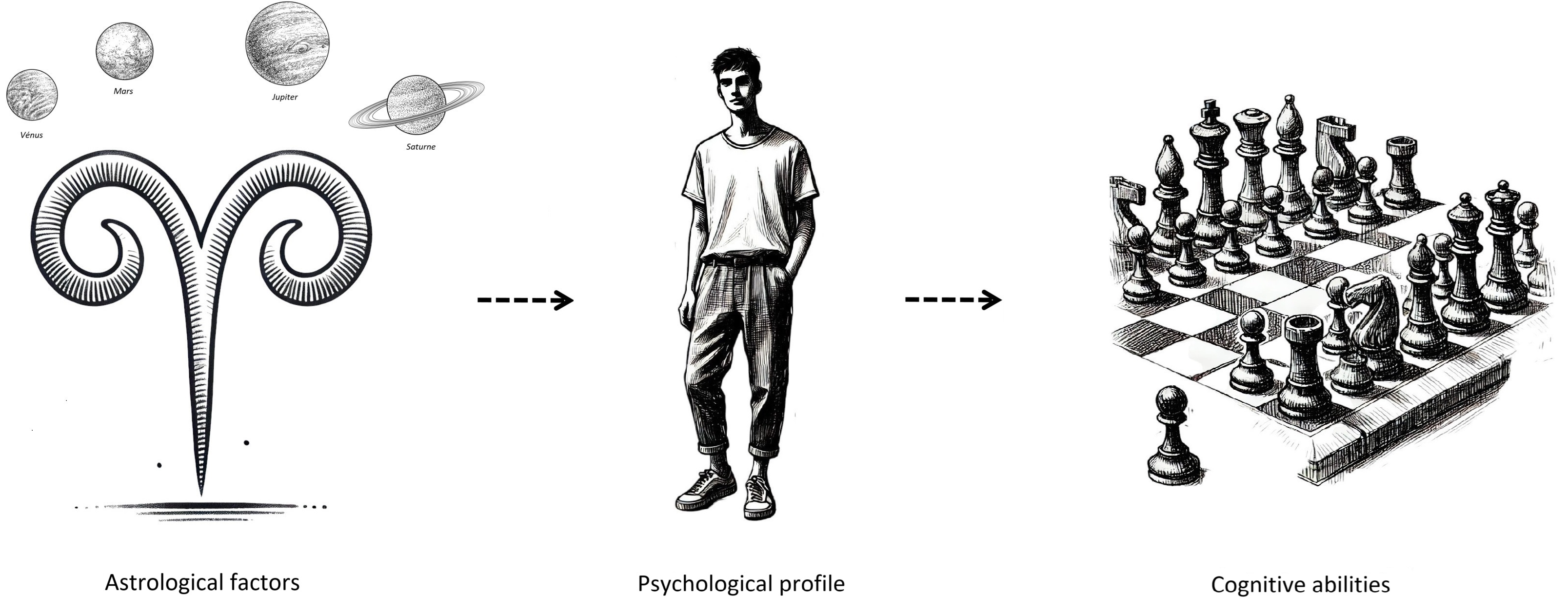
This model first illustrates the influence of the astrological chart on an individual's psychological and behavioral structure. For example, let’s consider a subject with a dominant Venus-Mars-Jupiter-Saturn stellium in Aries. This configuration would describe a personality marked by strong sensory perception (Venus-Mars, corresponding to the "e" level of the RET model), realism and practicality (Mars-Jupiter-Saturn, corresponding to the "E" level of the RET model), all set against a backdrop of dynamism and spontaneity (Aries).
The second connection then focuses on the cognitive abilities that characterize the individual and the activities in which they might apply these skills. Could this person develop the cold realism and strategic acumen required of a top-level chess player? That is difficult to determine from their natal chart alone.
Astrological influence is shaped by biological, sociocultural, educational, and environmental factors. Observing an individual's behavior and psychology helps us understand how their nervous system translates the potential influences of their astrological chart. To fully grasp and assess the relationship between the receiver-subject and the emitter-object2 we must examine the match between the subject’s receptive capacities and the object’s emitted properties.
Therefore, it is entirely possible that certain specific cognitive abilities correlate with planetary or zodiacal dominances. However, this correlation is contingent on the subject possessing a genetic sensitivity that facilitates its expression. This explains why we might observe unusual prominence of certain astrological planets (or zodiac signs) within a population group believed to have distinct cognitive faculties.
More broadly, one can imagine that a planetary or zodiacal function encompasses multiple potential cognitive abilities, with the subject's nervous system selectively enhancing some over others. This would explain why the same planetary or zodiacal dominance could be observed in two distinct population groups, even if they do not share identical skill sets at first glance.
Finally, a significant correlation between an astrological grouping and a particular activity suggests a measurable astrological influence. Through statistical methods, we can demonstrate the existence of an astrological effect within a group using rigorous analysis.
Grandmasters (GMI)
In astro-statistics, the more elite a selected population cohort is, the higher the chances of observing statistically significant results. The cohort of chess players studied here consists of individuals who have earned the title of Grandmaster (GMI), the highest rank in chess.
The French-born Grandmasters, according to the Elo ranking established by the International Chess Federation (FIDE)3:
- (2779) Maxime Vachier-Lagrave, born on October 21, 1990, at 03:05 in Nogent-sur-Marne
- (2671) Etienne Bacrot, born on January 22, 1983, at 10:15 in Lille
- (2647) Romain Edouard, born on November 28, 1990, at 13:40 in Poitiers
- (2644) Christian Bauer, born on January 11, 1977, at 20:50 in Forbach
- (2625) Laurent Fressinet, born on November 30, 1981, at 00:10 in Dax
- (2614) Yannick Gozzoli, born on June 2, 1983, at 17:00 in Marseille
- (2599) Maxime Lagarde, born on March 16, 1994, at 09:25 in Niort
- (2591) Sébastien Feller, born on March 11, 1991, at 09:25 in Thionville
- (2576) Jules Moussard, born on January 16, 1995, at 15:55 in Paris
- (2559) Sébastien Mazé, born on February 8, 1984, at 13:15 in Paris
- (2548) Matthieu Cornette, born on September 4, 1985, at 00:00 in Bègles
- (2548) Jean-Marc Degraeve, born on January 26, 1971, at 06:50 in Tourcoing
- (2542) Jean-Pierre Le Roux, born on May 18, 1982, at 04:30 in Guingamp
- (2518) Fabien Libiszewski, born on January 5, 1984, at 08:30 in Saint-Etienne
- (2508) Arnaud Hauchard, born on November 15, 1971, at 20:02 in Rouen
- (2506) Igor-Alexandre Nataf, born on May 2, 1978, at 13:10 in Paris
- (2505) Manuel Apicella, born on April 19, 1970, at 08:55 in Longjumeau
- (2503) Anthony Wirig, born on February 3, 1983, at 19:25 in Thionville
- (2502) Axel Delorme, born on May 8, 1990, at 01:23 in Lyon
- (2500) Adrien Demuth, born on April 14, 1991, at 11:30 in Saint-Denis de la Réunion
- (2495) Jean-Noël Riff, born on April 22, 1981, at 18:55 in Mulhouse
- (2477) Olivier Renet, born on December 21, 1964, at 23:25 in Cenon
- (2477) Jonathan Dourerassou, born on April 10, 1989, at 11:12 in Sarcelles
- (2463) Laurent Guidarelli, born on June 18, 1981, at 19:40 in Carpentras
- (2453) Eloi Relange, born on July 1, 1976, at 14:40 in Paris
- (2451) Marie Sebag, born on October 15, 1986, at 15:50 in Paris
- (2446) Jean-Luc Chabanon, born on August 13, 1971, at 18:00 in Clermont-Ferrand
- (2439) Éric Prié, born on March 14, 1962, at 17:20 in Paris
- (2439) Cyril Marcelin, born on May 16, 1979, at 06:25 in Suresnes
- (2421) Emmanuel Bricard, born on May 4, 1966, at 23:05 in Versailles
- (2369) Marc Santo-Roman, born on September 13, 1960, at 18:00 in Toulouse
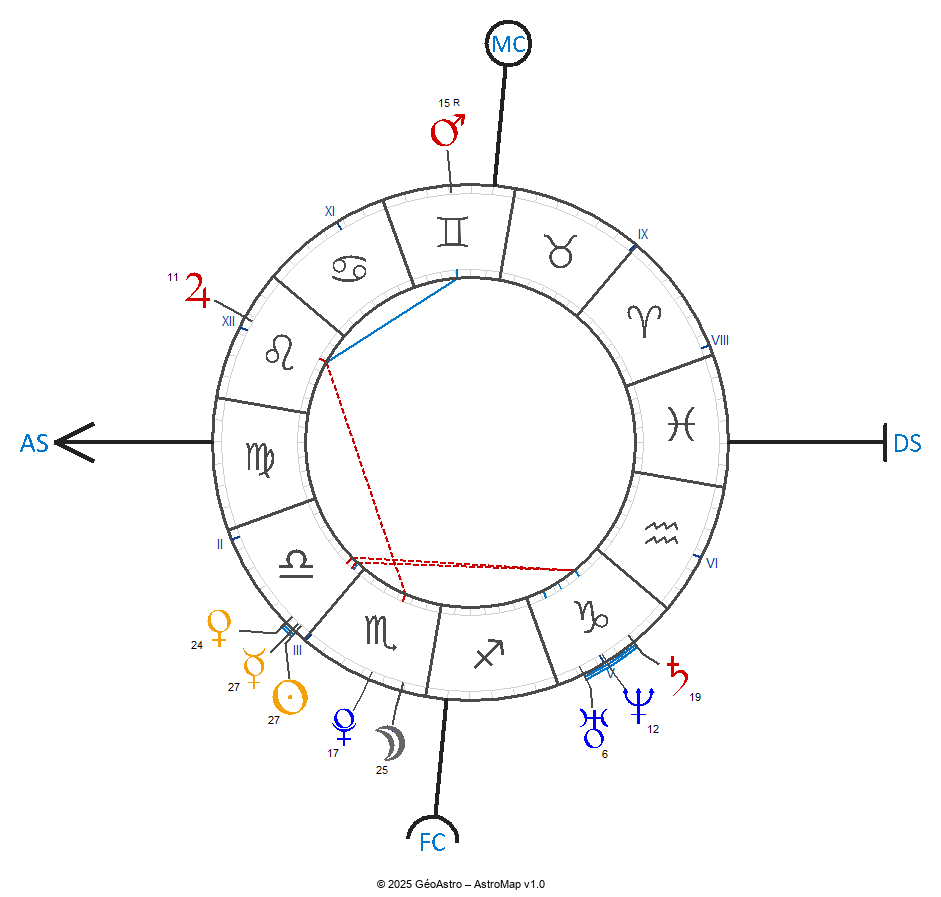
This astro-statistical study on chess players will focus on dominant planets and RET planetary families.
Since the GMI cohort consists of only 31 participants, analyzing zodiac signs is more challenging.
An astrological chart typically highlights only two or three zodiac signs, meaning a larger sample size would be needed to evaluate normal distribution probabilities and obtain statistically significant results.
The Dominant Planets of Chess Grandmasters
AstroStat Software
To statistically evaluate the astrological data extracted from a selected population cohort, it is necessary to calculate the probability that a randomly formed sample could show the same results.
Using a constant angular probability could be an initial evaluation method. An astrological chart consists of four angular areas (AS, MC, DS, FC), and their range in domitude spans 138° out of the 360° of the zodiac band, or approximately 38%4. This figure could serve as an average statistical value and a criterion to assess the planetary results obtained from the group of chess players under study.
However, this method, based on angularity, does not take into account the rotational speeds of the domitude zones in the chart, which vary from sign to sign, nor the respective orbital periods of the planets around the Sun, which also affect their frequency of angularity. Thus, this percentage only corresponds to an approximate average frequency of planetary angularity and is primarily useful for the astrologer in practical observations.
For a larger-scale statistical study, a statistical model is used to randomly mix the birth dates and times. This allows for establishing normal probabilities for each planet. The AstroStat software calculates the normal distribution probabilities of the planets by performing 10,000 random mixes of the birth dates and times of the selected chess players.
Then, the software determines the probabilities of obtaining statistical results identical to the chess players' group, based on the normal results obtained from the random distributions. This process evaluates how likely it is that the observed planetary patterns among chess players occurred by chance.
The evaluation criterion used by the AstroStat software is the average rank in the hierarchy, ranging from 1 to 10 for the astrological planets and from 1 to 8 for the RET planetary families. Using the average rank in the planetary hierarchy as an evaluation criterion allows for a more graduated and precise approach than the angularity criterion: it progressively determines what is strong, average, or weak in the astrological charts of the analyzed group.
Finally, in statistics, a result is considered mathematically improbable if it falls below a probability threshold of 5%. Results below this threshold are deemed too improbable to be due to chance, indicating an astrological effect.
Abnormal Planetary Valuations
The following graphs highlight the probabilities of obtaining the planetary valuations and RET planetary families of the International Chess Grandmasters, based on the normal distribution probabilities.
The Dominant Planets
The graph below shows the probability of obtaining lower planetary hierarchical ranks from random distributions.
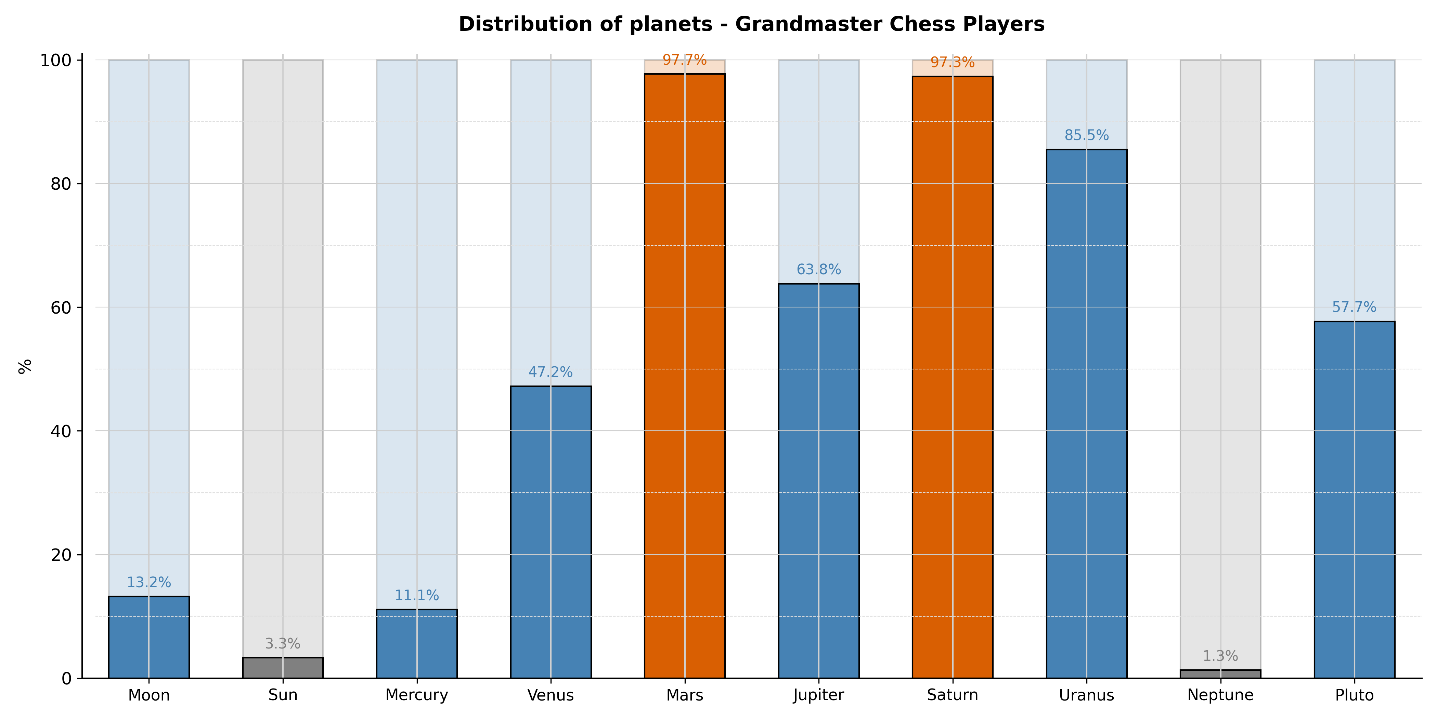
Each bar corresponds to a planet and shows the associated probability, expressed as a percentage. Values within the range expected under random chance (between 5% and 95%) are shown in blue, while significant deviations are highlighted using different colors: grey for underrepresentations (below 5%) and orange for overrepresentations (above 95%). For example, for the Sun, the probability that a random sample would show a lower value is approximately 3.3%.
Four planetary results stand out:
- The Sun is under-valued: 3.3 out of 100 simulations;
- Mars is overvalued: 97.7 out of 100 simulations;
- Saturn is overvalued: 97.3 out of 100 simulations;
- Neptune is under-valued: 1.3 out of 100 simulations.
Thus, compared to a random sample, there are about 3 chances in 100 of obtaining a lower valuation for the Sun, between 97 and 98 chances in 100 for Mars and Saturn, and about 1 chance in 100 for Neptune.
The RET Planetary Families
The next graph shows the probability of obtaining lower statistical results for the RET planetary families, using the same method.
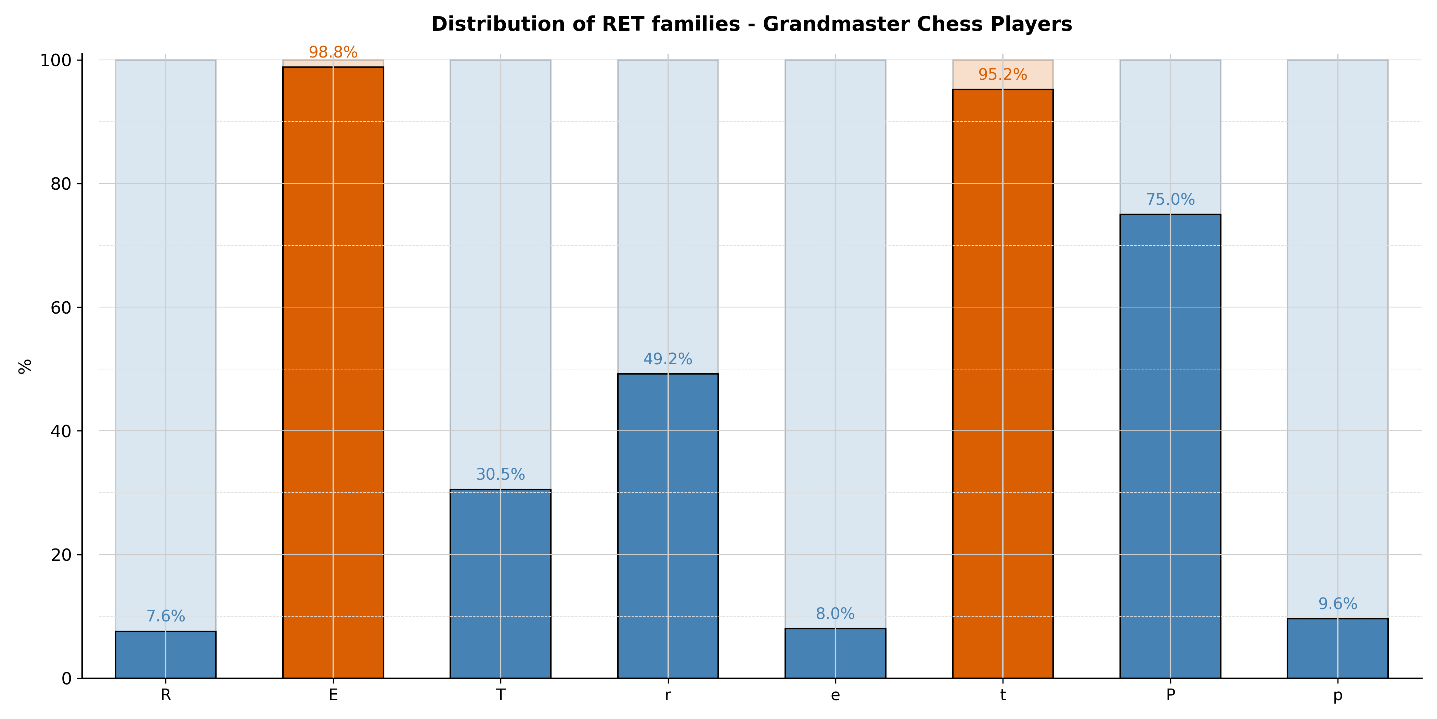
Each bar corresponds to a RET family and indicates the associated probability level. For example, for the extensive power family (“P”), the probability that a random sample would show a lower value is about 75%.
Two planetary families stand out with atypical results:
- The "extensive existence" family (E) is overvalued: 98.8 out of 100 simulations;
- The "intensive transcendence" family (t) has a slight over-valuation: 95.2 out of 100 simulations.
Thus, compared to a random sample, there are about 99 chances in 100 of observing a lower valuation for the extensive existence family, and about 95 chances in 100 for the intensive transcendence family.
The Planetary Profiles of Chess Players
Mars-Saturn or the Cartesian Mind
Two planets are significantly overrepresented among chess players: Mars and Saturn. These two planets belong to the "extensive existence" family, which forms realistic personalities that prioritize experience and have a practical mindset. We will seek to explain why these two planets are highly valued among top chess players. Why do they contribute to reaching the highest level in this popular strategic game?
Causalists and Probabilists
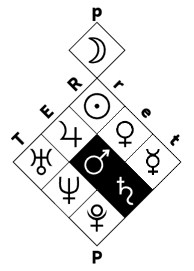
In conditionalist astrology, Mars is associated with the source level "E" and the goal level "e" of the RET. There is a redundancy of the existence level, meaning the world of facts, observable reality, and tangible phenomena.
Mars corresponds to the realm of pure mechanics, cause-and-effect dynamics, action leading to another action, principles of movement, and action-reaction. A Mars person is thus more attuned than others to observing phenomena, analyzing causes and effects (one fact leads to another), and may have a greater aptitude for understanding mechanical reasoning and the logic of gears.
To illustrate the type of reasoning a Mars person is supposed to be comfortable with, here are two examples:
1 - If wheel A turns counterclockwise, which way does wheel C turn?

Clearly, wheel B, which follows wheel A, turns clockwise, and wheel C, which comes next, turns counterclockwise.
2 - If wheel A makes six turns, how many turns does wheel C make?

This second question, slightly more complex than the first, requires counting the teeth on the wheels (one tooth drives another). When wheel A makes one full turn, 4 teeth are engaged on wheel B, as well as on wheel C (which has 6 teeth). Therefore, when wheel A makes 6 full turns, 24 teeth are engaged on wheel B, as well as on wheel C, which makes 4 turns (24/6).
This type of question requires practical logic and an understanding of cause-and-effect relationships. Here, both examples are simple, and anyone with a sufficient cognitive level will easily solve them. For a Grandmaster with a dominant Mars, this mechanical/logical intelligence reaches a very high level, allowing them to quickly assess all possible moves and the consequences resulting from the movement of each piece on the board.
Regarding Saturn, it is characterized in conditionalist astrology by the level "E" from which it starts and the level "t" to which it reaches. We transition from the world of facts, the observable and tangible, to the world of the multiple, the unknown, and the hypothetical.
With Saturn, we are in the realm of the hidden laws of reality, the mechanisms behind facts, experimental hypotheses, analytical thinking, and the investigation of events. A Saturn person is more attuned than others to formulating hypotheses and possible future consequences, having a greater capacity to deduce conclusions from pure hypotheses or probable phenomena.
To illustrate the type of reasoning a Saturn person is supposed to feel comfortable with, let’s look at syllogisms, characteristic of analytical thinking:
1 - Simple syllogism
All men are mortal
Socrates is a man
Therefore, Socrates is mortal
This first syllogism, easy to understand, requires bringing together two terms (Socrates and mortal) with a third common term, allowing us to conclude their mutual relationship. The reasoning becomes more complex when the common term is used in a universal proposition:
2 - Less simple syllogism
All A are C (all scientists are logical)
Some B are C (some psychologists are logical)
Therefore, some B are A (some psychologists are scientists)
The conclusion of this syllogism is false. One method to solve it is to replace the universal terms with concrete propositions (in parentheses) and be misled by linguistic confusion or by our preconceived beliefs about the propositions. The simplest way to solve this syllogism is, in fact, to mentally represent population circles:
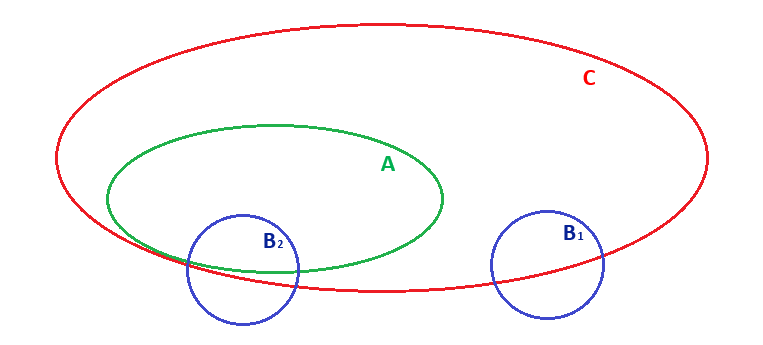
The first statement (all A are C) is easy to represent: draw circle A inside a larger circle C. The second statement (some B are C) is less simple to represent: draw circle B, where only part of it lies within circle C, but we do not know where circle B is positioned relative to circle A. There are two possibilities: one where circle B has no relation to circle A (B1), and the other where circle B overlaps circle A (B2).
We conclude that the syllogism's conclusion is false: some B are not necessarily A (case B1).
To answer such questions, the individual needs logical-deductive skills and the ability to dissect virtual possibilities. Here, both syllogisms are accessible. For a Grandmaster with a dominant Saturn, this analytical intelligence reaches a very high level, enabling them to quickly assess all potential moves, the probabilities of opponent reactions, and anticipate them.
A Simulation of Reflective Action
To determine the abilities required or facilitating access to a high level in chess, we will rely on various analyses5 dedicated to the psychology and strategy of this game.
Let's first analyze the mental gymnastics involved in a chess game. On this tactical battlefield, it's not just about mastering the rules; strategic thinking, foresight, and mental endurance are essential. In a chess game, players must create a strategic plan, which involves mentally exploring the different stages of the game: the opening (first moves on the board), the middlegame, and finally the endgame.
The openings aim to control the center of the board and develop pieces while protecting the king. The middlegame represents the main arena of battle, where players try to consolidate their positions and exploit their opponents' weaknesses. This is where they must coordinate their pieces and create strategic plans to gain an advantage. The game continues until the final phase, where competitors must find a way to secure victory (checkmate the opposing king).
In chess, players analyze the position of the pieces, devise strategies, anticipate possible moves, and evaluate risks. They meticulously plan their long-term strategy to trap their opponent while managing their time. This mental projection into the future of the game requires strong analytical and anticipatory skills, closely resembling the cognitive abilities discussed above regarding the planets Mars and Saturn.
Chess is a strategic simulation that mobilizes both causal-mechanistic observation (Mars) and the analytical anticipation of possibilities (Saturn). It involves positioning pieces and coordinating strategies, executing immediate maneuvers, and creating long-term plans, forecasting each move in one's mind... The cognitive Mars person, with their logical-empirical and causal mindset, joins the cognitive Saturn person, with their hypothesis-driven and probabilistic thinking, to reach the highest level in this strategy game.
The Neptunian Globalist and the Solar Model in the Blind
Two planets are under-valued in the Grandmaster group: the Sun and Neptune. Why are they thus dismissed by top chess players?
Let’s start with Neptune. In the RET, the Neptunian function has an inverse logic to that of the Saturnian function. While the latter begins at the "E" level and reaches the "t" level, Neptune begins at the "T" level and reaches the "e" level. Where the Saturnian focuses on the analysis ("t") of observable phenomena ("E"), the Neptunian prefers to feel ("e") the invisible ("T").
According to our statistical results, playing chess would require inhibiting the cognitive mode that the Neptunian favors: intuitive, clairvoyant, subtle, and nuanced, more intra-personal than Cartesian. Chess emphasizes analytical and rigorous logic, leaving little room for imagination, unlike creative disciplines.
In analyzing the possible moves and cause-and-effect mechanisms required to become a strong chess player (Mars-Saturn), the Neptunian prefers inspiration, the feeling of the external ambiance, and imagining virtual possibilities, which, according to our statistical results, opposes reaching the highest level in chess. A dominant Neptune is more frequently found in activities requiring imagination and empathy, such as art, spirituality, humanitarian work, or psychology.
Regarding the Sun, what explanation can be given for its under-valorization among chess players? Could this "game" unconsciously fulfill an Oedipal desire to "kill the king" (blind Sun), symbolizing the father, with the complicity of the queen-mother? Or is it simply a marked disinterest from this planet in playing chess?
Let's start by astrologically defining the Sun6 : "(The Sun) makes you more attentive to your appearance, your prestige. You know exactly what you want and what you are worth. You are aware of the image you project and what it represents. You do not mind being in the spotlight7". "Professions requiring brilliance, authority, a sense of structure and display. Positions more honorary than active." "The dispositions are brilliant, the subject is noticed early, and their destiny, like the daily course of the Sun, knows a phase of apotheosis8".
By reading these texts, it is clear that the solar personality contrasts sharply with the mindset of a chess player. Chess is a solitary activity, performed alone, not shared, and not fostering communication. The relationship with the opponent is also cold and distant: one focuses not on the opponent but on impersonal game pieces, one internalizes and does not communicate, all effort is directed at checkmating.
A dominant Sun naturally favors social exchanges and warm relationships. A true solar personality loves being noticed and listened to and may have more difficulty than others being in the shadows.
We imagine a chess player who is more inwardly focused, interested in their internal world rather than the company of others, and whose motivation is to invest their abstraction skills in a game that is more suited to this than to being admired. Not particularly appealing for a solar personality that enjoys appearances and being the center of attention.
Feet on the Ground and a Solid Critical Mind
At the level of RET planetary families, we observed a marked over-valorization of the extensive existence family ("E") and a slight over-valorization of the intensive transcendence family ("t").
The first result ("E" dominant) logically follows from the planetary results observed: Mars and Saturn, overvalued, both belong to the extensive existence "E" family. Chess players in our study stand out for their practical mindset, focused on raw facts and experience.
The over-valorization of the intensive transcendence family ("t") that follows supports the Saturnian formula compared to the Mars formula: high-level chess players are long-term realists, with a skeptical and reflective temperament, evaluating all possibilities, multiplying hypotheses, and questioning facts from all angles to extract hidden information ("t").
In contrast, the planet Mars ("eE"), also overvalued, is only supported at the planetary family level by the extensive existence "E" family. Chess players are thus more oriented towards concrete facts and observation logic than towards emotion or immediate sensations (less of the intensive existence "e").
Deep-Rooted Prejudices
An astro-statistical study serves the purpose of confronting theories with the reality of facts and highlighting any potential biases attributed to certain planets. In this case, it is Mars, more so than Saturn9 which has often been labeled by astrologers. Mars is often associated with athletes, soldiers, surgeons, adventurers—essentially, all professions requiring energy and dynamism. Conversely, it would not typically be expected to be found in high-level chess players.
However, observation shows that there are men of action who have weak Mars placements and individuals born under a strong Mars influence who are more speculative than active. In fact, Mars concerns the subject's realism, sensitizing them to raw facts ("eE").
Here, Mars-dominant chess players, much more numerous than in a random population sample, use their sense of realism and mechanistic logic in a strategic game—an activity much more speculative than active. After all, isn’t it said that intellectual evolution and human creativity are closely linked to the ability to play? When one has a good understanding of cause-and-effect mechanisms (Mars), it is fitting to use this in an intellectual activity that lends itself to it.
In general, theories and observations must engage in a dialogue to enrich each other. Observation refines our astrological descriptions and enhances our understanding of the astrological reality.
Another widespread misconception in astrology is that weak planetary placements merely reflect personal shortcomings, but this is not always the case. Our study shows that, to reach a high level in a given activity (in this case, chess), it may actually be preferable to have certain planets in blind spots.
Jean-Pierre Nicola's "Hero" and "Shadow" model10, offers a relevant insight on the matter. It is based on analyzing the strengths and weaknesses that structure an astrological chart. The Hero embodies the strong tendencies of the personality, associated with dominant planets and zodiac signs, while the Shadow groups together the non-dominant elements of the chart. When well-integrated, the Hero expresses their potential in an appropriate way, but in the case of dissonant configurations, their strengths may turn into excesses or awkwardness. The Shadow, on the other hand, constitutes a reservoir of adaptive resources: its harmonic aspects can be mobilized by dominant planets, particularly when these require complementary support.
The absence of certain astrological dominants can also turn out to be an asset. A Hero marked by a blind Sun, for example, expresses less concern for self-presentation and individual affirmation. Rather than suffering from a lack of recognition, the individual may prioritize areas where discretion and withdrawal are valued. For chess players, this weakness in both the Sun and Neptune appears to have favored their adaptation to a discipline that demands solitary concentration and where intuition must be inhibited.
Finally, there is a tendency to consider statistics unsuitable for studying astrology, as they may not adequately account for the complexity of the relationship between Humans and the Heavens. However, if the tool is used rigorously enough, it can reveal significant results and demonstrate astrological influence on a given group of individuals. The future will tell whether statistical methods will become a distinct branch of conditionalist astrology.
Methodological note — update
This article was originally based on analyses carried out using the AstroStat software developed by Julien Rouger. Since its publication, we have continued this work within the GeoAstro statistical engine, which follows the same methodological logic while adopting a more synthetic approach.
Minor differences may therefore appear between the results obtained with AstroStat and those generated in GeoAstro, without affecting the main trends discussed in this article.
The charts presented here were generated afterwards using GéoAstro, based on the same cohorts, in order to provide a consistent visual representation of the results.
Appendix: The chess grandmasters – Mars
This appendix presents additional statistical elements concerning the members of the chess grandmasters, based on graphical representations not included in the main article. These results aim to broaden the analytical perspective and to support a more nuanced interpretation of the data.
The result presented here corresponds to the most pronounced statistical deviation observed within the group and is provided as an illustrative example of the statistical evaluation method applied to all planets.
Gaussian Distribution Curve
A Gaussian function is an exponential function used to represent the distribution of a dataset based on the density of its values. The following Gaussian curve illustrates the probability of observing, in the general population, a lower valuation of Mars than the one found among chess grandmasters.
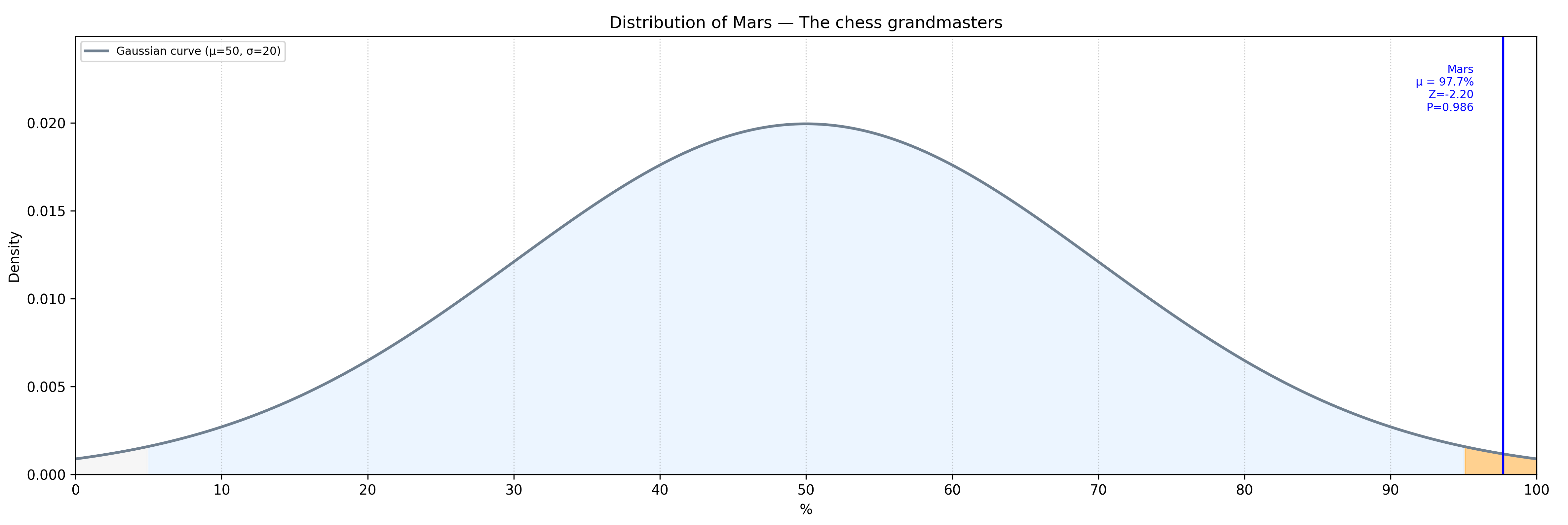
The graph above shows the following results for Mars:
- Empirical probability: 97.7% of simulations yield a lower score.
- Z-score: –2.20, indicating that the result is statistically significant.
- Theoretical p-value: 0.986, indicating the relative position of the observed result within the theoretical distribution expected under the null hypothesis.
Kernel Density Estimation Curve (KDE)
In statistics, kernel density estimation (KDE) is a non-parametric method used to estimate the probability density function of a random variable based on observed data. The KDE curve is based on hierarchical rank values, as the software computes probability estimates from the empirical distribution of these ranks.
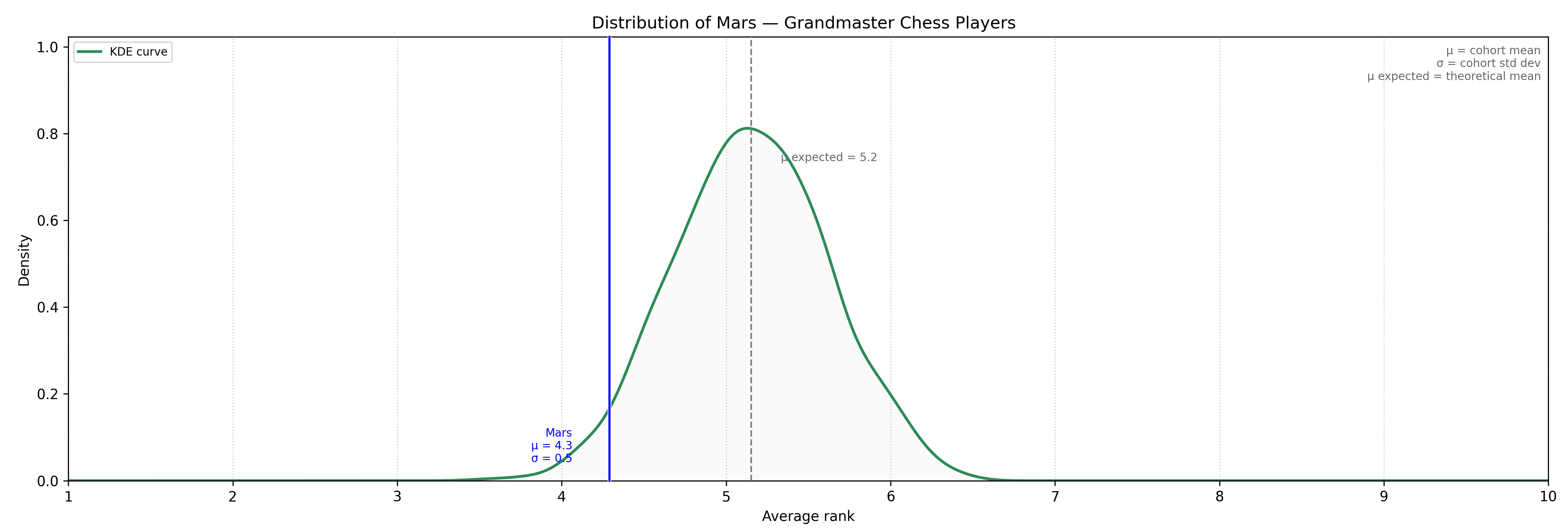
The graph above shows the following results for Mars:
- Cohort rank: 4.3 on a scale from 1 to 10.
- Cohort standard deviation: 0.5, indicating the dispersion of values around the mean rank.
- Expected rank: 5.2, corresponding to the theoretical average under a null hypothesis.
The Gaussian and KDE curves provide a statistical representation that complements the global histograms, allowing a more detailed examination of the rank distribution for a given element and its relative position within the studied population.
Notes
1See the astrological charts of Alan Turing, Bill Gates, Steve Wozniak, Mark Zuckerberg, etc.
2Read, among others, "Introduction au système S.O.R.I.", Richard Pellard, on AstroAriana.com.
3Check the official website of the French Chess Federation (FFE), under the sections "Secteurs de jeu, Haut niveau et titrés, Les Grand-Maîtres". The ranking is from 2020.
4The angular zones are defined according to the following ranges: 15° in the 1st house and 20° in the 12th house for the Ascendant; 18° in the 10th house and 20° in the 9th house for the Midheaven; 20° in the 7th house and 15° in the 6th house for the Descendant; 15° in the 4th house and 15° in the 3rd house for the Imum Coeli.
5See the following articles on CapaKaspa.info: "La stratégie et la psychologie dans le jeu d’échecs"; "La psychologie des échecs : concentration et décisions stratégiques"; and "La stratégie aux échecs : l’art de la guerre sur l’échiquier".
6It is noted in the statistical results of the RET planetary families that the "R" (extensive representation) family tends towards a slight undervaluation.
7Le Grand Livre des Prévisions, Éditions Sand, Jean-Pierre Nicola.
8Le Grand Livre de l’Astrologue, Éditions Sand & Tchou, Jean-Pierre Nicola.
9Saturn is more often attributed an influence on cerebral personalities than Mars, although this association is not always justified.
10Read "Le Héros et son Ombre", Jean-Pierre Nicola, on Astroariana.com.