
The Stars
Dancers of the Paris Opera Ballet
By Manuel da Costa — GeoAstro
The Paris Opera Ballet, based at the Palais Garnier, is the oldest and one of the most prestigious classical dance companies in the world. Founded in 1661 by Louis XIV, the Royal Academy of Dance was merged into the ballet corps of the Royal Academy of Music in 1669 and today forms part of the Paris Opera.
As of 2023, the ballet company includes 154 dancers, 17 of whom hold the esteemed title of “Étoile,” and performs more than 180 times per year. Most of the dancers are trained at the company’s own ballet school, widely regarded as one of the finest in the world. With few external recruits, the company’s internal talent pool ensures the stylistic consistency of French ballet.
“Étoile” is the highest rank a dancer can achieve within the Paris Opera Ballet’s hierarchy. The title is awarded on stage by the director of the Paris Opera, following a proposal from the director of dance. Since 2004, this prestigious appointment takes place in front of the audience...
In this article, we’ll explore whether we can once again observe any unusual planetary or RET planetary family emphases among the Étoiles of the Paris Opera Ballet. Does this specific group, like those studied previously, exhibit distinctive astrological traits?
Principal Dancers
The selected cohort includes both current and former principal dancers who have performed with the Paris Opera Ballet, according to the online encyclopedia Wikipedia. In total, 89 dance artists are listed, of whom 77 have a fully known birth chart1. The incomplete birth data (DN) concern the following individuals: Sae Eun Park, Hannah O'Neill, Eleonora Abbagnato, Marie Taglioni, José Carlos Martínez, Mickaël Parienté: born abroad; Emma Livry: born in Paris in 1841, but the birth certificate does not mention the time; Delphine Moussin, Laetitia Pujol, Alice Renavand, Patrick Armand, Jean-Pierre Franchetti: the known birth dates and places were not sufficient for the civil registry to locate them. Among these 77, there are 34 male dancers and 43 female dancers.
This group once again brings together many favorable conditions for significant astro-statistical results. The list comes from a reliable source, the selection criteria are both precise and elitist (the Étoiles are the very best in their field), and the activity itself appears to be highly specialized in terms of required abilities. Compared to other population cohorts, this one presents a remarkable characteristic: it consists of two subgroups2 — male and female dancers. The previous study on humorists also included a group of men and a group of women, but the gender balance was less even (only about twenty women out of 100 humorists), and statistical comparisons of the two subgroups did not reveal any significant results. This distinction allows us to compare their dominant astrological traits.
Below are the ballet artists of the Paris Opera who make up our cohort. Let us begin with the current Étoiles.
Male Principal Dancers:
- Mathieu Ganio, born on 16 March 1984 at 14:00 in Marseille
- Mathias Heymann, born on 1 October 1987 at 19:10 in Marseille
- Germain Louvet, born on 23 May 1993 at 22:50 in Chalon-sur-Saône
- Hugo Marchand, born on 7 December 1993 at 18:25 in Nantes
- Paul Marque, born on 12 April 1997 at 12:20 in Dax
- Marc Moreau, born on 6 November 1986 at 07:55 in Saint-Georges-de-Didonne
- Guillaume Diop, born on 6 March 2000 at 07:35 in Paris
Female Principal Dancers:
- Dorothée Gilbert, born on 25 September 1983 at 13:30 in Toulouse
- Ludmila Pagliero, born on 15 October 1983 at 08:25 in Buenos Aires (Argentina)
- Myriam Ould-Braham, born on 14 January 1982 at 02:15 in Neuilly-sur-Seine
- Amandine Albisson, born on 30 January 1989 at 17:45 in Marseille
- Laura Hecquet, born on 8 April 1984 at 09:20 in Dunkirk
- Léonore Baulac, born on 10 May 1990 at 17:38 in Paris
- Valentine Colasante, born on 5 March 1989 at 11:25 in Paris
Former Male Étoiles:
- François Alu, born on 3 December 1993 at 10:10 in Saint-Doulchard
- Jean-Paul Andréani, born on 22 May 1929 at 03:00 in Le Petit-Quevilly
- Cyril Atanassoff, born on 30 June 1941 at 05:30 in Puteaux
- Albert Aveline, born on 23 December 1883 at 02:00 in Paris
- Jean Babilée, born on 3 February 1923 at 21:30 in Paris
- Jean-Guillaume Bart, born on 7 June 1972 at 07:00 in Saint-Denis
- Patrice Bart, born on 30 July 1945 at 03:30 in Paris
- Kader Belarbi, born on 18 November 1962 at 15:35 in La Tronche
- Jérémie Bélingard, born on 19 August 1975 at 04:15 in Paris
- Jean-Pierre Bonnefous, born on 9 April 1943 at 22:10 in Bourg-en-Bresse
- Max Bozzoni, born on 30 May 1917 at 03:00 in Paris
- Stéphane Bullion, born on 8 April 1980 at 15:30 in Lyon
- Michael Denard, born on 5 November 1944 at 11:15 in Dresden (Germany)
- Patrick Dupond, born on 14 March 1959 at 09:00 in Paris
- Jean Guizerix, born on 27 October 1945 at 16:40 in Paris
- Laurent Hilaire, born on 8 November 1962 at 16:35 in Paris
- Josua Hoffalt, born on 19 May 1984 at 00:05 in Pertuis
- Charles Jude, born on 25 July 1953 at 10:45 in My Tho (Vietnam)
- Attilio Labis, born on 5 September 1936 at 07:00 in Vincennes
- Manuel Legris, born on 19 October 1964 at 09:55 in Paris
- Nicolas Le Riche, born on 29 January 1972 at 16:10 in Sartrouville
- Jean-Yves Lormeau, born on 6 March 1952 at 12:30 in Dalat (Vietnam)
- Hervé Moreau, born on 2 December 1977 at 03:00 in Saint-Mandé
- Karl Paquette, born on 19 December 1976 at 13:40 in Paris
- Benjamin Pech, born on 3 April 1974 at 12:15 in Béziers
- Michel Renault, born on 15 December 1927 at 02:30 in Paris
- Wilfried Romoli, born on 2 March 1963 at 19:40 in Saint-Denis
Former Female Étoiles:
- Josette Amiel, born on 19 November 1930 at 15:00 in Vanves
- Carole Arbo, born on 24 September 1961 at 22:30 in Biarritz
- Claude Bessy, born on 21 October 1932 at 04:00 in Paris
- Yvette Chauviré, born on 22 April 1917 at 08:15 in Paris
- Isabelle Ciaravola, born on 12 March 1972 at 06:45 in Ajaccio
- Florence Clerc, born on 23 July 1951 at 23:10 in Houilles
- Émilie Cozette, born on 8 August 1981 at 08:10 in Rouen
- Lycette Darsonval, born on 12 February 1912 at 01:00 in Coutances
- Liane Daydé, born on 27 February 1932 at 00:25 in Paris
- Aurélie Dupont, born on 15 January 1973 at 11:30 in Paris
- Fanny Gaïda, born on 7 September 1961 at 11:40 in Saint-Germain-en-Laye
- Marie-Agnès Gillot, born on 7 September 1975 at 13:32 in Caen
- Isabelle Guérin, born on 6 May 1961 at 01:00 in Rosny-sous-Bois
- Sylvie Guillem, born on 23 February 1965 at 05:00 in Paris
- Dominique Khalfouni, born on 23 June 1951 at 15:00 in Charenton-le-Pont
- Geneviève Laffitte, born on 6 February 1965 at 22:00 in Carcassonne
- Françoise Legrée, born on 15 July 1957 at 11:30 in Paris
- Agnès Letestu, born on 1 February 1971 at 05:40 in Saint-Maur
- Monique Loudières, born on 15 April 1956 at 15:15 in Choisy-le-Roi
- Elisabeth Maurin, born on 1 January 1963 at 07:30 in Angers
- Claire Motte, born on 21 December 1937 at 06:30 in Belfort
- Clairemarie Osta, born on 10 July 1970 at 05:50 in L’Haÿ-les-Roses
- Ethéry Pagava, born on 13 March 1932 at 09:45 in Paris
- Marie-Claude Pietragalla, born on 2 February 1963 at 07:45 in Paris
- Wilfride Piollet, born on 28 April 1943 at 15:30 in Saint-Rambert-d’Albon
- Élisabeth Platel, born on 10 April 1959 at 14:00 in Paris
- Noëlla Pontois, born on 24 December 1943 at 12:30 in Vendôme
- Jacqueline Rayet, born on 26 June 1933 at 09:55 in Paris
- Solange Schwarz, born on 12 November 1910 at 13:00 in Paris
- Claudette Scouarnec, born on 19 October 1940 at 17:30 in La Rochelle
- Ludmilla Tchérina, born on 10 October 1924 at 04:30 in Paris
- Ghislaine Thesmar, born on 18 March 1943 at 02:30 in Beijing (China)
- Nanon Thibon, born on 1 November 1943 at 23:30 in Paris
- Christiane Vaussard, born on 17 November 1923 at 11:45 in Neuilly-sur-Seine
- Christiane Vlassi (Bassi), born on 5 June 1938 at 07:00 in Neuilly-sur-Seine
- Claude de Vulpian, born on 29 December 1952 at 01:10 in Paris
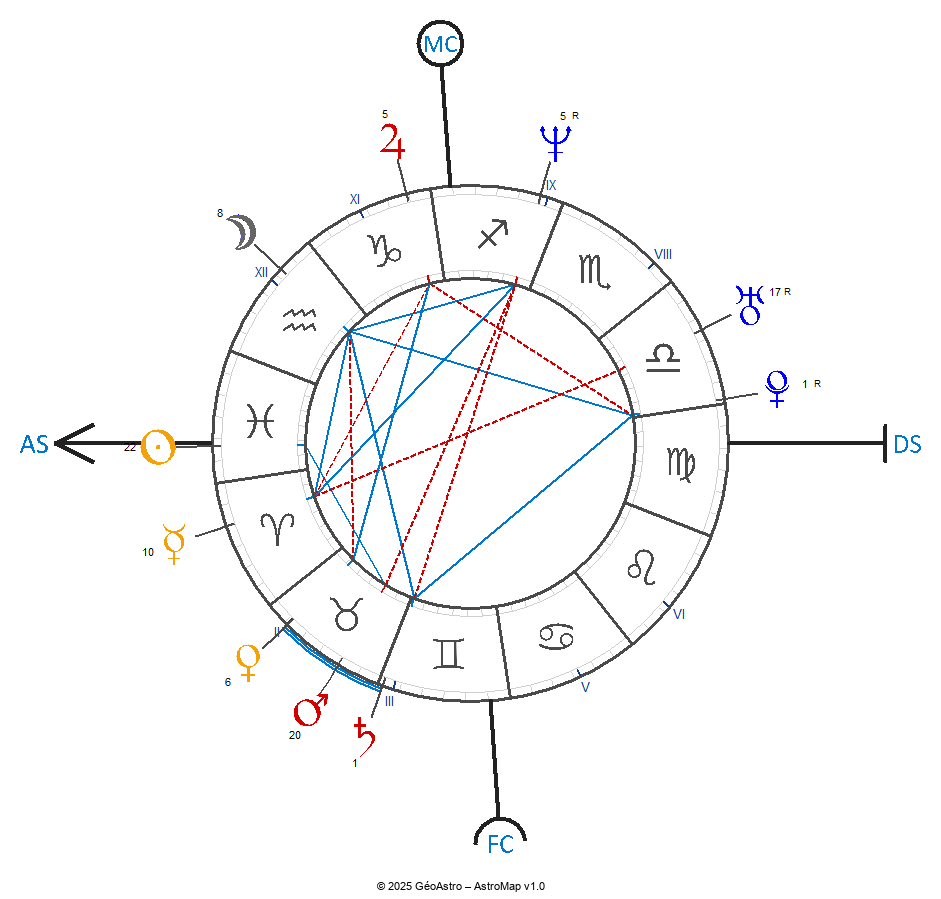
The Étoile dancer Isabelle Ciaravola was born with the Sun in Pisces and Mercury in Aries, both dominant at the Ascendant, opposed to Pluto and Uranus located at the Descendant. Jupiter is also angular at the Midheaven, in a square to Mercury and Pluto.
According to her chart, Isabelle Ciaravola is primarily sociable, radiant, and communicative (Sun-Mercury "R"), as well as determined, self-assured, and strong in decision-making (Sun-Jupiter-Uranus "r").
To go further, the dominant astrological signs3 emphasize the Sense of Contrasts (dominant Pisces and Aries), which sensitizes one to choices between conflicting values or situations, as well as the slowness of winter inhibition (Pisces and Moon in Aquarius): one is calm, phlegmatic, resilient, and enduring.
Astrological Dominants of the Étoiles
The following charts present the probabilities of observing the planetary and RET planetary family dominants found among the Étoiles (principal dancers) of the Paris Opera, based on normal distributions.
Planetary Dominants
The chart below shows the probability (on the vertical axis, from 0% to 100%) of obtaining lower planetary rank values based on random distributions. The planets of the astrological chart, from the Moon to Pluto, are shown on the horizontal axis.
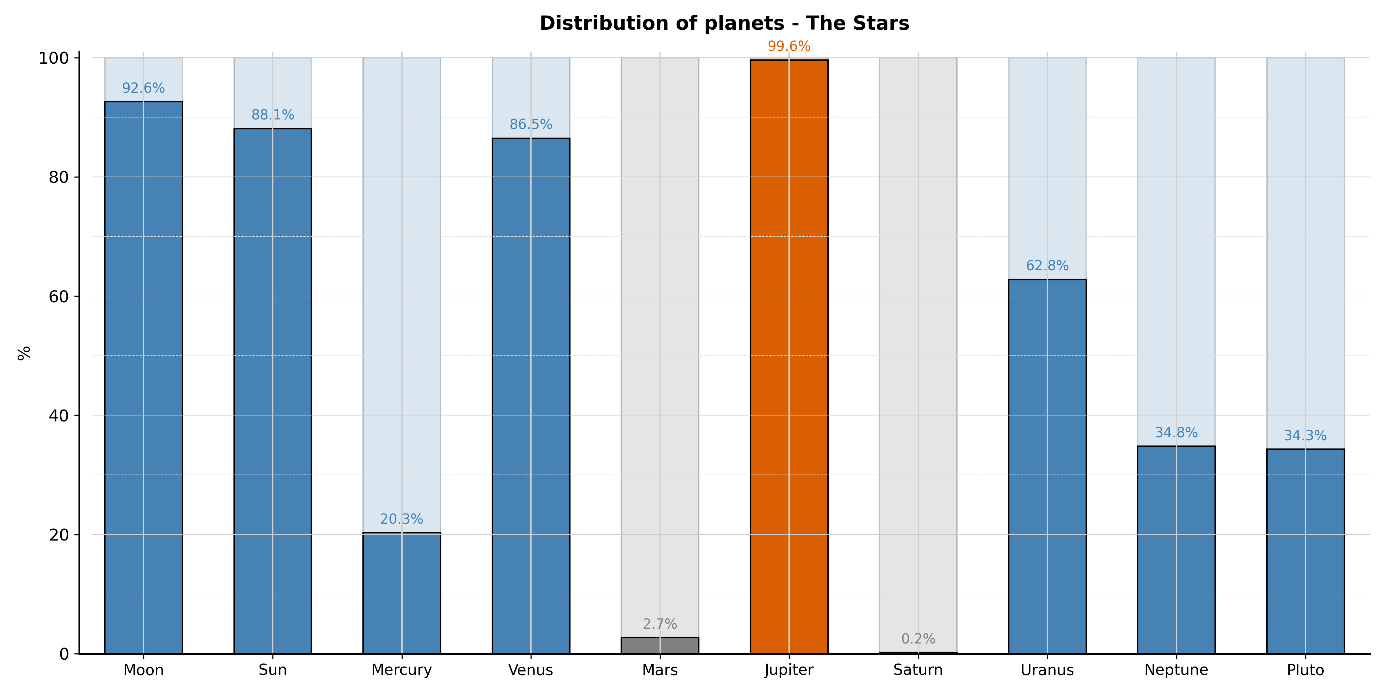
Three planets stand out due to statistically unlikely, atypical results:
- Jupiter is overvalued: 99.6 out of 100 simulations;
- Mars is under-valued: 2.7 out of 100 simulations;
- Saturn is under-valued: 0.2 out of 100 simulations.
Compared to a random population sample, there are more than 99 out of 100 simulations of observing a lower Jupiter valuation, between 2 and 3 out of 100 simulations for Mars, and less than 1 chance out of 100 for Saturn. It is worth noting that three planets, each displaying statistically atypical valuations, all belong to the "extensive existence" (E) family of the RET model.
RET Planetary Family Dominants
The chart below shows, using the same method, the probability of obtaining lower statistical results for the RET planetary families.
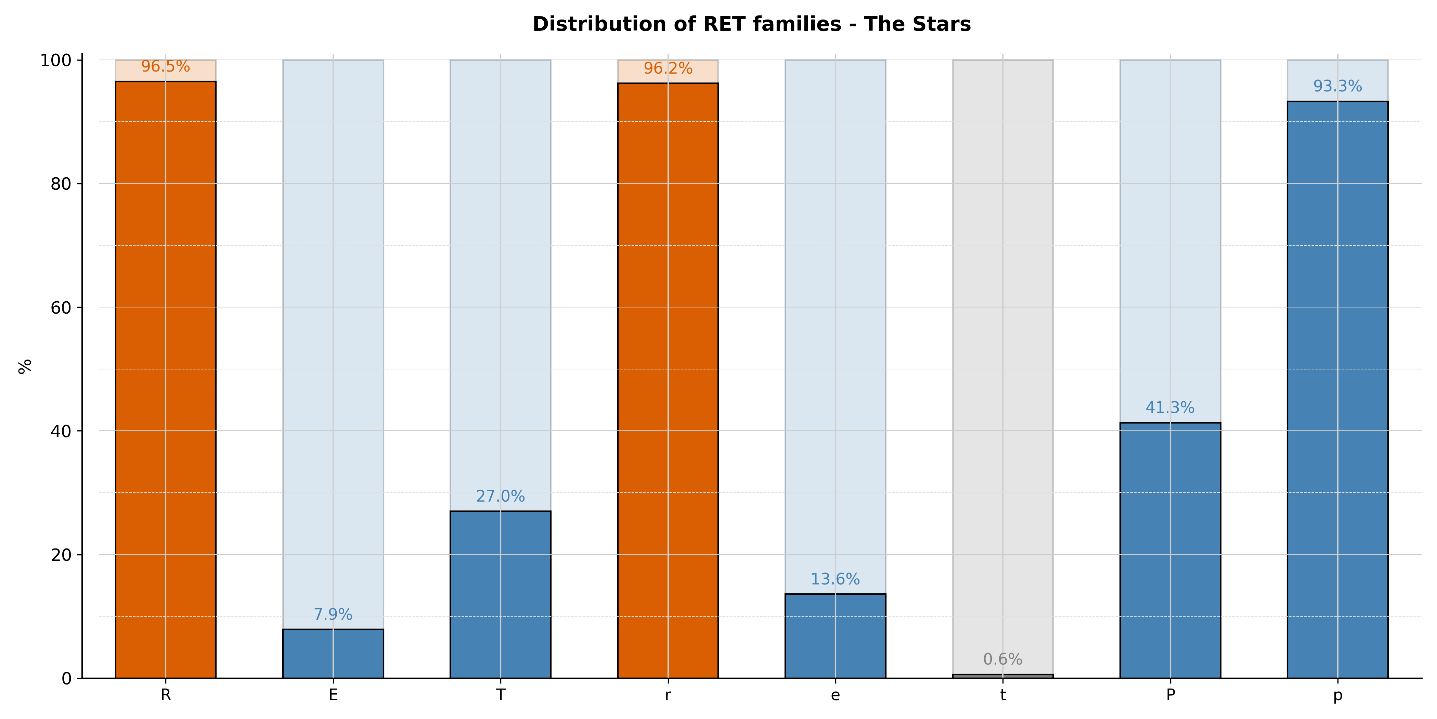
Three planetary families stand out:
- The "extensive representation" (R) family is overvalued: 96.5 out of 100 simulations;
- The "intensive representation" (r) family is overvalued: 96.2 out of 100 simulations;
- The "intensive transcendence" (t) family is under-valued: 0.6 out of 100 simulations.
Compared to a random population sample, there are between 96 and 97 out of 100 simulations of observing a lower valuation of the extensive representation and intensive representation families, and less than 1 chance out of 100 for the intensive transcendence family. It is also worth noting that the "intensive power" (p) family comes close to the overrepresentation threshold with a statistical probability of 93.3%, though it does not surpass it.
Some of the results observed among the dancers of the Paris Opera appear to be correlated: Jupiter, which is overrepresented, belongs to the intensive representation ("r") family, which is also overrepresented. Conversely, Saturn, associated with the intensive transcendence ("t") family, is underrepresented, as is this planetary family. We can thus mainly interpret a strongly dominant Jupiter “r” and a non-dominant Saturn “t”.
A Comparison Between Men and Women
As part of our study on the Étoiles of dance, it is relevant to make a comparison between men and women, as the cohort is fairly balanced (34 men and 43 women). The statistical results obtained are as follows.
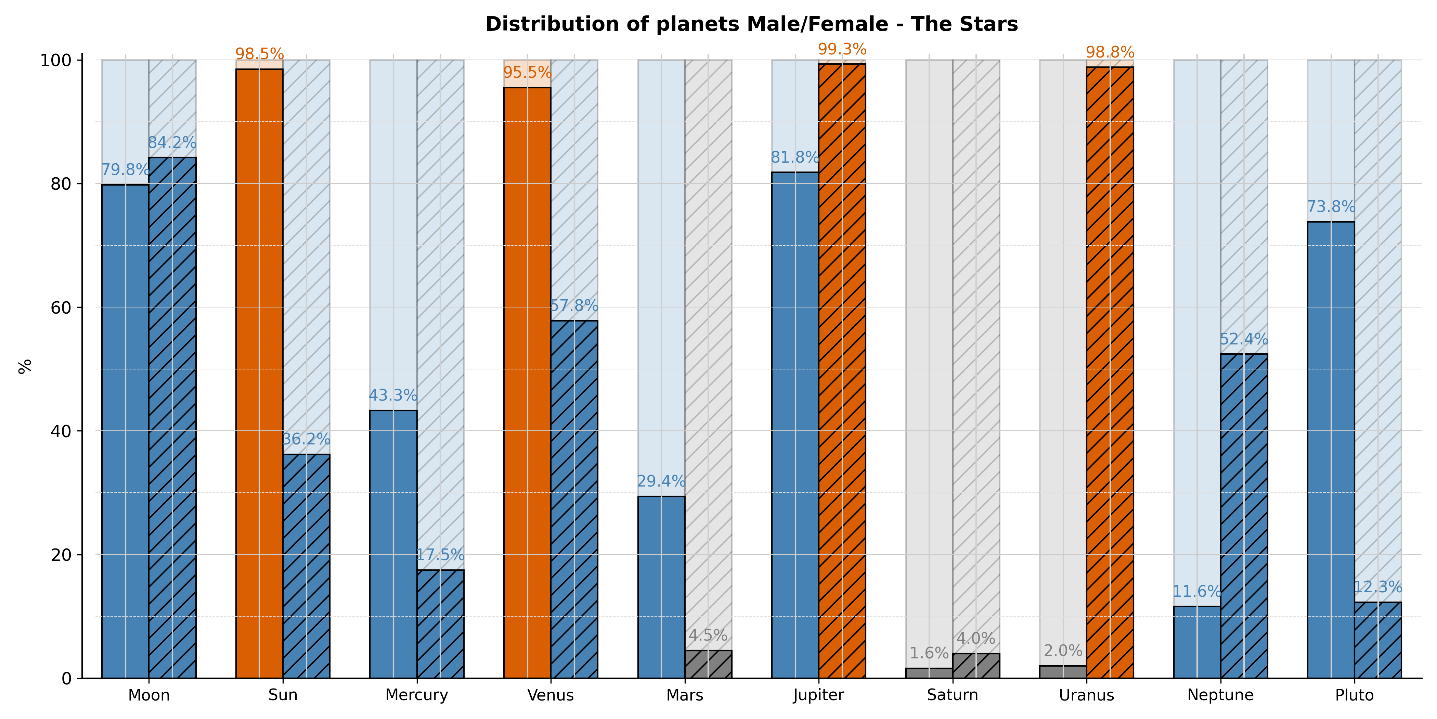
For each planet, two bars are shown: one for male dancers (solid) and one for female dancers (hatched). Here are the main results to note.
For male dancers:
- The Sun and Venus are overvalued, with probabilities of 98.5% and 95.5%, respectively;
- Saturne and Uranus are under-valued, with statistical probabilities of 1.6% and 2%.
For female dancers:
- Jupiter and Uranus are overvalued, with probabilities of 99.3% and 98.8%, respectively;
- Mars and Saturn are under-valued, with statistical probabilities of 4.5% and 4%.
We conducted the same comparison in terms of RET planetary:
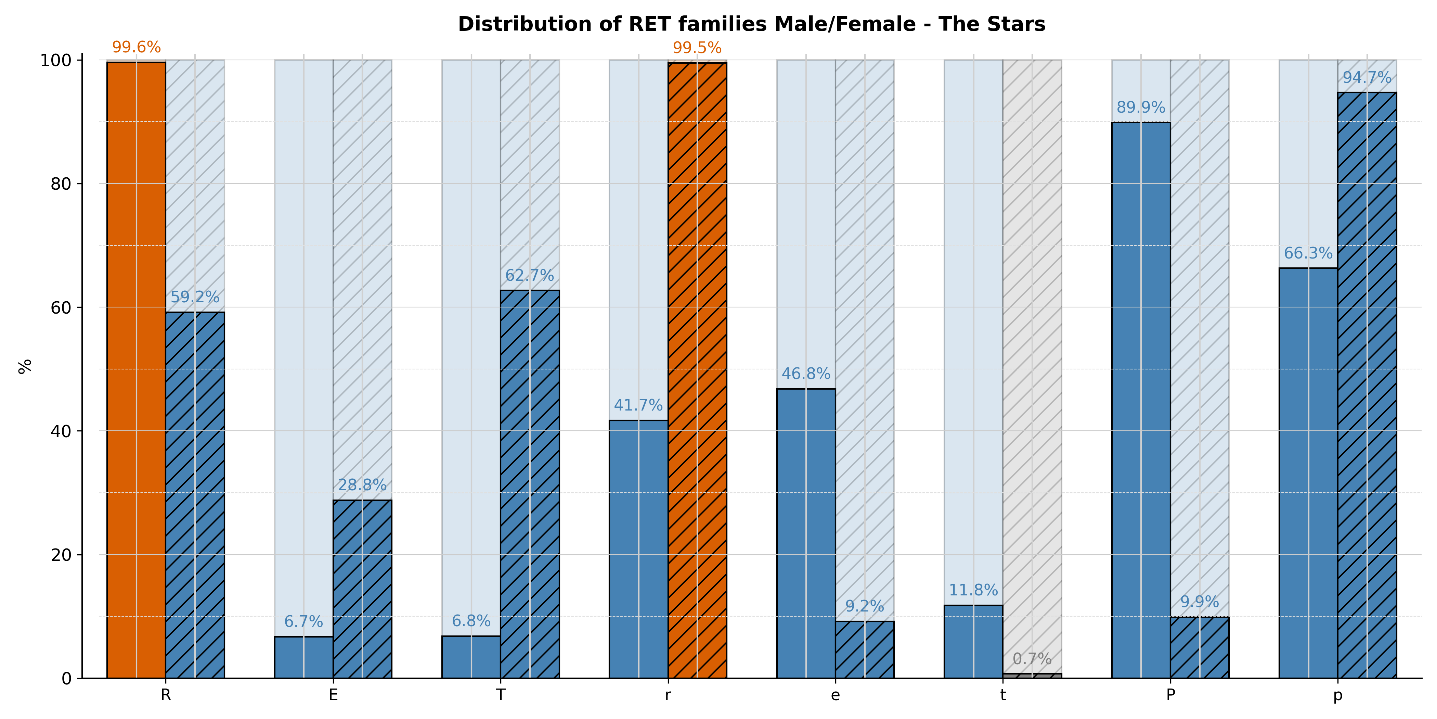
RET results — Male dancers:
- The "extensive representation" (R) family is overvalued, with a probability of 99.6%.
RET results — Female dancers:
- The "intensive representation" (r) family is overvalued, with a probability of 99.5%;
- The "intensive transcendence" (t) family is under-valued, with a probability of 0.7%.
When comparing the results, we observe that male dancers exhibit an overrepresentation of the Sun, Venus, and the extensive representation family (the Sun and Venus belong to the “R” family). Female dancers, on the other hand, display an overrepresentation of Jupiter, Uranus, and the intensive representation family (Jupiter and Uranus belong to “r”), as well as an underrepresentation of Saturn and the intensive transcendence family (Saturn belongs to “t”). Finally, the case of Uranus is noteworthy, as it is underrepresented among male dancers and overrepresented among female dancers.
Entering the Dance
The three planets that show atypical results within our cohort of Étoiles are Jupiter, which is overrepresented, and Mars and Saturn, which are underrepresented. As the adjacent chart illustrates, all three planets belong to the planetary family of extensive existence or “E,” which pertains to observable facts, tangible phenomena, experience, sensation, and lived reality. From this foundational level “E,” Jupiter gravitates toward the representational goal level (“r”), associated with simplicity, visibility, and familiarity; Mars remains at the existential level (“e”), centered on sensation and concrete realities; and Saturn is directed toward the transcendental goal level (“t”), the domain of questioning, complexity, and the unknown.
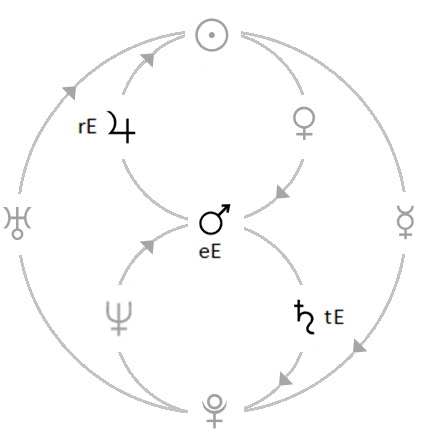
Furthermore, we observed The statistical results also highlighted4 an overvaluation of the family "Représentation extensive" or "R." This will be further discussed below, as it is really marked only in male dancers. an overrepresentation of the planetary family intensive representation (“r”), to which Jupiter belongs, and an underrepresentation of the family intensive transcendence (“t”), linked to Saturn.
How can these statistical findings among the Étoiles of the Paris Opera be explained?
A Machine for Social Reproduction
To guide our inquiry, we will draw on the book Entrer dans la danse (“Entering the Dance”)5 Joël Laillier, Entrer dans la danse. L’Envers du Ballet de l’Opéra de Paris (CNRS Éditions, 2017). by sociologist Joël Laillier. This field study explores the conditions under which dancers of the Paris Opera become Étoiles and will serve as a thread to help us interpret the astro-statistical results mentioned above.
The Paris Opera Ballet is one of the most prestigious dance companies in the world. It is considered both the oldest ballet company still in operation and the representative of the French classical dance style, regarded as the first of its kind. This style is distinguished by its unique gestures and techniques: poses, glides, arabesques, arm movements, leg beats, and spatial patterns. Its repertoire is broad, ranging from Romantic references and great classical ballets to works by the Ballets Russes, as well as modern, neoclassical, and contemporary choreography.
A General Homogeneity
According to the author, the entire operating logic of the Paris Opera is geared toward reproducing established dance practices and shaping bodies to match the stereotypes valued by the institution. Ballet performances demand similarity among dancers, synchronization, and overall uniformity, based primarily on a "homogeneity of bodies and ways of dancing." This aesthetic of bodies and practices allows the Opera to claim a distinct identity and singularity, thus ensuring its continuity and reproduction as an elite within its professional field.
This reproduction of elite status—selecting dancers who share not only similar physical characteristics but also the same way of executing movements—illustrates the logic of the Jupiterian function (representation of existence), which is overrepresented among the Étoiles of the Opera.
At the collective level, Jupiter’s function is to orient actions, practices, and experiences (“E”) toward a defined goal, guided by predetermined norms and models (“r”). The planet is attuned to actions and skills (“E”) that are organized according to tested and recognized standards (“r”).
Classical dance at the Opera relies on physical expression and the use of the body (“E”), strictly in line with the codified norms taught within the institution (“r”). Learning and practicing dance here involve a genuine formatting of both mind and body, with the aim of conforming to the mold imposed by the institution’s models and standards (Jupiter “r”): a certain idea of the sublime, a particular aesthetic of bodies, a unique style, a pursuit of perfection in movement…
Such vocational commitment ultimately demands self-transcendence, a quest for excellence that is both physical and technical: near-sacrificial investment, intensive use of the body, rationalization of physical pain, and the reconstruction of one's self-image around dance. From the viewpoint of intensive representation, it is about reaching… for the stars, pushing the system to its limits.
The Paris Opera School
The Paris Opera School operates according to the same logic of institutional norm reproduction and occupies a central place in this process, as nearly all the Étoiles have trained there. Often described as a true factory for artistic elites, the ballet company selects and trains young children, often from the age of 8 or 10, in order to mold their bodies and teach them how to dance in the style unique to the Opera.
Here again, we find the logic of conformity to valued stereotypes, central to the Jupiterian “rE” function. The children selected are first and foremost seen as gifted, because they display physical traits and predispositions that mark them as future dancers: slender morphology, long and fine legs, particular shape of the waist, feet, arms, neck, and shoulders; flexibility in the back and hips… In short, selection is based on aesthetic and physical criteria that conform to institutional standards (Jupiter and “r”).
In addition to these supposed innate physical qualities, evaluation also takes into account talents such as musicality and sense of rhythm. This additional criterion enables the Opera to shape the students’ way of dancing, once again with the goal of ensuring the reproduction (Jupiter and “r”) of its identity and uniqueness.
Lastly, certain social resources greatly facilitate access to a career as an Étoile. Yet many parents do not fully support this career path, instead seeking the prestige and education the institution provides. For them, the Opera is perceived as a gateway to elite social status, a way to gain access to the most “legitimate” culture—the culture of the ruling classes: proper conduct, moral values, aesthetic judgments, “good taste”…
This dynamic of reproduction and social ascent once again evokes the attributes of Jupiter. On an individual level, when well-integrated, Jupiter predisposes one to seek a socially rewarding position and to fulfill material ambitions. In the RET planetary model, moving from Mars to the Sun symbolizes a desire to rise above the crowd and achieve social recognition.
That same representational dynamic seems to apply to the Opera itself. Did we not observe that through its logic of reproducing the physical and aesthetic criteria of classical dance, it seeks above all to maintain its legitimacy and social prestige in its professional domain (Jupiter)?
A Rigorist and Sectarian Environment
We explained that the functioning of the Opera is primarily based on a logic of reproduction (“r”) of norms and practices (“E”), which closely mirrors the attributions of the Jupiterian function. The school’s formal objective is to select future dancers for the company and shape them for the Paris Opera ballet.
This “factory” for Étoile dancers, while necessary for the institution to preserve its original identity and solidify its social legitimacy, nonetheless presents aspects of rigorism and sectarianism. This exaggerated logic of model reproduction involves the repression of spontaneous behaviors (blind Mars), especially in the students, as well as the exclusion of any practice or norm that disrupts the standards valued by the institution (blind Saturn). Indeed, we have observed an underrepresentation of both Mars and Saturn among the Étoiles of the Opera.
A Particular Disciplinary Framework
The Opera School functions as a closed social group focused on the learning of dance. The sociological study mentioned earlier emphasizes the strict educational framework within which the students of the school evolve to become the future dancers of the company.
The first aspect of this strict educational environment is reflected in precise temporal and spatial constraints within the boarding school. All students must wake up at a set time and have 30 minutes to make their bed, shower, and tidy up their belongings. They then head to class. At precisely noon, they must be at the cafeteria, from which they can only leave with permission. Finally, the afternoon is entirely devoted to the dance studio and rehearsals, followed by dinner and curfew.
In addition to these temporal constraints, there is constant surveillance and submission to the same obligations governing the institution. Each term, students receive a behavior grade, which is factored into their final grade and end-of-year ranking. Everything seems designed to stifle any spontaneous impulse, thus preventing any free expression of immediate desires and moods (blind Mars).
At first glance, such a disciplinary framework might be associated with the planet Jupiter; however, its extreme rigidity also resembles the repression of Mars, which lies just below Jupiter in the RET system. Mars is linked to direct contact with the environment, to action and reaction based on immediate experience (“eE”). When a theme is marked by dominant Jupiter and blind Mars, the spontaneous expression of desires and impulses (non-“eE”) is suppressed, deemed thoughtless or unreasonable. The priority is given to absolute self-control, which involves distancing oneself from immediate emotions and desires.
It is precisely according to this logic that the Étoiles dancers appear to be molded: the strict framework they operate within tends to suffocate any spontaneous freedom of existence, perceived as a source of disorder and scatter (non-“eE”).
The second aspect of the Opera School’s rigid disciplinary framework is revealed in the very teaching of dance. The “training” imposed on the students during their dance lessons is based on an extreme demand for body control: straight posture, straightened back, tucked-in stomach, low shoulders, neck held precisely… The instruction aims to transmit distinct rules of conduct that students must deeply integrate in order to assimilate the behavioral norms of the institution.
This body control is also exercised under the constant gaze of others. Teachers and students continuously observe and evaluate each dancer’s attitudes, gestures, and expressions. This constant exposure is the primary means of incorporating the ways of dancing, bodily norms, and posture, with obsessive attention to detail. Even during rest periods, students must stand straight, avoid leaning on the barre, or appearing slouched.
Typical behaviors, rigid body posture, and an obsessively controlled self-presentation… Once again, we encounter the dual logic of a strong Jupiter and a blind Mars. Everything is designed to limit, domesticate, and impose absolute self-control over spontaneous personal expressions (weak Mars) in order to conform the dancers to the institution's norms, which are meant to embody an artistic elite (Jupiter “rE”).
A Self-contained Environment
The sociological study also highlights the Opera's rigid closure to any outside influence, whether it be practices foreign to its standards or any form of originality. The Étoiles are almost exclusively recruited internally within the school, and the few external dancers hired are subject to extremely strict evaluations based on criteria specific to the institution.
The Opera, which claims to be the birthplace of classical dance, bases its legitimacy on the rigid maintenance of its original identity. Above all, it is about ensuring that the members of the institution conform to the dominant habits, excluding any practice or norm foreign to the stereotypes of the Opera. Upon entering the school, students are told they are not there to become mere dancers, but to become Opera dancers, trained according to the exclusive criteria of the institution.
We have mentioned that the planet Saturn, like Mars, is blind in the Étoiles. Additionally, the intensive transcendence family (“t”) is also underrepresented. The Saturnian function invites us to question and step back (“t”) from facts and experiences (“E”). When dominant, it encourages the questioning of practices and know-how, the opening to the unknown and to multiplicity.
Once again, it appears that the functioning of the Opera, which can be described as excessive, is based on a strong Jupiter, accompanied by a repression of Saturn. This logic of reproducing the institution's specific norms (Jupiter “rE”) leads to the rejection of any form of innovation, whether it be a different dance style or new aesthetic criteria that could alter the Opera’s image (blind Saturn and “t”).
This logic of closure is reflected through a selection of students based on their physical conformity, a near-exclusive internal recruitment, and a rigorous formatting of the dance style. It also relies on the internalization of the institution's stereotypes, a rigidity of norms that excludes any outside influence, and little regard for individual trajectories. By establishing its own criteria as the absolute reference, the Opera self-legitimizes and thus locks out any space for questioning. This dynamic reflects a radical closure to Saturnian values and the “t” dimension mentioned earlier: there is no room for self-criticism, nor for openness to the unknown (non-“t”).
Another factor reinforcing this logic is that teaching at the Opera is exclusively led by former dancers of the institution. In charge of selecting and training the students, they are naturally inclined to reproduce the values, practices, and aesthetic criteria of the Opera, while perpetuating the prestige of the institution from which they themselves draw their legitimacy. In this context, any openness to new know-how or ways of being (Saturn “t”) is seen as a threat, both to the value system that underpins the institution's prestige and to its elites.
Finally, the weakness of Saturn in the Étoiles is also reflected in the social isolation they are subjected to. From their schooling, the students of the Opera are immersed in a separate world that isolates them from the outside world and reinforces their exclusive identification with the institution. The intensive education keeps them in a closed socialization space, most of their friends being from the same environment. This restricted socialization intensifies the closure to any culture foreign to the institution’s values (blind Saturn), preventing the emergence of alternative models or outside influences (non-“t”).
Gender Stereotypes
As part of our investigation into the Étoiles of dance, we also compared the profiles of female and male dancers. For female dancers, the results are generally similar to those of the entire group: Jupiter and intensive representation are overrepresented, while Mars, Saturn, and intensive transcendence are underrepresented. However, there is a notable overvaluation of Uranus.
For male dancers at the Opera, the results differ significantly, with the exception of the underrepresentation of Saturn, which remains. For male dancers, the Sun, Venus, and extensive representation are overrepresented, while Uranus is underrepresented. Do these differences suggest that the paths to reaching the highest level of classical dance are not the same for girls and boys?
Gendered Categories of Leisure
In general, classical dance is seen by parents as a leisure activity conducive to the development of girls. Therefore, one might wonder how some boys come to want to practice this discipline and make it their profession. The vocational relationship to dance indeed follows very different logics depending on gender.
According to the previously mentioned sociological study, the perception of leisure activities varies greatly depending on social background. Thus, classical dance is much less perceived as a "deviation" for boys from families with high cultural capital, due to a greater proximity to the world of classical music or the visual arts. In general, a significant cultural capital fosters a certain distance from the dominant social norms.
The author of the study also notes that many professional dancers or students in training come from wealthy families with substantial cultural capital and were often introduced to dance in a family setting. This observation echoes the astrological values associated with the Sun, Venus, and extensive representation, which are precisely overrepresented in male dancers.
From a solar-Venusian perspective, and more generally with a dominance of the “R” family, an individual tends to imitate the social and educational models that have deeply structured them and with which they identify. The solar function (“rR”) pushes individuals to faithfully reproduce the cultural norms and values transmitted by the family environment. The Venusian function (“eR”) shapes our way of feeling and experiencing the world through the social codes that have been instilled in us.
The Sun, Venus, and the “R” family also predispose individuals to seek admiration and recognition, to open themselves to exchanges with their environment while considering the expectations of others. Self-image becomes a central issue: one becomes attentive to how one is perceived, seeking to meet external expectations for validation and approval. This tendency leads to a strong identification with the norms and behavioral models transmitted by the family background.
Given the gender prejudices associated with classical dance, it is not surprising that male dancers often come from families immersed in culture, sensitized to the arts, and moving in a universe perceived as more "feminine" by common sense. For them, the figure of the Étoile dancer represents an aesthetic ideal that values (Sun-Venus), allowing them to fully embody parental expectations and build an idealized self-image (“R”).
Finally, the astrological formula for Étoiles dancers excludes the planet Mercury, which, despite being part of the extensive representation family, leads from the "R" source level to the “t” goal level, associated with questioning, doubts, and reassessment. However, life at the Opera is based on a logic of reproducing practices, involving a closure to the unknown and approaches that do not conform to stereotypes (non-“t”). This explains why Mercury is not among the overrepresented factors for these dancers.
A Comparative Imbalance
It is often more challenging for boys to pursue classical dance as a leisure activity due to gender stereotypes surrounding the practice. However, those who pursue it gain a comparative advantage because they are much fewer in number. Their rarity makes them more visible and attracts the attention of professionals, thus facilitating their progress and access to privileged opportunities.
This is why boys often benefit from an easier path than girls to be perceived as talented and to integrate into the Opera. Many of them have also trained alone in dance studios. During entrance competitions, it is not uncommon to see one or two boys struggling with the required movements, while twenty girls with a more homogeneous and often much higher level perform better.
This imbalance is also evident in the internal stages and competitions leading to higher hierarchical positions6. The Ballet of the Opera includes three categories in the corps de ballet: the quadrilles, the coryphées, and the sujets. There is also a category of demi-soloists: the first dancers and first ballerinas, as well as a soloist category: the Étoiles.. Due to their smaller numbers, boys receive more focused attention, while girls must face increasingly tough competition. They are subjected to more stringent selection criteria, with two elimination thresholds compared to one for boys, and undergo stricter control over their bodies, particularly as they approach the age of 18.
This contrast between the careers of male and female dancers is reflected in the Uranian function, which is underrepresented in the former and overrepresented in the latter. Uranus, which starts from the multiple, the invisible, and the underlying (“T”), tends toward affirmation, decision, and direction (“r”). The Uranian individual is a resolute volunteer, an ambitious go-getter who knows exactly what they want and how to achieve it. Moving from “T” to “r” means concentrating one's forces on a specific goal, breaking out of anonymity, and forging an individual path. This Uranian verticality pushes for self-discipline, rigor, and self-transcendence.
The statistical difference observed between men and women regarding Uranus is easily explained. Female dancers, immersed from the outset in a race for performance and fierce competition, must constantly improve to hope to reach the excellence required by the Opera. This quest for elitism and self-overcoming reflects a strong Uranian dominance. In contrast, boys, immediately recognized because of their small numbers, are encouraged and valued without having to follow the same logic of extreme perfectionism. Their path would be more in tune with the “R” family, overrepresented in their profiles, which encourages immediate acceptance and recognition.
A Factory of Astrological Destiny
In conclusion, it is important to emphasize that the formation of a social elite is considered in the humanities as the result of a "fabrication": a process through which certain individuals socially value their activity and give themselves importance. The vocation of the dancers of the Opera Ballet is no exception to this logic and is part of a process of social reproduction, thus legitimizing their belonging to the prestigious position they occupy.
A social elite is now also an astrological factory. Very often, at least, since a significant portion of the cohorts of selected populations around specific criteria show abnormal valuations of planets and planetary families RET. Once again, any activity that claims to be analyzed from a globalist approach must consider the diversity of influences that shape it, with astrological conditioning being an unavoidable factor.
Once again, we observe that the characteristics inherent to an activity or profession (the Object reference) are reflected in the astrological charts of those who perform it at the highest level (the Subject reference). Thus, individuals whose profile best matches the activity in question might adapt more easily to its implicit codes and progress more smoothly. This is precisely what this study reveals about the Étoiles of the Paris Opera.
Of course, favorable astrological conditioning for the practice of an activity must align with other factors that facilitate the acquisition of the necessary skills in the field: physiological dispositions, cognitive abilities, educational environment... This is the essence of conditionalist astrology, which no longer considers astral influence as an absolute determinism but as one element among others in the construction of the individual, placed at the crossroads of multiple influences that shape them deeply.
Methodological note — update
This article was originally based on analyses carried out using the AstroStat software developed by Julien Rouger. Since its publication, we have continued this work within the GeoAstro statistical engine, which follows the same methodological logic while adopting a more synthetic approach.
Minor differences may therefore appear between the results obtained with AstroStat and those generated in GeoAstro, without affecting the main trends discussed in this article.
The charts presented here were generated afterwards using GeoAstro, based on the same cohorts, in order to provide a consistent visual representation of the results.
Appendix: Stars of the Paris Opera (Male/Female) – Uranus
This appendix presents additional statistical elements concerning the members of the Stars of the Paris Opera, based on graphical representations not included in the main article. These results aim to broaden the analytical perspective and to support a more nuanced interpretation of the data.
The result presented here corresponds to the most pronounced statistical deviation observed within the group and is provided as an illustrative example of the statistical evaluation method applied to all planets.
Gaussian Distribution Curve
A Gaussian function is an exponential function used to represent the distribution of a dataset based on the density of its values. The following Gaussian curve illustrates the probability of observing, in the general population, a lower valuation of Uranus (Male/Female) than the one found among stars of the Paris Opera.
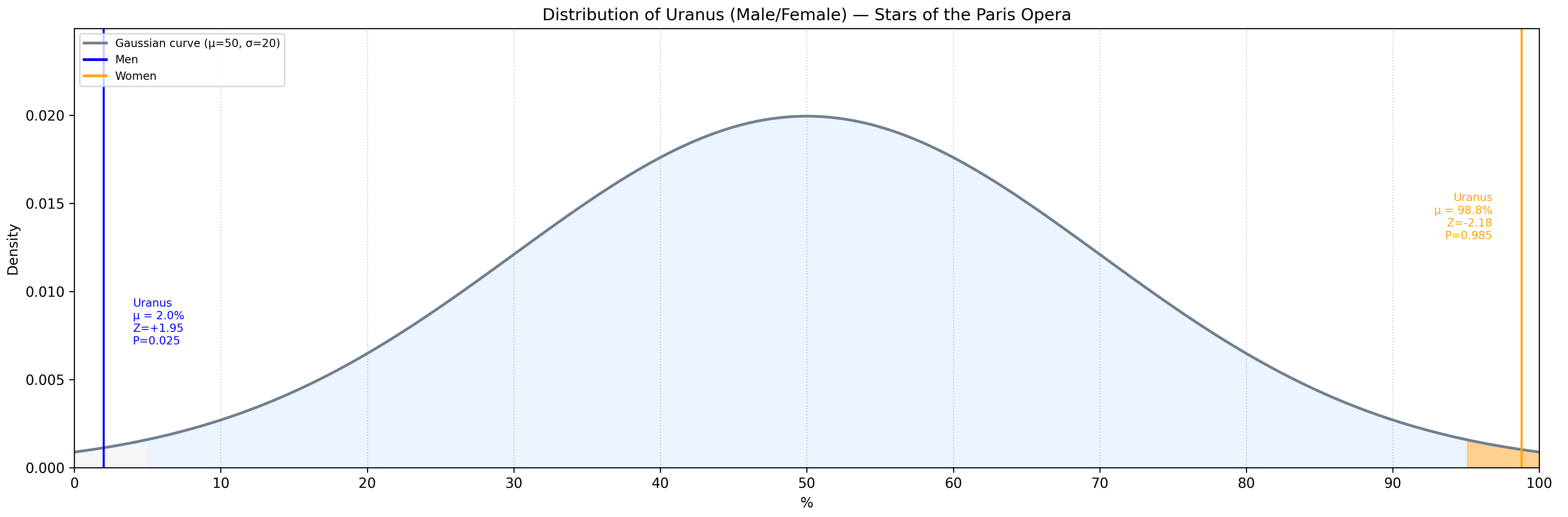
The graph above shows the following results for Uranus (Male/Female):
- Empirical probability: 2.0% for Male dancers and 98.8% for Female.
- Z-score: +1.95 for Male dancers and -2.18 for Female.
- Theoretical p-value: 0.025 for Male dancers and 0.985 for Female.
Kernel Density Estimation Curve (KDE)
In statistics, kernel density estimation (KDE) is a non-parametric method used to estimate the probability density function of a random variable based on observed data. The KDE curve is based on hierarchical rank values, as the software computes probability estimates from the empirical distribution of these ranks.
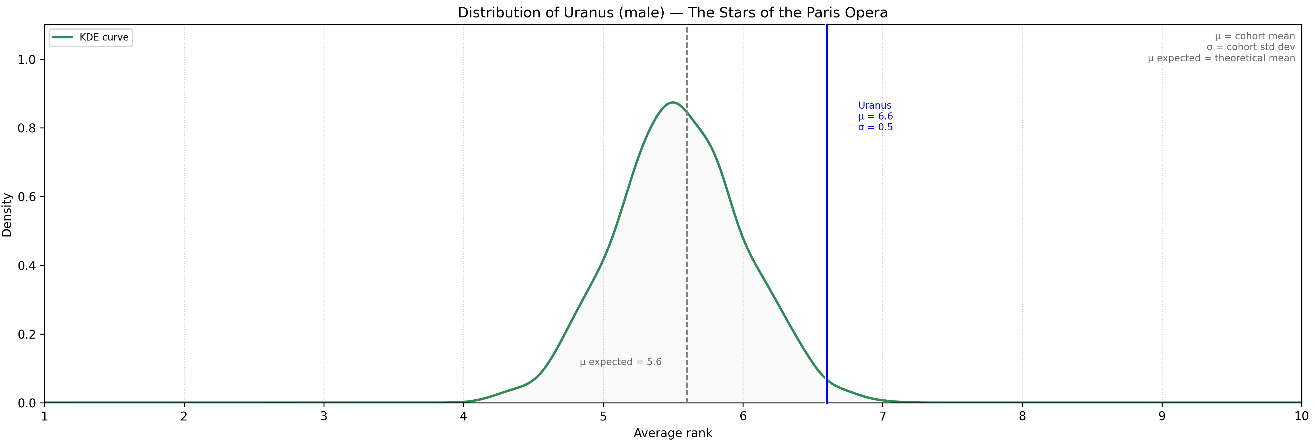
The graph above shows the following results for Uranus (Male):
- Cohort rank: 6.6 for Male dancers on a scale from 1 to 10.
- Cohort standard deviation: 0.5.
- Expected rank: 5.6, corresponding to the theoretical average under a null hypothesis.
The Gaussian and KDE curves provide a statistical representation that complements the global histograms, allowing a more detailed examination of the rank distribution for a given element and its relative position within the studied population.
Notes
1 The incomplete birth data (DN) concern the following individuals: Sae Eun Park, Hannah O'Neill, Eleonora Abbagnato, Marie Taglioni, José Carlos Martínez, Mickaël Parienté (born abroad); Emma Livry (born in Paris in 1841, but the birth certificate does not mention the time); Delphine Moussin, Laetitia Pujol, Alice Renavand, Patrick Armand, Jean-Pierre Franchetti (the known birth dates and places were not sufficient for the civil registry to locate them).
2 The previous study on humorists also included a group of men and a group of women, but the gender balance was less even (only about twenty women out of 100 humorists), and statistical comparisons of the two subgroups did not reveal any significant results.
3 For a detailed description of the zodiacal formulas, refer to the reference works in the bibliography.
4 Joël Laillier, Entrer dans la danse. L’Envers du Ballet de l’Opéra de Paris, CNRS Éditions, 2017.
5 The Ballet of the Opera includes three categories in the corps de ballet: the quadrilles, the coryphées, and the sujets. There is also a category of demi-soloists: the first dancers and first ballerinas, as well as a soloist category: the Étoiles.
6 Source references for statistical methodology: AstroStat software developed by Julien Rouger; GeoAstro statistical engine (post-publication update).