
Victims of Fashion
The Great Fashion Designers
By Manuel da Costa — GeoAstro
In the 19th century, under Napoleon III, Paris transformed into the City of Light, and its prestige attracted talents from all over Europe. Charles Frederick Worth, a young couturier of English origin, settled in Paris and opened his own fashion house. He revolutionized the industry by introducing live mannequin runway shows and the concept of clothing collections, soon adopted by the major department stores of the capital.
Haute couture, born in France, is a protected title that demands artisanal craftsmanship and prestigious runway shows. The haute couture houses are establishments where great couturiers have often collaborated over the years, playing a pioneering role, and whose creations set the stage for future fashion trends.
Today, French haute couture enjoys worldwide renown and has produced iconic figures such as Jean Patou, Jeanne Lanvin, Coco Chanel, Christian Dior, and Jean-Paul Gaultier.
But what are the strongest and weakest planets and RET planetary families at the time of birth of these great couturiers? Are the titans of French fashion, too, marked by a particular astrological conditioning?
A Conditional and Even Ambivalent Correlation
The connection between the astrological chart and activity is probabilistic and non-linear. We do not directly move from astrological conditioning to the analyzed activity. First, the link between the chart and personality depends on numerous influences: biological, sociocultural, educational, etc. It is not so much the astrological chart that tells us how a person works, but the observation of their behavior that reveals how they live their chart.
Then, the connection between personality and the activity performed is complex: the same behavioral trait does not always lead to the same activity, and a given activity does not exclusively gather only one type of personality. However, it is possible that among individuals engaged in the same activity, there are a greater or lesser presence of a particular behavioral trait than in the general population. We will talk about over- or under-valorization of a given disposition compared to a randomly selected group.
In astro-statistics, we also seek to determine if different cognitive aptitudes (logic, observation skills, critical thinking, etc.) can be correlated with a planetary dominant or zodiac sign. Again, the link between an astrological dominant and a given cognitive ability will be ambivalent: this implies that the individuals concerned also have a nervous system that favors the expression of the ability in question. Therefore, it is possible to observe such a correlation only if the population cohort is particularly well-constructed: the activity must be very targeted, the individuals involved must be among the most gifted, and the required skills must be highly specific and refined...
A Statistical Probability Calculation Software
AstroStat is an astrology software that allows for the evaluation of statistical probabilities related to planets, RET planetary families, and zodiac signs that can be extracted from a given population group.
To calculate the statistical probabilities extracted from a given population group, AstroStat shuffles the birth dates and times of the individuals in the cohort a certain number of times (1,000 times, 10,000 times, etc.) in order to establish the "normal" distribution probabilities for each planetary or zodiacal dominant, etc. The software thus calculates the probabilities of each element in an astrological chart being dominant, based on the same birth dates.
From the baseline probabilities of a normal distribution, the software then calculates the statistical probability of obtaining identical astrological results as those found in the tested population cohort. In other words, it assesses the probability that the statistical results obtained with this population cohort could be due to chance.
Once these probabilities are obtained, the software identifies the results on the graph that fall below a certain probability threshold. Generally, those with a probability lower than 5% are interpreted as unlikely to be due to chance and indicate an astrological effect in the tested population group.
The Cohort of French Fashion Designers
The list of renowned French fashion designers comes from the website "vos-celebrites.fr1", which catalogs various celebrities by category. This list is not established by a specialized committee, as is the case for other evaluated groups such as the Fields Medalists. However, after extensive research, it appears that the vast majority of the prominent names in French fashion are included on this list.
This cohort is relevant because it is based on a precise criterion (haute couture), groups an elite with specialized skills, and was compiled independently, thus excluding any astrological selection bias. The list of renowned French fashion designers, who are also stylists, perfumers, and fashion creators, is as follows:
- Agnès B, born on 26/11/1941 at 16:15 in Versailles
- André Courrèges, born on 09/03/1923 at 10:45 in Pau
- Chantal Thomass, born on 05/09/1947 at 03:00 in Malakoff
- Christian Audigier, born on 21/05/1958 at 17:00 in Gap
- Christian Dior, born on 21/01/1905 at 01:30 in Granville
- Christian Lacroix, born on 16/05/1951 at 11:30 in Arles
- Christian Louboutin, born on 07/01/1963 at 00:45 in Paris
- Christophe Guillarmé, born on 15/09/1977 at 10:05 in Fontenay-aux-Roses
- Coco Chanel, born on 19/08/1883 at 16:00 in Saumur
- Daniel Hechter, born on 30/07/1938 at 14:30 in Paris
- Didier Lecoanet, born on 08/04/1955 at 02:00 in Chaumont
- Emanuel Ungaro, born on 13/02/1933 at 02:30 in Aix-en-Provence
- Guy Laroche, born on 16/07/1921 at 05:00 in La Rochelle
- Hedi Slimane, born on 05/07/1968 at 12:25 in Bagneux
- Hermès, born on 09/07/1940 at 06:30 in Nîmes
- Hubert de Givenchy, born on 20/02/1927 at 11:30 in Beauvais
- Isabel Marant, born on 12/04/1967 at 21:35 in Boulogne-Billancourt
- Jacques Doucet, born on 19/02/1853 at 21:00 in Paris
- Jacques Fath, born on 06/09/1912 at 09:50 in Maisons-Laffitte
- Jacques Griffe, born on 29/11/1909 at 02:00 in Conques-sur-Orbiel
- Jean-Charles De Castelbajac, born on 28/11/1949 at 22:00 in Casablanca (Morocco)
- Jean-Louis Scherrer, born on 19/02/1935 at 16:00 in Lyon
- Jean Patou, born on 27/09/1887 at 20:00 in Paris
- Jean-Paul Gaultier, born on 24/04/1952 at 19:00 in Bagneux
- Jeanne Lanvin, born on 01/01/1867 at 01:00 in Paris
- Louis Vuitton, born on 04/08/1821 at 03:00 in Anchay (Saint-Hymetière-sur-Valouse)
- Maxime Simoens, born on 15/11/1984 at 02:20 in Lesquin
- Nicolas Ghesquière, born on 09/05/1971 at 08:00 in Comines
- Paco Rabanne, born on 18/02/1934 at 11:45 in Saint-Sébastien (Spain)
- Philippe Venet, born on 22/05/1929 at 14:45 in Oullins
- Pierre Balmain, born on 18/05/1914 at 08:15 in Saint-Jean-de-Maurienne
- Pierre Cardin, born on 02/07/1922 at 14:00 in Sant’Andrea di Barbarana (Italy)
- Raymond Loewy, born on 08/11/1893 at 10:15 in Paris
- Sonia Rykiel, born on 25/05/1930 at 23:55 in Paris
- Ted Lapidus, born on 23/06/1929 at 05:00 in Paris
- (Manfred) Thierry Mugler, born on 21/12/1945 at 21:55 in Strasbourg
- Val Piriou, born on 30/08/1963 at 00:15 in Rennes
- Vanessa Bruno, born on 21/07/1967 in Denmark, time unknown
- Véronique De La Cruz, born on 03/11/1974 in Saint-François (Guadeloupe), time unknown
- Yves Saint-Laurent, born on 01/08/1936 at 19:45 in Oran (Algeria)
This list, which features 40 prominent French couturiers, includes complete birth data for 382 of them (date, place, and time of birth).
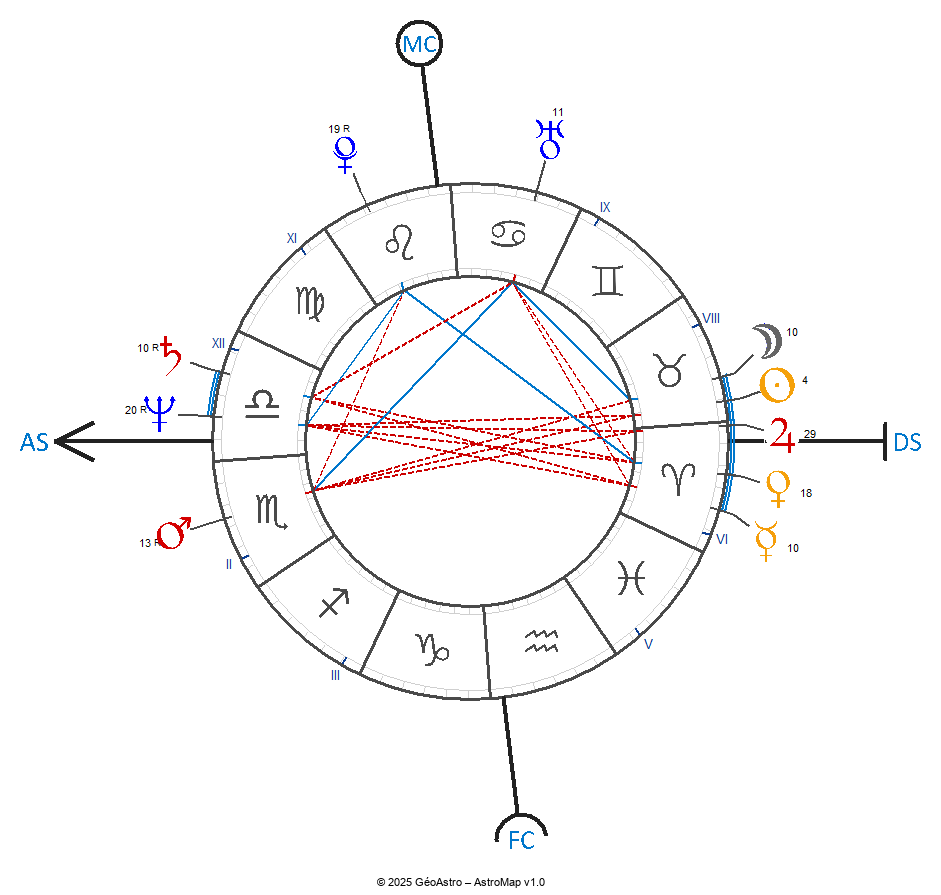
To take an example, the famous fashion designer and perfumer Jean-Paul Gaultier was born with a dominant Neptune on the Ascendant in Libra, with Pluto and Uranus angular at the Midheaven, as well as a cluster of Sun-Moon in Taurus and Jupiter-Venus in Aries near the Descendant, opposing Neptune on the Ascendant.
Thus, his personality can be described as both whimsical, inspired, and intuitive, gifted with great imagination ("T" of Neptune, Uranus, and Pluto) and also very sociable, extroverted, even talkative, and definitely skilled in projecting an image ("R" and "r" of Sun-Jupiter-Venus, with a spring-like background).
The Astrological Planetary Dominants of French Fashion Designers
The following charts indicate the probability that the valuations of the planets and RET planetary families of the French fashion designers are due to chance, according to "normal" distributions.
Planetary valuations
The chart below shows, on the vertical axis, the probability (between 0% and 100%) of obtaining planetary hierarchical ranks lower than those expected according to random distributions. The horizontal axis represents the planets in the astrological chart, from the Moon to Pluto.
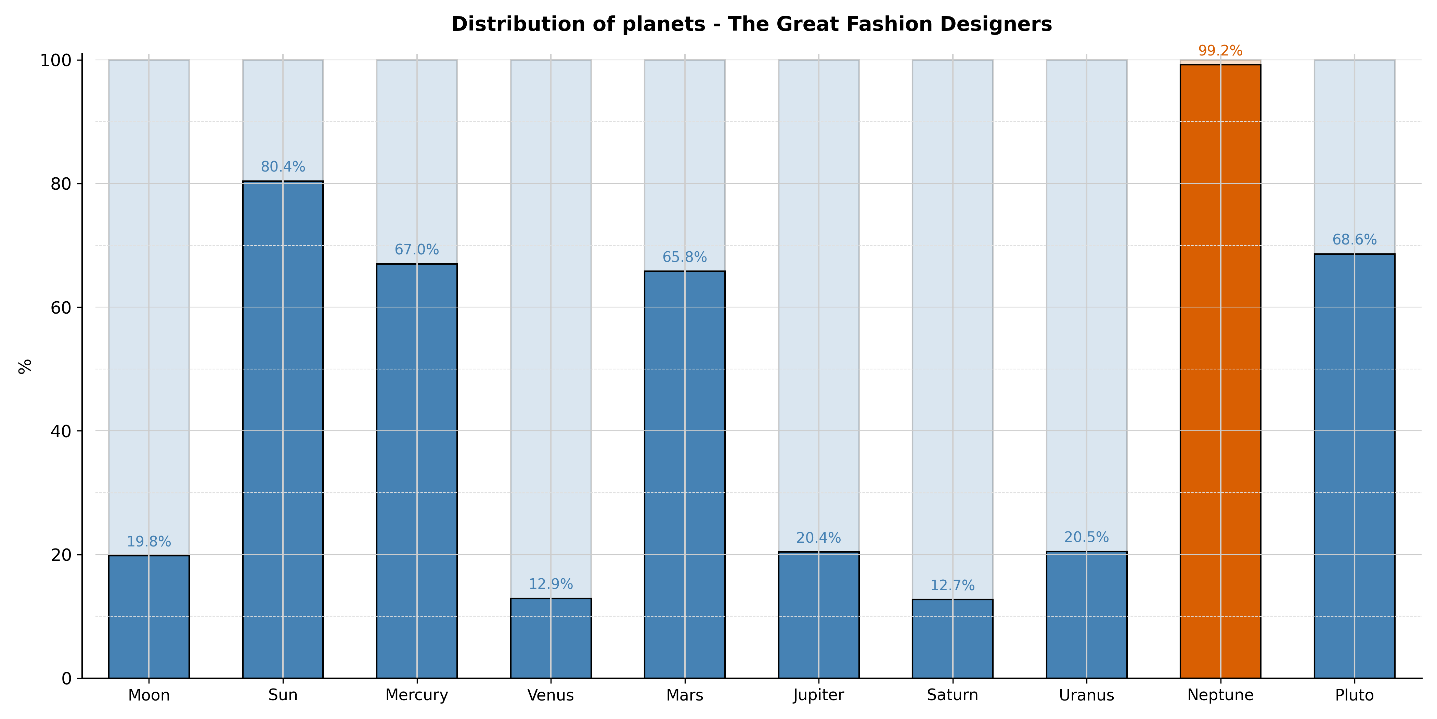
Only one planet shows an atypical statistical result:
- Neptune is overvalued: 99.2 out of 100 simulations.
Relative to a random sample, there is over a 99% chance of obtaining a lower valuation of Neptune, or approximately 99.2 out of 100 simulations.
Valuations of planetary families
The following chart illustrates the distribution of probabilities for the RET planetary families, applying the same analysis method.
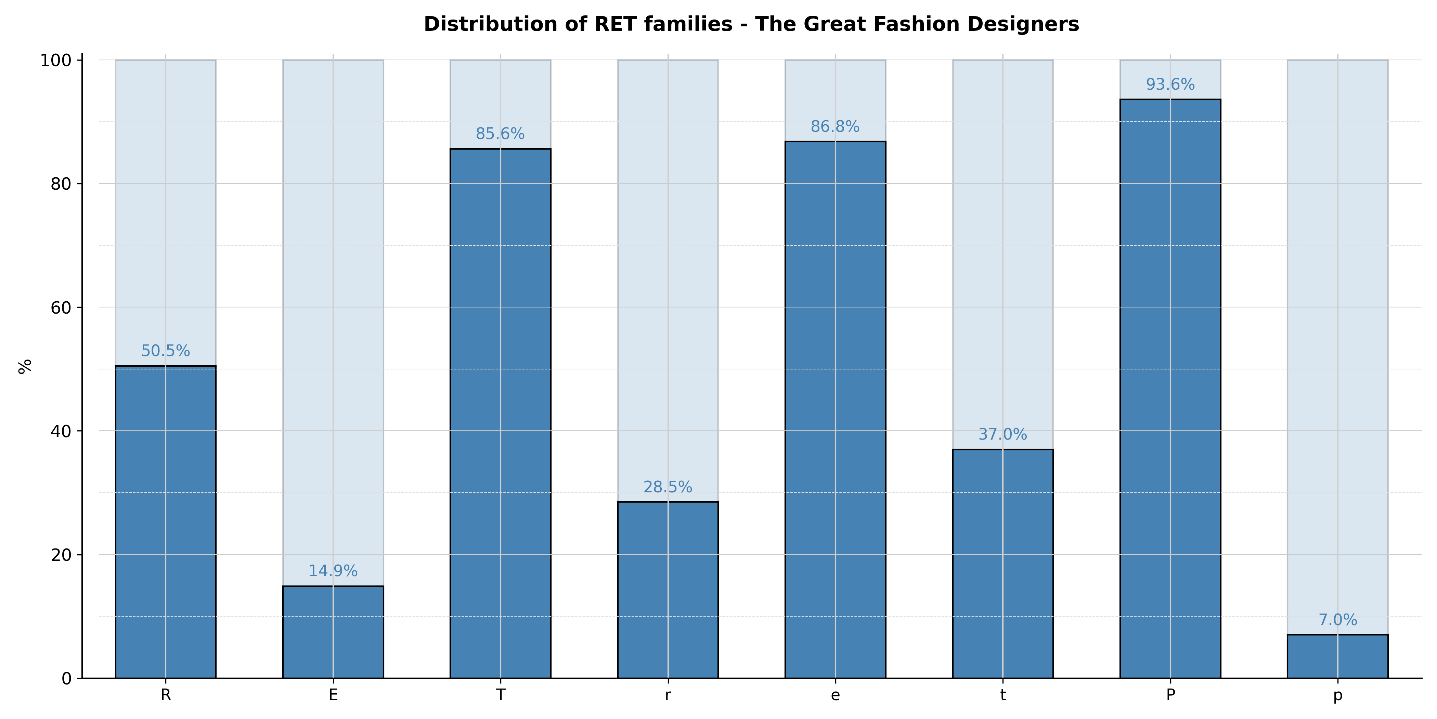
No planetary family shows an atypical result: each one falls within the normal range compared to a random population sample.
The Planetary Profiles of French Fashion Designers
Neptune, the visionary
According to our statistical results displayed above, only one planet is overvalued: Neptune, whose formula in conditional astrology is the existence of transcendence ("eT"). Why does it show a strong valuation among French fashion designers? How does their activity relate to a Neptunian dominant?
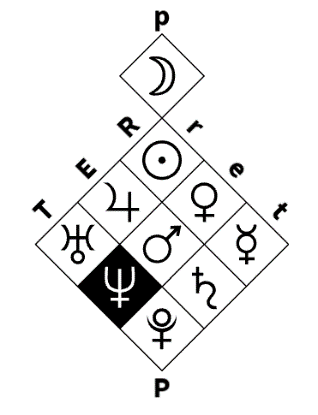
Let’s start by defining Neptune in conditional astrology. Moving from the "T" level of subtle and underlying realities to the "e" level of the experienced and felt, the Neptunian is an intuitive individual haunted by the powers of the imagination, guided by deep aspirations and following their inspiration and intuition.
Here is a brief excerpt from Le Grand Livre de l’Astrologue3, about the Neptunian function: "The meanings of Neptune are both Multiple and Dual. In other words, this planet governs the transformations from the universal-multiple into the dualities and confrontations of existence. There’s no need to insist on the Neptunian multiplicity, as it’s highlighted with redundancy: collectivism, democracy, mysticism, expansiveness of consciousness, irrationality, oceanic inspiration, etc."; "Its duality allows it to introduce the universal that inhabits it into lived experience"; "To concretize the non-apparent, the invisible, the irrational. To humanize the universal, to bring the distant closer, to familiarize the unknown, to animate things, to create to maintain the link between existence and essence (...) to give heart, flesh, or muscle to impersonal collective values."
Thus, the Neptunian’s vocations might involve "professions related to collectivist, humanistic, or redemptive ideologies (...) but also careers where one can dream, continuously renew horizons and sensations. All activities that awaken the universal through the heart and senses, deconditioning acquired social imprints."
How do these psychological traits correspond to the activity of French fashion designers, stylists, and creators, and guide them in their work?
An expression of individual creativity
Although not classified among the nine major arts4, haute couture is often considered close to the arts, and the great fashion designers are regarded as artists in their own right. In the current classification of the arts, fashion design is defined as an applied art, and haute couture as a means of expression reflecting the creativity of the couturier5.
Like a painter or sculptor, the fashion designer is a creator6 who shapes silhouettes, playing with textures, colors, and forms. Their work integrates concepts of volume, movement, and geometry, requiring a keen sense of aesthetics and innovation. Truly a visionary, they can translate through their creations an idea of modernity or collective psychology, using clothing as a means of expression to reflect their era. Through their creations, they express their own potentials to make a new voice heard in the creative field.
Fashion is thus defined as a realm of freedom, a laboratory for experimentation where creations have no limits and resemble an artistic performance. Bold collections, sublimated elegance, reinvention of silhouettes: haute couture constantly pushes the boundaries of creativity. Today, fashion houses compete in eccentricity, and fashion is showcased in museums highlighting iconic pieces that marked their time. Some great houses, like Dior or Louis Vuitton, even publish books in homage to their creators.
By nature, haute couture is an exceptional activity, an artistic and innovative approach. It embodies an art in itself, or at least, according to Yves Saint Laurent’s words, "an activity that is not quite art, but needs an artist to exist."
What link can we draw between haute couture and the psychological values associated with Neptune in astrology? This planet, overvalued among fashion designers, is known to promote inspiration, imagination, and creation. A Neptunian is connected to their inner aspirations, moods, and unconscious eruptions. By linking "T" and "e," or imagination and reality, the formula often favors the expression of personal talents and a desire to leave their unique imprint on their work, if their individuality is rich.
This planet frequently dominates in artistic and creative professions: opera singers, choreographers, musicians, painters… All activities requiring focus primarily on one’s feelings, inspiration, or the creation of dreams and emotion.
From a professional perspective, a talented Neptunian will often have the desire to orient their career according to their instinct, prioritizing perspectives that take into account their talents and inner resources. Haute couture, therefore, is an activity that allows them to express their talent and emotions (e) as much as to bring forth the original and influence society (T), according to Neptune's astrological formula.
Finally, statistical results show no overvaluation of the "T" and "e" families among the fashion designers. Therefore, these designers, strongly influenced by Neptune, can often be both inspired intuitives and sensitive, delicate sensitives, or even both at once.
A Neptunian management style?
Fashion houses bet on the creativity of their designers, but, on the flip side, they also have to deal with their sensitivity and frequent whims. The antics of stars in luxury houses are well known. The management methods of top luxury houses7 reveal a lot about the temperament of their creators.
One key to success is letting the designer find a balance between their personality and the brand's DNA. Take Tom Ford8, for example, who was hired by Gucci in 1990 when the house was dormant. He tapped into the brand's "Jet Set" heritage and reinterpreted it provocatively with the creation of "porno chic." Luxury houses typically do not have a Marketing Director. Imposing a set of guidelines on a designer is counterproductive.
To encourage their creativity, the owners of these houses give their designers a great deal of freedom in how they work and tolerate their eccentricities. Hedi Slimane, for example, feels more at home in his Los Angeles apartment than in Paris, where the house is based. Some work in high heels, while others disappear for important meetings, leaving for spontaneous trips. Designers’ whims are a staple of the haute couture world.
Studies on luxury strategy highlight the central role of emotion in managing top designers. The leaders ensure that the creators work in an emotionally secure environment. Collection directors, selected primarily for their relational skills, are tasked with diffusing daily tensions, playing the role of confidants, or channeling frustrations when collections face setbacks.
Top couturiers seem to embody the qualities associated with Neptune, their dominant planet. Inspired, imaginative, and in constant pursuit of creation, they shine through their boundless creativity. But with each quality comes a downside: Neptunians are also described as ambiguous, whimsical, irrational, and unpredictable. Their management style reflects this, fluctuating between eccentricities, whims, and a strong emotional sensitivity.
Does clothing define the “Self”?
When we speak of fashion as a form of art, we generally refer to haute couture and the creativity of top couturiers. But fashion is also a popular art, a form of expression and self-exploration accessible to everyone.
Clothing is more than a practical necessity; it also carries a strong symbolic dimension9. Choosing one's clothes, combining them, and arranging them is a form of communication, allowing one to convey a message about oneself and society. Fashion is the art of staging oneself: we seek to reflect who we are or who we wish to be. Our clothes thus create our identity and open us to others. They embody a conception of self, revealing aspects of our personality or social standing.
Clothes also mark our affiliation to a group (urban, sporty, casual, BCBG, trendy, artistic, skater, etc.), giving us the illusion of being seen positively and accepted. They correspond to an identity quest, a need to feel that our personal image is validated by others. What is the connection with Neptune, the planet already discussed? At first glance, none?
Fashion is a silent language that reflects our identity, ideas, and relationship with others. In this sense, it fits perfectly within a Neptunian dynamic: it relies on non-verbal communication of the self ("T"), which is expressed through clothing and more generally through the adopted style ("e"). Fashion thus pertains to intuition and feelings ("e"), not objective parameters.
For some psychologists, clothing reflects the body-mind connection: the better we feel, the more we dare to display our style. Our attire reveals the attention and care we give ourselves and shows our personal balance and self-esteem. The correspondence with Neptunian logic in astrology is once again evident: what we wear ("e") would be the barometer of our mental state ("T"), externalizing our mindset.
On a societal or era-wide scale, everyone individualizes and creates their own style through the codes and norms accepted by their sociocultural group. Creating one's style means playing with social codes, either adhering to them or subverting them in an accepted way. Beyond mere aesthetic choice, our clothes are indeed an expression ("e") of an inner dialogue between our individuality and the collective cultural unconscious ("T").
Material culture: expression of social psychology
While Neptune fosters talent and creativity on an individual or particular level, the planet also concerns, on a collective and universal level, the material culture of an era and a society of men. In social sciences, material culture refers to all the objects created by humans, studied from a social and cultural perspective. It includes the creation, use, and trade of objects, as well as the behaviors, norms, and rituals associated with these objects.
Fashion, revealed by social psychology, expresses the ideas, values, and contrasts of a society. As the flagship of the luxury industry, haute couture targets a wealthy elite, but its role extends beyond mere prestige: it sets trends that shape fashion. The image of haute couture reflects on ready-to-wear and promotes the development of emerging brands.
Thus, major fashion trends distinguish an era: sequins, studs, rhinestones, and fishnets in the 2000s; sweatshirts, jeans, and Hawaiian shirts in the '90s; wealth and flashiness, eccentricities of the '80s; romantic dresses, fringed jackets, and bell-bottom pants of the '70s… Some collections and pieces of couture have entered collective memory and are now displayed in the world's greatest museums.
Fashion is part of the material culture of an era, just like architecture, art, transportation, gastronomy, writing, jewelry, and craftsmanship. This material culture encompasses all the objects created by humans and can be defined as the way in which collective values of a given era, culture, or society are objectified ("e"). As such, it aligns with the Neptunian function ("eT") at the universal level, or belonging to the Integration framework10.
Top couturiers have overturned established codes and reference points by launching innovative styles. They provoke the status quo and break with tradition. In the 1910s, Coco Chanel shortened skirts and removed the waist to liberate the female body. Under her influence, clothing became simpler and more practical to adapt to women's active lives. Christian Dior reinvented silhouettes, enhancing curves, while Yves Saint Laurent introduced a new modernity for women.
Reflecting the trends and values of an era ("T"), fashion is expressed through tangible forms (“e”), thereby embodying a Neptunian dynamic. More generally, the "eT" function concerns the emergence of new times, changes in collective values that manifest through various concrete, tangible forms.
For comparison, each historical period can also be characterized by the ideological systems and moral values that define it: philosophical movements, scientific, political, and humanistic values… These collective ideological systems and moral values would align more with the "r" level specific to a culture or era ("T") and correspond to the Uranian formula ("rT"). To quote a few examples that marked 20th-century France: regulated work, social protection, sustainable development, bioethics, secularism, epistemology, psychoanalysis, conditionalism… All these are manifestations of the Uranian dynamic, contrasting with the more diffuse and artistic expression of Neptune, notably embodied in fashion.
A collective personality
Top couturiers, just like other evaluated groups, present significant astro-statistical results. Once again, we have demonstrated that astrological influence can be observed in a population group, and that the conditionalist tools enable numerous analyses that align with the observation of facts. Thus, it is easy to imagine that the methods and concepts forged by this school of astrology are destined to eventually supplant those that preceded it.
Furthermore, reflecting on the astrological conditioning of a population cohort ultimately gives the impression that it shares a group personality, a sort of "collective memory." Collective personality thus defines the character traits that the majority of members of a given group possess, considering it to be largely homogeneous. One can then consider that each human group constitutes a cohesion of individuals or a supra-individual social being, as if it carried a part of the universal within itself.
Thus, the individual and the group to which they belong are not two distinct and separate terms whose relationship is studied. The group personality is intimately present within each individual: learning behaviors, internalizing norms, representations… A kind of culture, in the narrower sense, makes each member of the group an inseparable part of the collective and fully inscribes them in the Integration framework.
Astro-statistics opens the door to a broader exploration of birth chart elements. By delving deeper into the study of planets and zodiac signs in particular, we could refine our understanding of astrological dominants and lay the foundations for a genuine branch of conditionalist astrology.
Methodological note — update
This article was originally based on analyses carried out using the AstroStat software developed by Julien Rouger. Since its publication, we have continued this work within the GeoAstro statistical engine, which follows the same methodological logic while adopting a more synthetic approach.
Minor differences may therefore appear between the results obtained with AstroStat and those generated in GéoAstro, without affecting the main trends discussed in this article.
The charts presented here were generated afterwards using GéoAstro, based on the same cohorts, in order to provide a consistent visual representation of the results.
Appendix: The Great Fashion Designers – Neptune
This appendix presents additional statistical elements concerning the members of the Great Fashion Designers, based on graphical representations not included in the main article. These results aim to broaden the analytical perspective and to support a more nuanced interpretation of the data.
The result presented here corresponds to the most pronounced statistical deviation observed within the group and is provided as an illustrative example of the statistical evaluation method applied to all planets.
Gaussian distribution curve
A Gaussian function is an exponential function used to represent the distribution of a dataset based on the density of its values. The following Gaussian curve illustrates the probability of observing, in the general population, a lower valuation of Neptune than the one found among Great Fashion Designers.
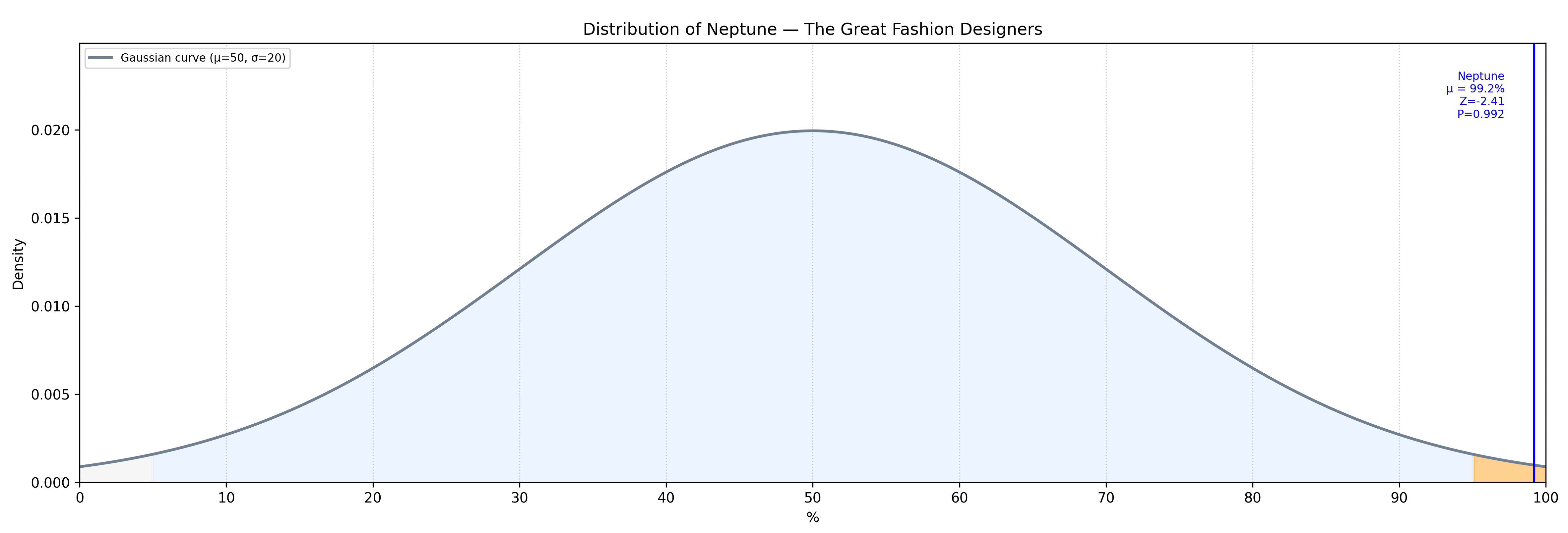
The graph above shows the following results for Neptune:
- Empirical probability: 99.2% of simulations yield a lower score.
- Z-score: –2.41, indicating that the result is statistically significant.
- Theoretical p-value: 0.992, indicating the relative position of the observed result within the theoretical distribution expected under the null hypothesis.
Kernel density estimation curve (KDE)
In statistics, kernel density estimation (KDE) is a non-parametric method used to estimate the probability density function of a random variable based on observed data. The KDE curve is based on hierarchical rank values, as the software computes probability estimates from the empirical distribution of these ranks.
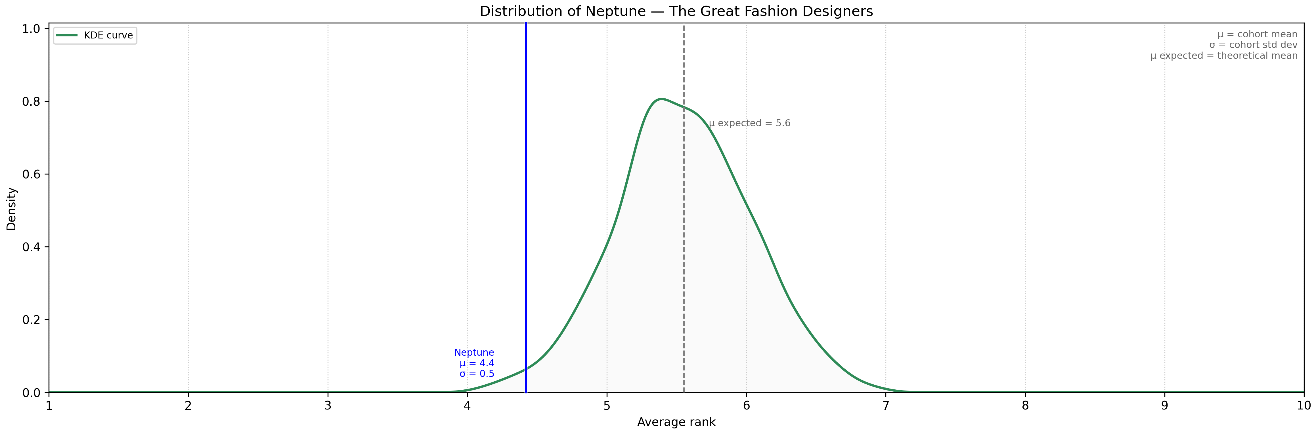
The graph above shows the following results for Neptune:
- Cohort rank: 4.4 on a scale from 1 to 10.
- Cohort standard deviation: 0.5, indicating the dispersion of values around the mean rank.
- Expected rank: 5.6, corresponding to the theoretical average under a null hypothesis.
The Gaussian and KDE curves offer a dual statistical perspective—both theoretical and empirical—on Neptune’s representation within this elite population. These tools complement the main analyses and reinforce the robustness of the findings presented in the core article.
Notes
1 Source: vos-celebrites.fr (“Mode” section, “Grands Couturiers et Stylistes” list).
2 Among the two people for whom we do not have a birth time, Vanessa Bruno was born in Denmark, making it impossible to obtain her birth time. Her city of birth is even unknown. As for Véronique De La Cruz (couturier and former Miss France), the civil registry office of Saint-François, Guadeloupe, informed us that their search efforts at that time were unsuccessful.
3 Le Grand Livre de l’Astrologue, Jean-Pierre Nicola, Éditions Sand & Tchou.
4 There are nine major arts, referencing the nine Muses of Greek mythology, who presided over the arts. One of them, Urania, presided over astronomy and astrology. See Hesiod, Theogony — Works and Days, Pocket Classics.
5 Styling concerns the production of ready-to-wear, while Haute Couture is a craft involving the creation of often unique pieces, characterized by the style of their creator. Source: Wikipedia.
6 For further reading on this topic: “La mode est-elle le 10e art ?” (Influencia.net); “La haute couture, laboratoire créatif de la mode” (fashionnetwork.com).
7 Source: magazine Capital – Actualités économiques, bourse & finance.
8 Tom Ford, born August 27, 1961, in Austin (United States). Not included in the study.
9 See on the topic: Psychosociologie de la mode, Marc-Alain Descamps, Presses Universitaires de France, 1979.
10 Integration refers to the dynamic of collective unification and structuring, where the individual fits into a larger whole by assimilating the values and norms of a system or group that transcends and encompasses them. See “Introduction to the S.O.R.I System” on AstroAriana.com.