
The Immortals
Members of the Académie française
By Manuel da Costa — GeoAstro
Founded in 1635, the Académie française has “as its primary mission to work with all possible care and diligence to establish certain rules for our language and to render it pure, eloquent, and capable of dealing with the arts and sciences” (Article XXIV of the Statutes and Regulations). The Academy's debates, held on a non-profit basis, aim to refine and promote literature while playing a key role in the evolution of French society.
Made up of 40 members, the Académie française meets once a week, following an agenda set by the Permanent Secretary, who represents the institution at official ceremonies. The Academy carries out its work through committees, the main ones being responsible for managing the Academy’s assets (Administrative Committee), compiling its dictionary (Dictionary Committee), and awarding prizes (Literary Committees).
Members of the Académie française owe their nickname “the Immortals” to the motto “À l’immortalité” (“To immortality”) inscribed on the seal granted to the Academy by its founder, Cardinal Richelieu. This motto in fact refers not to the members themselves, but to their mission: to serve the French language, which, unlike them, is immortal.
From an astrological point of view, we will once again seek to determine whether this population group shows statistically unusual results, and whether these results can be meaningfully interpreted using the tools developed by the conditionalist school.
A Distinctive Cohort?
The astrological analysis of a given cohort can reveal unexpected correlations. In the case of the members of the Académie française, beyond their individual profiles, it may be the very nature of the institution that implicitly shapes their planetary dominants. To better understand this issue, we must situate the Académie française within the broader dynamics of societal power structures.
The hypothesis of specific cognitive or behavioral skills seems unlikely, given the diversity of the members’ backgrounds. Some are philosophers, others poets, government advisors, or researchers at the CNRS. Among them are also literature professors, doctors of Latin studies, and graduates of the École Normale Supérieure. One could almost expect to find an astrologer among them!
At first glance, this cohort might not seem likely to yield statistically meaningful results. And yet... The following findings suggest a connection between the social role of the Académie française and certain astrological indicators, as revealed by multiple analyses. It is not unreasonable, in fact, to attempt to correlate the personalities of its members with the underlying logic of how the institution functions.
The Members of the Académie française
This cohort includes members of the Académie française as of January 1st, 2022. The study covers the 27 academicians whose full birth data is known, out of the 35 members of the institution at that date (five seats were vacant):
- Dominique Bona (born Conte), born on July 29, 1953 at 07:00 in Perpignan
- Gabriel de Broglie, born on April 21, 1931 at 01:30 in Versailles
- Hélène Carrière d’Encausse, born on July 6, 1929 at 19:00 in Paris
- Barbara Cassin, born on October 24, 1947 at 11:15 in Boulogne-Billancourt
- François Chang, born on August 30, 1929 in Nanchang (China), time unknown
- Jean Clair, born on October 20, 1940 at 22:00 in Paris
- Antoine Compagnon, born on July 20, 1950 in Brussels (Belgium), time unknown
- Claude Dagens, born on May 20, 1940 at 12:20 in Bordeaux
- Xavier Darcos, born on July 14, 1947 at 23:59 in Limoges
- Florence Delay, born on March 19, 1941 at 07:00 in Paris
- Michael Edwards, born on April 29, 1938 in Barnes (United Kingdom), time unknown
- Dominique Fernandez, born on August 25, 1929 at 18:00 in Neuilly-sur-Seine
- Alain Finkielkraut, born on June 30, 1949 at 01:15 in Paris
- Patrick Grainville, born on June 1, 1947 at 22:30 in Villers-sur-Mer
- Jules Hoffman, born on August 2, 1941 at 16:30 in Echternach (Luxembourg)
- Dany Lafferrière, born on April 13, 1953 in Port-au-Prince (Haiti), time unknown
- Marc Lambron, born on February 4, 1957 at 15:00 in Lyon
- Amin Maalouf, born on February 25, 1949 in Beirut (Lebanon), time unknown
- Andreï Makine, born on September 10, 1957 in Krasnoyarsk (Russia), time unknown
- Jean-Luc Marion, born on July 3, 1946 at 13:00 in Meudon
- Pierre Nora, born on November 17, 1931 at 00:15 in Paris
- Erik Orsenna, born on March 22, 1947 at 13:15 in Paris
- Pascal Ory, born on July 31, 1948 at 10:10 in Fougères
- Angelo Rinaldi, born on June 17, 1940 in Bastia, time unknown
- Daniel Rondeau, born on May 7, 1948 at 02:30 in Mesnil-sur-Oger
- Pierre Rosenberg, born on April 13, 1936 at 05:30 in Paris
- Jean-Marie Rouart, born on April 8, 1943 at 11:20 in Neuilly-sur-Seine
- Jean-Christophe Ruffin, born on June 28, 1952 at 21:00 in Bourges
- Danièle Sallenave, born on October 28, 1940 at 14:10 in Angers
- Maurizio Serra, born on June 3, 1955 in London (United Kingdom), time unknown
- François Sureau, born on September 19, 1957 at 16:25 in Paris
- Chantal Thomas, born on October 18, 1945 at 19:00 in Lyon
- Mario Vargas Llosa, born on March 28, 1936 at 00:45 in Arequipa (Peru)
- Frédéric Vitoux, born on August 19, 1944 at 03:00 in Vitry-aux-Loges
- Michel Zink, born on May 5, 1945 at 19:45 in Issy-les-Moulineaux
Alain Finkielkraut, philosopher and academician elected in 2014, was born under a dominant Neptune on the Descendant, squared by the Sun conjunct Uranus at the Imum Coeli, set against a summery (Cancer-Leo) and solstitial (Cancer-Gemini) zodiacal background. This configuration highlights the planetary families of extensive transcendence (“T”) and intensive representation (“r”) according to the RET model.
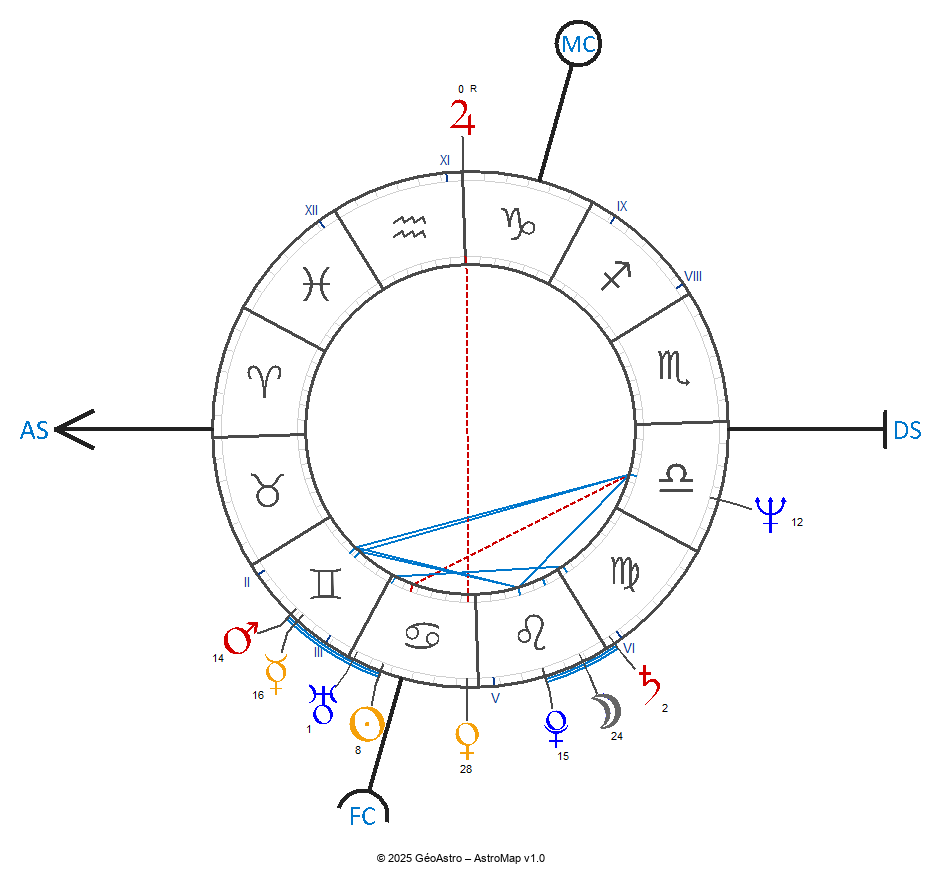
Finkielkraut is both intuitive and inspired (Neptune), intellectual and conceptual (Uranus), as well as idealistic and highly concerned with his public image (Sun). Such a configuration draws one toward the forces of the invisible (Neptune-Uranus), which one strives to make clear and structured (Sun-Uranus). Is this astrologically suited to the roles entrusted to a member of the Académie française?
The Astrological Dominants of the Academicians
The following charts indicate the probabilities that the planetary and RET planetary family valorizations observed among the academicians could be due to chance, according to a normal distribution.
Planetary valorizations
The chart below shows on the y-axis the probability (ranging from 0% to 100%) of obtaining lower planetary rank scores through random distributions. The x-axis represents the planets of the astrological chart, from the Moon to Pluto.
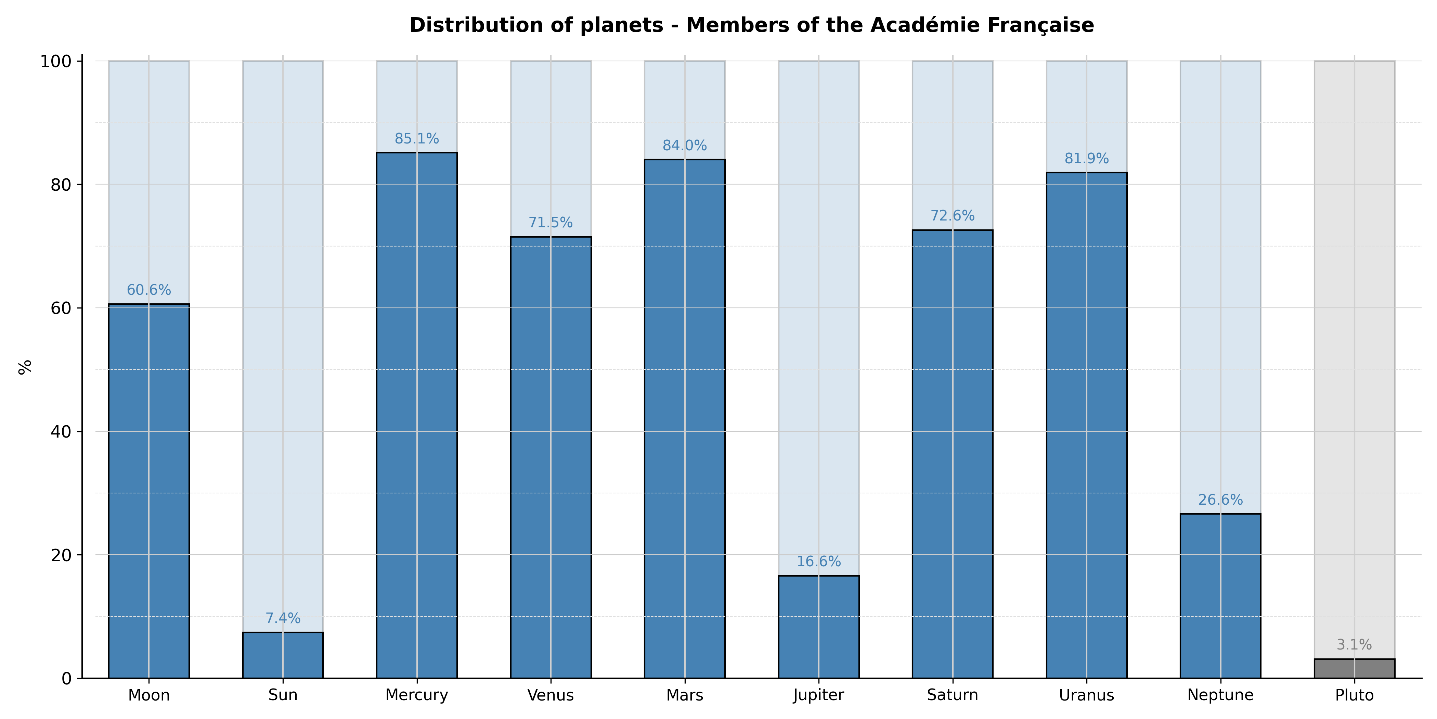
Only one planet stands out with an unusual result, deviating from statistical expectations:
- Pluto is undervalued: 3.1 out of 100 simulations.
Compared to a random sample, there is approximately a 3 in 100 chances of obtaining a lower valorization of Pluto.
Valorizations of planetary families
The following chart shows the probability of obtaining lower statistical results for the RET planetary families, using the same method.
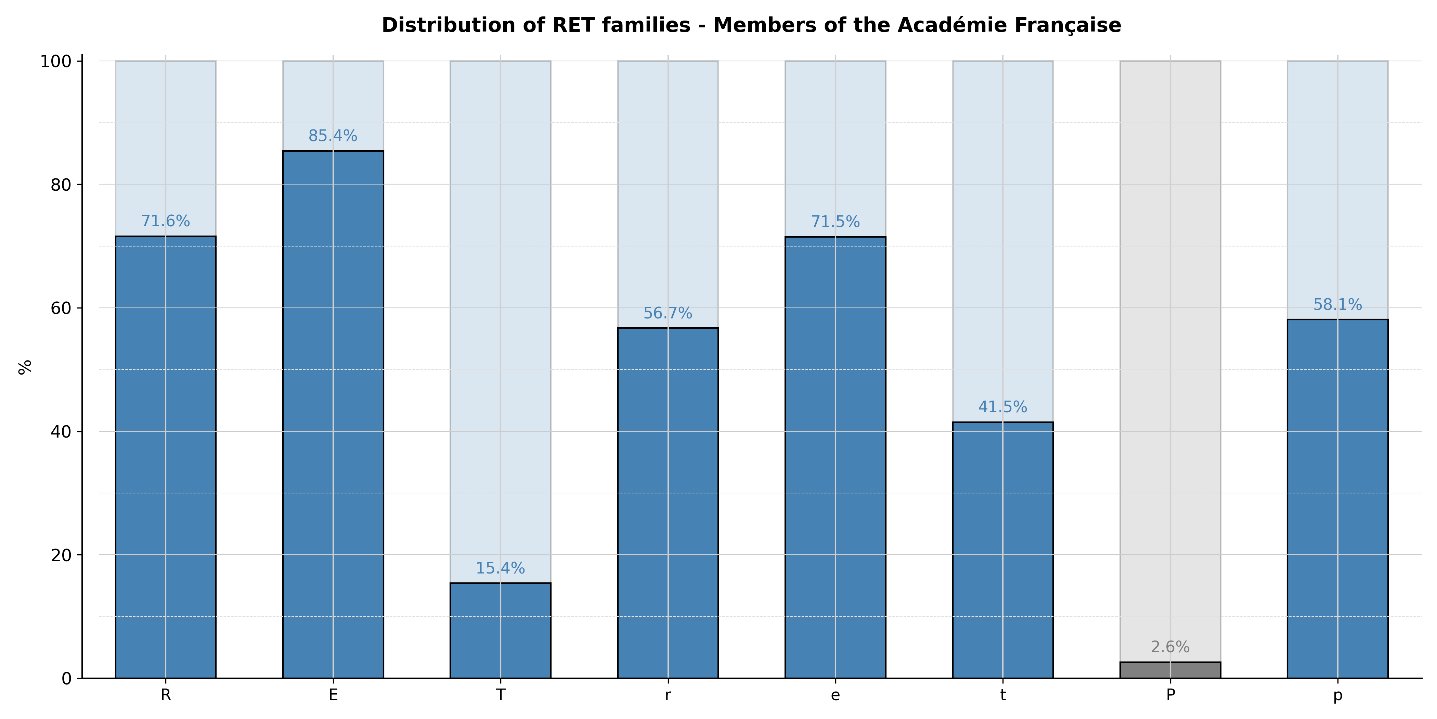
Only one result deviates from the expected probabilities:
- The “extensive power” family (P) is undervalued: 2.6 out of 100 simulations.
Compared to a random sample of the general population, there is approximately a 2 to 3 in 100 chances of observing a lower valorization for the extensive power family.
These two astro-statistical results for the cohort of academicians are directly related: Pluto belongs to the extensive power ("P") family in the RET model. The main interpretation, therefore, concerns an undervalued "P" Pluto, highlighting the relative weakness of this specific planetary function within this population.
A power of the Shadow in the Blind Spot?
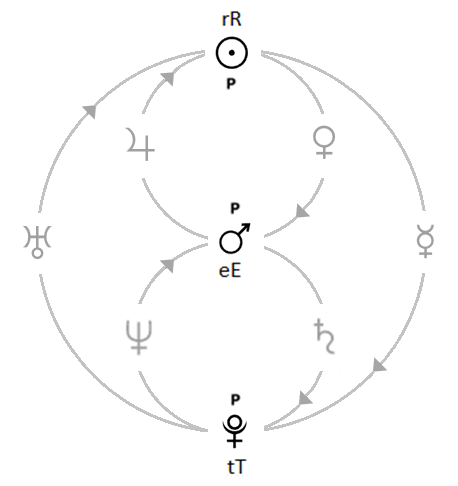
The extensive power Family (“P”) of the R.E.T. model functions to uphold and preserve the level of reality it represents. The solar (“rR”), Martian (“eE”), and Plutonian (“tT”) functions all share the same source and target levels: their logic is therefore one of self-preservation. Metaphorically, we speak of the functions of the King, the Warrior, and the Sorcerer to evoke the power of the known, the tangible, and the invisible. The question, then, is how these three powers manifest today—and why the Sorcerer’s power is undervalued among members of the Académie française.
Extensive power in Contemporary Societies
This symbolic framework of powers (King, Warrior, Sorcerer) can be transposed to the functioning of modern societies1. Solar power is primarily expressed through the State, whose fundamental mission is to guarantee national sovereignty. The State is responsible for establishing laws, ensuring security and public order, organizing the justice system, defining defense policies, and leading foreign affairs2... We clearly find here the “King’s” power, guardian of unity and norms.
On the solar level, power in our modern societies also includes the entire communication apparatus implemented by the media and official information channels, which seek to dictate what we should think—or not think—what is right or wrong, what is good or evil. Emblematic figures at this level include: politicians, journalists, teachers…
The Martian power pertains to the economic actor—an agent capable of making decisions that affect a country's economy3. These generally include financial and non-financial corporations, businesses, nonprofit institutions, public administrations, and households. These agents perform different functions: households consume goods and services; financial institutions collect, transform, and distribute financial resources; public administrations produce non-market services aimed at households, etc.
This is clearly the “Warrior’s” power, which manages material resources and administers and distributes collective goods. Symbolically, Martian power is also the power of money, which has become the driving force behind our modern societies. We often refer to “purchasing power” to designate the ability to acquire goods and services.
Plutonian power is undoubtedly the most difficult to grasp, since Pluto symbolizes the invisible. Essentially, Plutonian power relates to the various circles of influence operating behind the scenes to defend the interests of their group. A century and a half ago, before the 1905 law separating Church and State, Plutonian power was embodied by... the Church itself. But increasingly less so.
Before the 1789 French Revolution, the Church played a crucial role in state governance. Every individual was baptized, and the institution structured the life of Christians. People, fearing the Last Judgment, ensured their salvation by strictly adhering to religious practices. Public expressions of Christianity were also present in parish registers, in a significant portion of education, and many properties belonged to the Church...
Then came the 1801 Concordat under Napoleon, which sought to restore religious peace after the Revolution by organizing relations between the various religions and the State. This treaty recognized Catholicism as the religion “of the majority of French citizens,” no longer the religion of the State. The Head of State appointed bishops, whose numbers were reduced. The Church could no longer claim nationalized properties. The Concordat also allowed civil authorities to regulate religious practices. Its organic articles granted Protestant and Jewish ministers the same benefits as Catholic priests.
Abroad, many European states signed similar agreements with the Holy See, modeled on French law: Bavaria in 1817, the Netherlands in 1827, Spain in 1851, Austria in 1855, Portugal in 1857, Poland in 1925…
For centuries, the Catholic Church embodied the “Sorcerer’s” power: master of invisible laws, blessings, and curses. Its influence declined with the French Revolution. Yet it was only with the unilateral repeal of the Concordat through the December 9th, 19054 law that the Church's influence officially ended in France.
The law, a product of a long secularization process initiated by the Revolution, proclaimed freedom of conscience and ensured the free exercise of religion and non-discrimination among religions. It declared: 'The Republic recognizes no religion, pays for none, and subsidizes none.”
From then on, how does Plutonian power manifest itself in our secular societies? Who today embodies the “Sorcerer’s” power, working covertly in insidious ways?
Circles of Influence That Rule the World?
To illustrate how Plutonian power—subtle, hidden, distant—materializes in our society, let us examine a concrete example: the law on voluntary termination of pregnancy (abortion), or the “Veil Law” of January 17th, 1975. This law, which decriminalized abortion in France, is widely attributed to Simone Veil5, then Minister of Health under President Valéry Giscard d’Estaing. But that’s not entirely accurate…
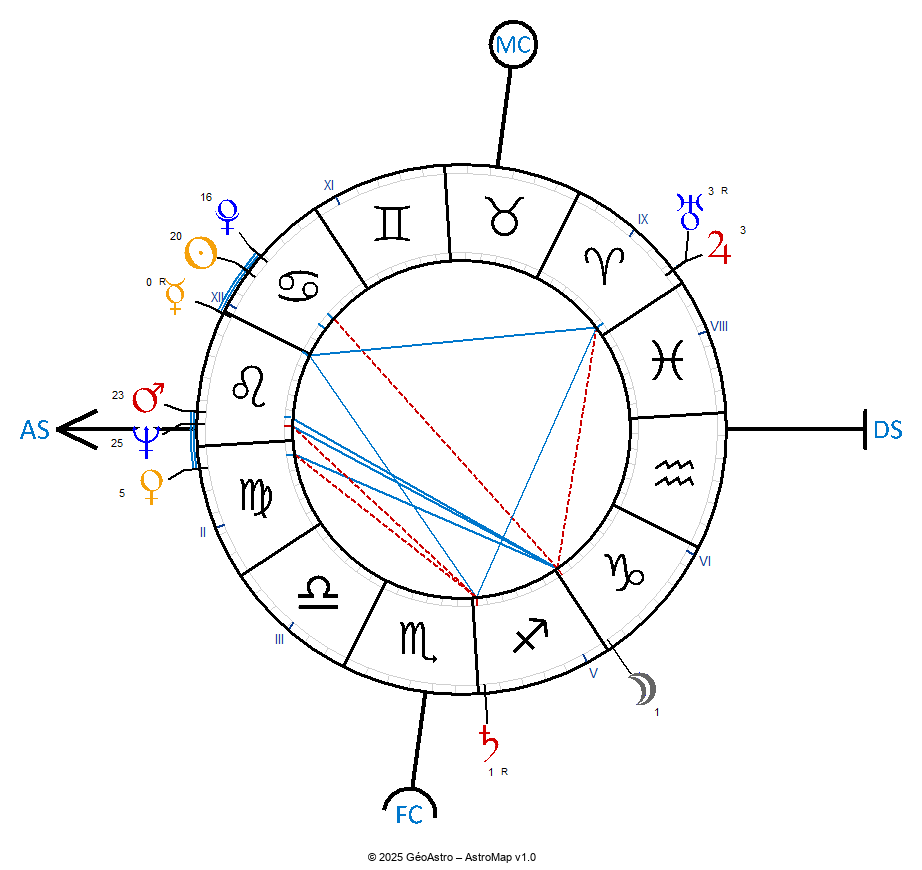
Let’s examine her professional profile. With a law degree from Sciences Po, Simone Veil passed the magistracy exam in 1956 and went on to serve as a senior official in the prison administration at the Ministry of Justice. Any conditionalist, theoretically equipped with a solid critical mind, must then ask: is it possible that a politician with no specialization in medicine single-handedly crafted a law on such a sensitive subject—one that would apply to an entire nation?
While she was certainly the public figurehead of the law’s recognition (“R”), who truly inspired it (“T”)?
Today, with the relative transparency enabled by the Internet, we can easily find other relevant information. Let us turn to another key figure: Pierre Simon6, a French doctor who worked extensively in fields related to women’s rights and societal views on life—painless childbirth, contraception, the legalization of abortion, medically assisted procreation, the right to die with dignity7…
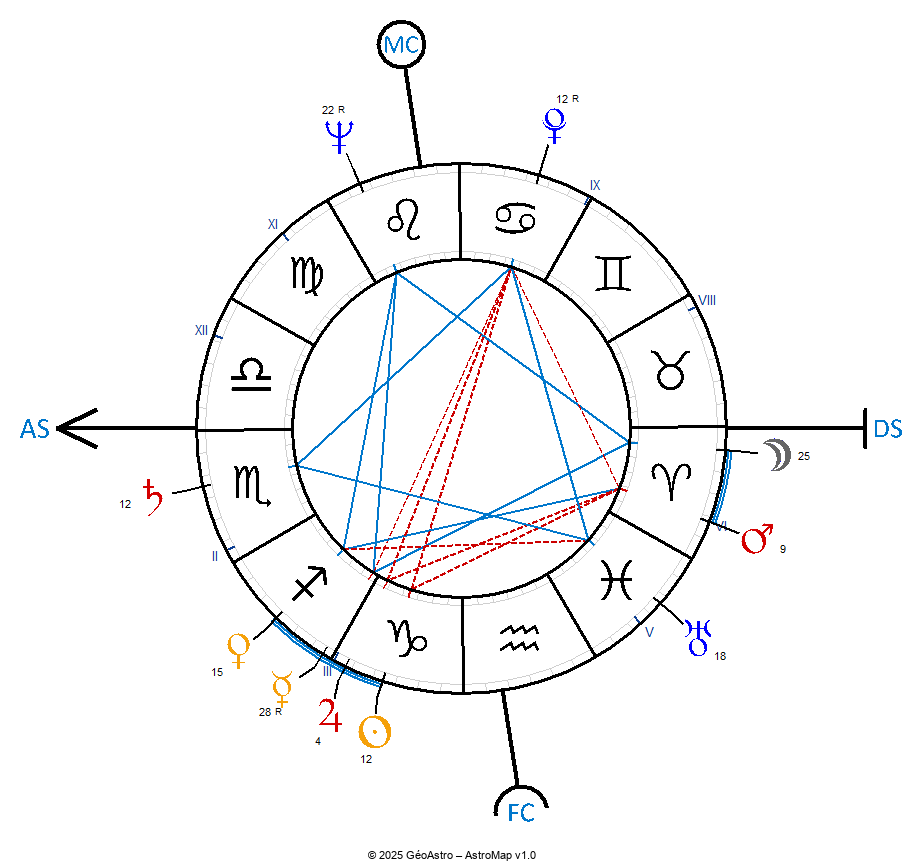
In fact, several French medical figures are known to have played crucial roles in the push to legalize abortion. Among them, Pierre Simon stands out. Others include Dr. Jean Dalsace and Dr. Anne-Marie Dourlen-Rollier, who were also active participants in the public debates around this cause.
Moreover, many sources claim that the laws on abortion were long conceived not just in France, but across Western Europe and the U.S., within Masonic lodges. Pierre Simon himself was a member of the Grande Loge de France (GLDF), one of the two main Masonic obediences in France, and even held the title of Grand Master.
Here, we touch the very core of the Sorcerer’s power in our society: a covert force of proposal operating in the shadows, and more broadly, a “P” dialectic between the Sun and Pluto—visible power versus invisible power…
Solar power, embodied by the political realm, shapes public opinion and guides debates. Simone Veil, for instance, championed the abortion law as a defender of women’s rights in France. Behind the scenes, Plutonian power works quietly through various influence networks. Pierre Simon, one of the law’s key architects, may have played a crucial role in its design. The shadows, too, have their heroes…
Many circles of influence shape political decisions behind closed doors. Industry lobbies (pharmaceuticals, agribusiness, tobacco…), elite clubs like Le Siècle, think tanks, and NGOs all help shape public discourse.
If these groups now embody Plutonian power, we might ask: where does the Académie Française stand in this dynamic? Once a major force in shaping language norms, does it still play a behind-the-scenes role of influence—or has it lost that subtle power, explaining its astrologically observed under-valorization of Pluto?
An Unbalanced Relationship Between the powers
Another question that interests us is what kind of relationship the different powers—“R”, “E”, and “T”—maintain among themselves. At present, these three powers, though complementary by nature, appear to operate in our society in a duel rather than a duo. It seems, in fact, that the Solar power—the power of appearances, visibility, and communication—seeks to suppress the other two.
With regard to Plutonian power, our current society makes every effort to conceal the influence of communities like those previously mentioned. The origin of a law such as the legalization of abortion (IVG), for instance, is presented solely through the public figure who promoted it politically. More broadly, the influence of ideological circles behind laws and societal changes is actively hidden.
These changes are attributed to political or public figures on the front lines, when in truth, those individuals are merely the visible tip of a much larger system that underpins and transcends them.
Any mention of circles of influence is quickly dismissed as conspiracy theory. Likewise, few “serious” sociological or philosophical texts ever discuss them. Solar power strives to create an illusion of transparency, thereby concealing the influence of Plutonian power, which is exercised by closed circles that remain inaccessible to the average citizen. Yet, a minimum of observation is enough to detect the discreet influence of such hidden networks.
With regard to Martian power, our society seems to control the facts on the ground in favor of a deceptive ideology intended to obscure them. Once again, the Solar power of appearances manages to cover, or at least soften, the expression of another power that contradicts its well-meaning ideology.
For instance, we’re told that everyone is born with equal opportunity in life—that each person begins with the same advantages for professional, economic, and social success. Yet for a Mars-inclined individual rooted in the hard facts of reality, it’s obvious that some are born into more favorable economic, social, and cultural environments, making them naturally more inclined to reproduce the models of dominant classes to which they’ve been exposed. Some are born advantaged, others not.
In another vein, the silencing of Martian power by Solar ideology is also evident in the widespread hypocrisy of political correctness. We are bombarded with euphemisms: the elderly become “seniors,” disabled people are “persons with reduced mobility,” the unemployed are “job seekers,” and “people from diverse backgrounds” refers, in reality, to Black and Arab populations… As if merely renaming things (Solar power) could transform their actual reality (Martian power).
Immortals Deprived of Influence?
While an astro-statistical study allows for many rich digressions related to the subject at hand, let us now return to the initial question: why do members of the Académie française—those so-called “immortals”—collectively exhibit an underemphasis of Pluto and “extensive power”?
To answer this question, we will mainly rely on the insightful analysis by journalist Pierre Robert, aired on Radio France in November 20178 as well as the interview given by linguistics professor Maria Candea9, (University of Paris 3 – Sorbonne Nouvelle) to the journal Ballast in September 2017.
In the 18th century, the Académie française played a major role10. It was carried by the spirit of the Enlightenment: during that time, three editions of their dictionary were published, along with two major spelling reforms.
Each edition of the dictionary helped shape the spelling and structure of French grammar. With the third edition in 1740, one-third of the words were modified, and accents were introduced: “throne” and “escrire” became “trône” and “écrire.” In 1835, the sixth edition of the dictionary further reformed conjugation: the “oi” in words like “étoit” became “ai,” giving us “était.”
For over two centuries, the Académie served as a key agent in the standardization of French orthography. Political power at the time leaned heavily on the Academy’s work to define what was considered correct, and by which standards. So much so that Parliament—of which the Academy functioned almost like a ghostwriter in literary matters—saw it as a rival authority.
We find here the dynamic previously mentioned: the Académie française, a somewhat secretive or at least esoteric institution, worked to normalize language, while Parliament, the more official body, legislated on the basis of this work. The sorcerer’s power (Plutonian), embodied by the Académie in literary matters, operated in a discreet and underground fashion, and the king’s representative power (Solar) served as its public voice before society.
Today, the Académie no longer holds a normative role and has lost its former social influence. If the institution stood as an authority for over two centuries, it was also because only a small elite could challenge its positions.
With the widespread democratization of education and the rise of professional linguistics, the Academy gradually relinquished its monopoly over linguistic authority. The last linguist to sit at the Académie was philologist Gaston Paris, who died in 1903.
According to its original statutes, the Academy was meant to produce a Dictionary, a Grammar, a Poetics, and a Rhetoric. In nearly four centuries, it has completed only eight editions of its dictionary and has published just one grammar—back in 1930. Its current influence is more symbolic or media-related, evident in its frequent participation in linguistic debates11.
The Academy began to be widely challenged in the 19th century, and after their last dictionary was published in 1935 (none have been released since), it entered into decline. “Their first grammar was so heavily mocked and criticized that it was more or less the final blow,” says Maria Candea, author of L'Académie contre la langue française. The Académie has lost its former prestige.
Additional criticisms of the institution include: being composed mainly of absentee members; lack of linguistic expertise, since co-optation is not based on formal training in language sciences; the dissemination of sexist, conservative, and reactionary messages; weak argumentative quality; and a very low level of female representation among its ranks…
If the Academy is no longer where decisions about the French language are made, where do such decisions happen today? Primarily within the Direction Générale de la Langue Française et des Langues de France (DGLFLF), part of the Ministry of Culture. Over 200 experts, selected for their linguistic qualifications, sit on 19 advisory boards charged with language standardization.
The Association française de normalisation (Afnor) also plays a major role. When the Academy is asked to give its opinion on matters of language—particularly neologisms—it is often not the academicians themselves who respond, but rather staff members with degrees in literature.
The evolution of the Académie française—from a once influential institution to a mostly symbolic one—is reflected in the astrological configuration of its members. If Pluto is underemphasized among the academicians, it may be because they belong to an institution whose authority no longer rests on subterranean influence, but rather on social and media recognition.
It is not illogical to correlate the personalities of the Academy’s members with the social role of the institution itself, as both likely follow a shared logic.
Once influential behind the scenes in shaping the French language (Pluto “P”), the academicians now appear relegated to a symbolic role under the official power (Sun “P”). The Academy, whose founding mission was to guide the evolution of language, has gradually been stripped of any real influence.
It once embodied Plutonian power in the literary domain, but it no longer fulfills that role and has lost all capacity for behind-the-scenes action—explaining the observed underemphasis of Pluto “P” within this cohort. The sorcerer's power (Pluto), once embodied by the Academy in the literary domain, is now wielded by institutions more directly linked to official authority (Sun).
Moving Beyond the Subject Frame of Reference
An astro-statistical study generally focuses on the Subject frame of the SORI model12. Drawing on a given population cohort, it seeks to identify the dominant planets (and signs, etc.) and correlate them with the specific aptitudes (behavioral, cognitive…) of the individuals in the cohort.
However, an astro-statistical study can also move beyond this framework and delve deeper. The dominant planetary (and zodiacal, etc.) factors that emerge from the tested cohort can also be correlated with the activity around which the individuals were selected—since, in principle, they share the intrinsic psychological characteristics of that activity. Here, we move into the Object frame of reference.
Whereas most astrological schools remain almost exclusively focused on the Subject frame, conditionalism goes much further. Planetary meanings and the RET model in particular can be widely applied to other frames of reference and allow for numerous analyses that align with observation.
This text explores how the three powers of the RET model are embodied in our society (Object frame of reference), with a specific focus on the Plutonian power of the Sorcerer.
More generally, each planet and RET planetary family can be interpreted through the four levels of information of the SORI model. Combining the RET (three levels) and SORI (four levels) frameworks yields twelve informational levels: the representation, existence, and transcendence of the Subject; the representation, existence, and transcendence of the Object; the representation, existence, and transcendence of the Relationship; and the representation, existence, and transcendence of the Integration.
Conditionalist astrology is no longer content with merely analyzing individuals—it also reveals the invisible structures that govern reality. In this sense, it is undeniable that, sooner or later, it will be conditionalist astrology that becomes truly immortal.
Methodological note — update
This article was originally based on analyses carried out using the AstroStat software developed by Julien Rouger. Since its publication, we have continued this work within the GeoAstro statistical engine, which follows the same methodological logic while adopting a more synthetic approach.
Minor differences may therefore appear between the results obtained with AstroStat and those generated in GeoAstro, without affecting the main trends discussed in this article.
The charts presented here were generated afterwards using GeoAstro, based on the same cohorts, in order to provide a consistent visual representation of the results.
Appendix: The members of the Académie Française – Pluto
This appendix presents additional statistical elements concerning the members of the French Academy, based on graphical representations not included in the main article. These results aim to broaden the analytical perspective and to support a more nuanced interpretation of the data.
The result presented here corresponds to the most pronounced statistical deviation observed within the group and is provided as an illustrative example of the statistical evaluation method applied to all planets.
Gaussian Distribution Curve
A Gaussian function is an exponential function used to represent the distribution of a dataset based on the density of its values. The following Gaussian curve illustrates the probability of observing, in the general population, a lower valuation of Pluto than the one found among members of the Académie Française.
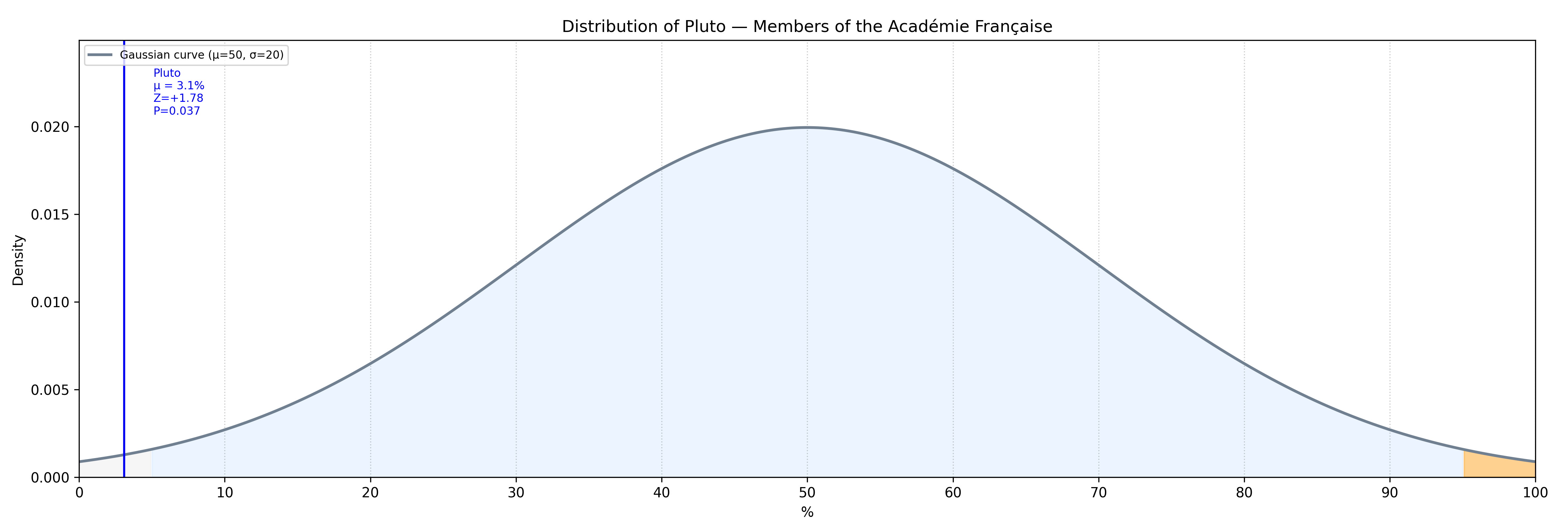
The graph above shows the following results for Pluto:
- Empirical probability: 3.1% of simulations yield a lower score.
- Z-score: +1.78, indicating that the result is statistically significant.
- Theoretical p-value: 0.037, indicating the relative position of the observed result within the theoretical distribution expected under the null hypothesis.
Kernel Density Estimation Curve (KDE)
In statistics, kernel density estimation (KDE) is a non-parametric method used to estimate the probability density function of a random variable based on observed data. The KDE curve is based on hierarchical rank values, as the software computes probability estimates from the empirical distribution of these ranks.
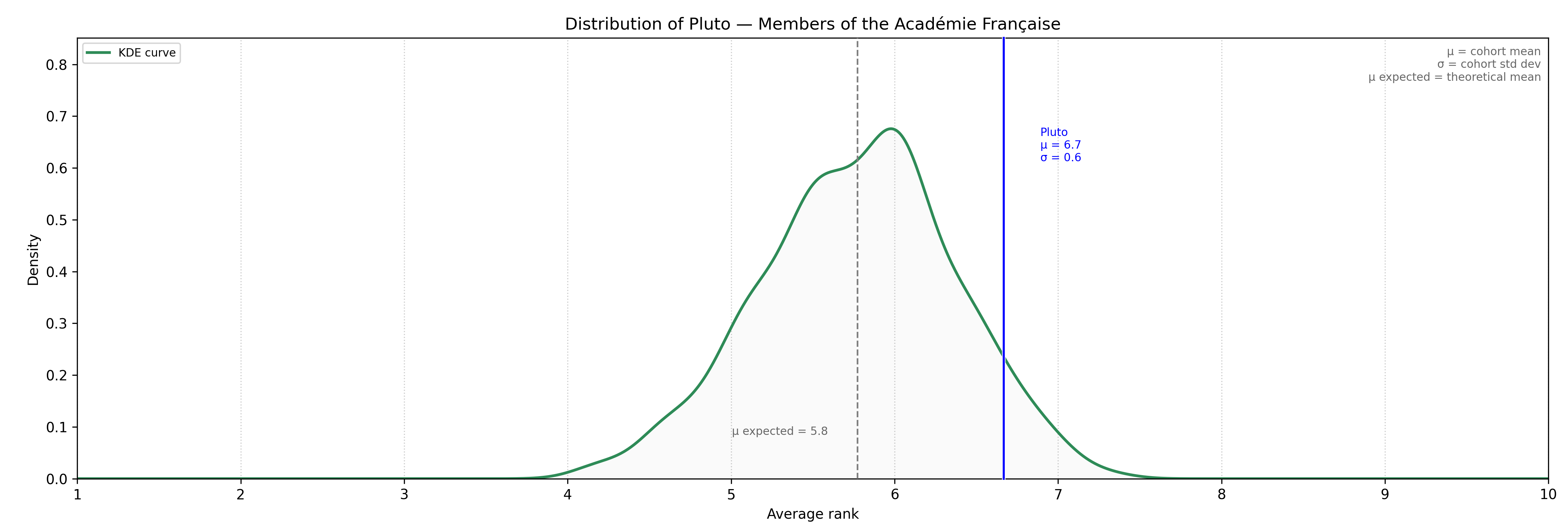
The graph above shows the following results for Pluto:
- Cohort rank: 6.7 on a scale from 1 to 10.
- Cohort standard deviation: 0.6, indicating the dispersion of values around the mean rank.
- Expected rank: 5.8, corresponding to the theoretical average under a null hypothesis.
The Gaussian and KDE curves provide a statistical representation that complements the global histograms, allowing a more detailed examination of the rank distribution for a given element and its relative position within the studied population.
Notes
1 Read on AstroAriana: “Soleil-Mars-Pluton : Pouvoir extensif” by Richard Pellard.
2 Source: Constitution of the Fifth French Republic, October 4, 1958.
3 Les acteurs de l’économie et les grandes fonctions économiques; editions-ellipses.fr.
4 It should be noted that the Concordat is still in effect, for historical reasons, in the departments of Bas-Rhin, Haut-Rhin, and Moselle (due to the annexation of these territories by Germany between 1870 and 1918).
5 Simone Veil, born on July 13, 1927, at 08:15 in Nice. The mention of this figure is particularly relevant in this study as she was a member of the Académie française from 2008 to 2017 (seat 13).
6 Pierre Simon, born on January 3, 1925, at 01:30 in Metz
7 Read the Wikipedia article on Pierre Simon.
8 Pierre Robert, L’Académie française est-elle encore utile ?
9 Maria Candea, Le langage est politique.
10 Olivier Ihl, historian, "Du Grain à Moudre" (May 2008), France Culture.
11 Example: recently, the Académie française issued a negative opinion on the question of the feminization of job titles and functions, which it described as a “mortal danger” to the French language.
12 Conditionalist model whose initials stand for: Subject, Object, Relation, Integration.